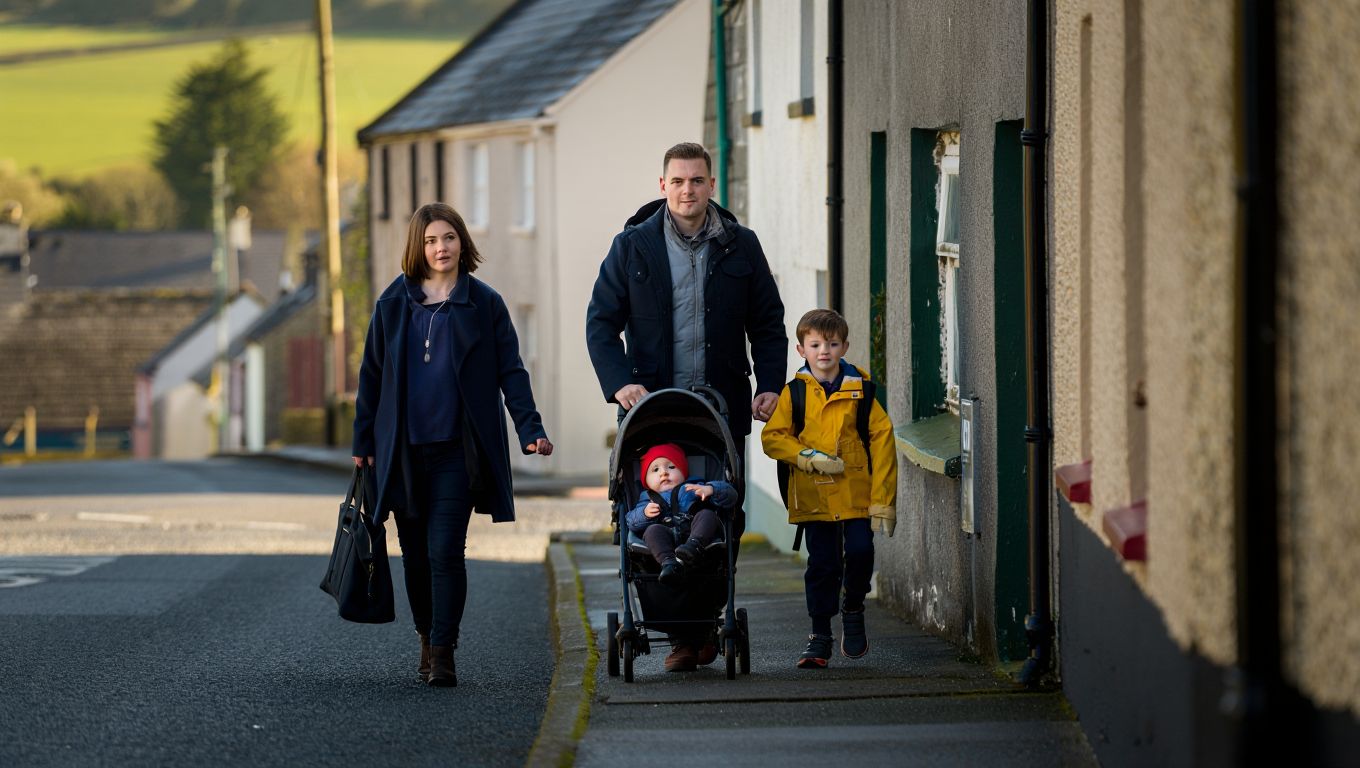
They arrived to hedgerows and peat smoke with suitcases that had seen three presidents, feeling both lighter and strangely unmoored. In Boston, their lives had grown dense with school calendars, freeway exits, and calendars stacked like bricks. In Roscommon, the first morning brought quiet so complete that the kettle seemed loud. They watched their children walk into a small stone school and counted sparrows, not traffic lights.
The commute that once swallowed an hour and a half now takes seven minutes. “I can hear my son tell a full story before we reach the gate,” Niamh said, laughing with a relief she could feel in her lungs. Colm added, “Across the Atlantic it felt like we were always arriving, never actually home.”
Why they left, and why they returned
Nineteen years is a long time to stay and a long time to leave. Their Boston life was built carefully, from the first rented room to the mortgage with a view over a highway that never slept. They had friends who became family, and a parish that felt anchored. Then came creeping costs, a weariness in the bone, and the child who asked if “Ireland is a holiday or a place.”
They began saying small goodbyes—to the Tuesday takeaway, to the speed of a convenience store, to the hum of late sirens. “We weren’t fleeing,” said Niamh, “but we kept picturing a slower clock and a nearer sky.” The pull was not drama, just the sum of tiny aches and remembered roads.
The long way back
The logistics were not romantic. There were visas to close, movers to price by cubic meter, and a family cat who required more paperwork than a second passport. Colm’s employer toyed with remote, then chose office. He pivoted, taking on freelance projects at night while applying to roles in Dublin he might never visit.
They landed with layered plans: a rental near the village, grandparents on speed dial, and a budget doubled for the unexpected. “The first weeks were a blur of forms, sockets, and tiny mismatches—bins on the wrong day, milk that tasted almost too honest,” said Colm. They kept a shared note labeled “tiny victories.”
Learning to breathe again
The village introduced itself in small ways. A nod from the post office, a loaf gifted still warm, a mechanic who refused payment until the rattle “introduced itself.” The children joined the GAA, learned the feel of a wet sliotar, and traded across accents like currency. Even the weather felt generous in its insistence, teaching them to carry layers and lower shoulders.
“America made us bigger in some ways,” Niamh said, “but here I can hear the blackbirds and my own thoughts.” On evenings they walk to the bog, where the ground remembers stories, and the sky seems to run on forever. They have become the people who wave from a tractor, who know which field floods by October and which neighbor bakes on Fridays.
Work, money, and the arithmetic of enough
Back-of-the-envelope math became a ritual. Childcare was cheaper, fuel sometimes dearer, groceries a shifting puzzle that nonetheless left them less anxious by month’s end. Colm stitched together contracts, then landed a role with a hybrid plan: two days in the city, three days by the lake.
Niamh restarted her craft business online, packing with more patience than panic, shipping to Cork and Kerry instead of Maine and Vermont. “Our income is a little lower,” she said, “but our margin of living is much wider.” They learned to price in what the ledger ignores: the ten unexpected minutes outside a school gate.
The school run that changed everything
In Boston, the car was a capsule of stress, a long crawl where questions dried out before they reached a mouth. Here the drive is a curved thread between hedges, with a lay-by where swans sometimes stage a slow parade. “Those seven minutes feel like stolen time,” said Niamh, “and they stitch our day back together.”
They talk about spelling and riddles, plan after-school mud, and argue cheerfully about which hill is most purple in late light. Each arrival feels like a small arrival, not the aftermath of a daily siege. The engine turns off, and there is quiet enough for a goodbye that is not rushed.
What they gained—and what they still miss
They gained grandparent Saturdays, the swing of a session in the pub where a stranger knows your name, the way seasons feel thicker when the nearest mountain is a daily compass. They miss diner coffee, the ease of late-night pharmacies, and the messy abundance of a city that could feed your curiosity at 1 a.m.
“Some days I crave that American scale,” Colm admitted, “then the mist lifts over the meadow, and I remember why we came.” Life here is not a postcard, but the imperfections are legible and local. The pothole has a story, and the fix is often a neighbor.
Notes for anyone considering the same leap
If you feel the pull of hedged roads and shorter clocks, two decades away need not be a barrier so much as a bridge. Their advice is practical, unsentimental, and hopeful.
- Test your budget against three scenarios: rosy, realistic, and rough.
- Build a work plan that can flex: remote, hybrid, or staged shifts.
- Treat community like a practice: show up, volunteer, buy one cake a week.
- Expect grief with the joy: say proper goodbyes, not just exits.
- Measure life by what returns to your day: light, time, and presence.
The texture of an ordinary day
By now the kettle whistles for tea, boots wait by the backdoor, and the calendar carries more white space than it used to dare. The children gather conkers, learn saints and counties, and sometimes ask about Fenway with a soft tug in their voices. The cat patrols the ditch, superior to all human drama.
On Friday evenings they drive the lane, past fields that trade green for gold, and park by the pitch. The week loosens its joints, the air smells of rain, and the future feels like something you can walk to, one small road at a time.

Beautifully written article.
Beautifully written…
A fabulous read
Incredibly well written. What a joy to read.
A beautiful read. Thank you.
Sounds likes the middle of nowhere. Absolutely nothing to do. How dreary.
Really well written, a reality check on how luck we are to have all we have in rural Ireland.
Lovely article
You write so poetically, love it, thank you
Such flowery language! I do enjoy the read of each but, after the first three I find that I realise it’s another of those (almost) whimsical Arrivals from Liam Kennedy who sees every situation through rosé-tinted glasses! It becomes difficult to take seriously! Only MY opinion and I know that I cannot write anything with such flair! Good luck Liam!!
Beautifully written as always Liam ❤️ I reared my children in Roscommon after leaving New York in 86 and can relate to everything you wrote except the stranger who knew my name. I can relate to that now that I have moved back north to the town i was reared in. It brings a tear to my eye everytime it happens as does your articles every time I read them
Beautifully written. Thank you 😊
This is the second article I have read. I consider Liam a talented writer
You have a lovely way with words.
Our son lives in Canada for the past 15years & sometimes talks of moving his young family home. I’m sure its not all rosy but I do think the pull of home gets greater with kids.
Just write a flowery pointless novel if you want to write fiction ffs
Engrossing read. Captivating from the start.
Go hàlainn.