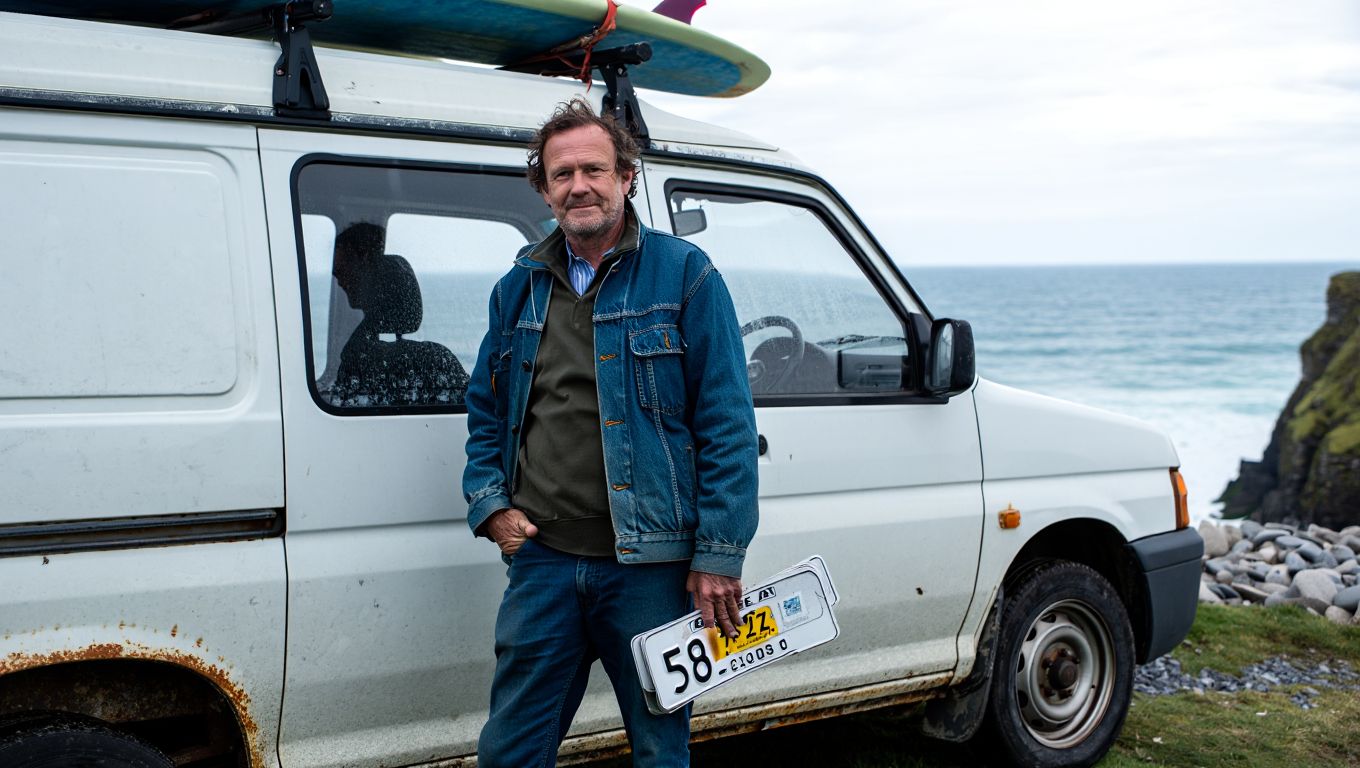
He was nearly sixty when he let the last fare go and pointed his secondhand van toward the edge of the island. In the glove box sat the receipt for a taxi plate he no longer owned, and in his chest a brand-new latitude. “I wanted the day to tell me where to go,” he says, voice soft as surf.
At home in Longford, he’d learned the geometry of town life—straight roads, familiar voices, the clink of coins sliding into a plastic tray. Now the curves belong to the coastline, the week a rope of tides he unspools one beach at a time.
Trading Fares for Tides
He sold the hard-won plate, paid cash for a used van, and left the meter’s red glow behind. “I’d measured too many nights in minutes,” he says, “and not enough in stars.” In the mirror, the city’s lights thinned; ahead, a salt-silvered horizon opened.
The van is plain, the fittings simple—a narrow bed, a camping stove, a chipped blue mug. He calls it his little republic, a space where the only law is the weather and a pot of tea.
A Map Drawn in Sand
Every Sunday, he checks a sketchy map and a steadier forecast, then drives until the land loosens and the wind starts to talk. Streedagh’s long arm of sand when Sligo is calm; Lahinch for noisy days when surfers stitch bright commas inside the waves; Inch like a silver ribbon under a Kerry sky.
On wilder weeks, Donegal feels like the edge of the old world, gulls carving big letters into the light. On gentler runs, he slips to Wexford, where Curracloe lies wide and forgiving, a place to sweep old worry into untouched dunes.
The Ritual of Arrival
He parks with the nose into the wind, windows cracked for the slow thrum of the sea. Shoes off at the step, kettle on the flame, a talismanic sprinkle of cheap salt into the pan because the air deserves a matching taste.
He walks the tideline with a battered bucket, picking light from broken glass and stories from washed-up rope. “You don’t own a shore,” he says, “you share a shore until the tide changes its mind.”
People Met Along the Shore
Children point at the sun-faded van, and their parents ask careful, curious questions. “Retired?” they guess. “Just started,” he grins. A man in Ballybunion once swapped him a bag of warm chips for a lesson in brewing strong tea at a slanting angle.
Fishermen teach the names of winds—how a biting easterly brings sharp eyes, how a lazy westerly can push a day open. “There’s a weather you can only learn by listening,” he says, “and listening is easier near the water.”
What He Learned to Carry Light
- One heavy blanket and one heavier promise to move with the seasons
- Coffee ground a bit too fine, because patience tastes better
- A toolkit for rattles and regrets, tightened slowly with a short spanner
- A paperback for wet days, a pencil for dry maps
- A quiet rule: leave less than you found
Small Money, Big Days
He keeps the numbers almost silent—a thin pension, careful fuel, eggs bought by the six, fish when luck or kindness says so. Campsites when signs say no, car parks when wardens say maybe, a farmer’s field by polite agreement and a handshake like a stamped letter.
“Time got cheaper when I stopped selling it by the mile,” he says. What grew was not wealth, but the stretch between breakfast and dark, ironed smooth by the long breath of the sea.
Weather, Worry, and Why It Works
Storm nights knock a drumbeat on the thin roof, and memory knocks right after. He counts the seconds between flash and thunder, then laughs at his old fears bunking down like uninvited guests.
Some mornings clamp him to the mattress with rain-heavy air, and he lets the plan go loose. “If you treat the schedule like stone,” he says, “the coast will bring you to your knees. Treat it like string, and it will fly its own kite.”
Rules of a Borrowed Edge
He learns the rhythms of local signs, the delicate dance between welcome and weariness. Rubbish packed out, dogs kept close, engines quieted before the sky gets blue again. The shoreline is not a stage, he reminds himself; it’s a living room with strict but kindly hosts.
When crowds surge in high summer, he slips inland to a shy pier, buys bread in a village shop, trades soft gossip for directions to the next safe turnout.
Time Measured in Tides
At 58 he traded certainty for weather, and found a calendar made of foam. Weeks have the weight of small stones now, warm in the pocket, turned by quiet thumbs.
“I thought I was running from a stopped clock,” he says, “but I was walking toward a bell I hadn’t heard yet.” On good nights the moon prints a pale road across the bay, and he parks on the first bright mile of it, engine off, hands still, chest open.
He doesn’t chase a perfect place, just the next honest morning. The kettle starts to sing, gulls coil and rise, and the day—kind as a borrowed coat—settles on his shoulders until the light says it’s time to move again.

Living the dream is this lad,so there is truth in this aul saying best of luck to ya
Beautiful article Liam. Poetic.
I agree, beautifully written
How is this week going for you is it a loose plan. Safe traveling.
Wonderful read
Living the dream, safe travels. Lovely article written by Liam.
Beautifully written, picture perfect. O how i wish 🌟🌊
Lovely article beautifully wriiten!
I also live a similar life style, I had a stroke at the age of 56 am 59 years young, u decided life is definitely to short, we’ve all heard it said .
But when you’re actually facing it , that’s the signal you need. I decided that’s it am enjoying the rest of it, got myself a wee Van a stove and a mattress. And the open road . Am Scottish, so done Scotland, I used to live in Donegal, before the Stroke, so my Van and I are back wild Atlantic way first, see how it goes. Who knows what is next…
Lovely writing
Wow! Inspiring. Thank you for sharing 🙏
Beautiful, evocative. Thank you.
Beautiful story ,brave man ,slowed his clock , lesson for all us vintage folk
Beautifully written article. Very poetic. A thoroughly enjoyable article.
Magical and inspiring piece.
What a beautiful & inspiring way to live.
And also a beautiful piece of writing
Pure poetry.
Beautiful