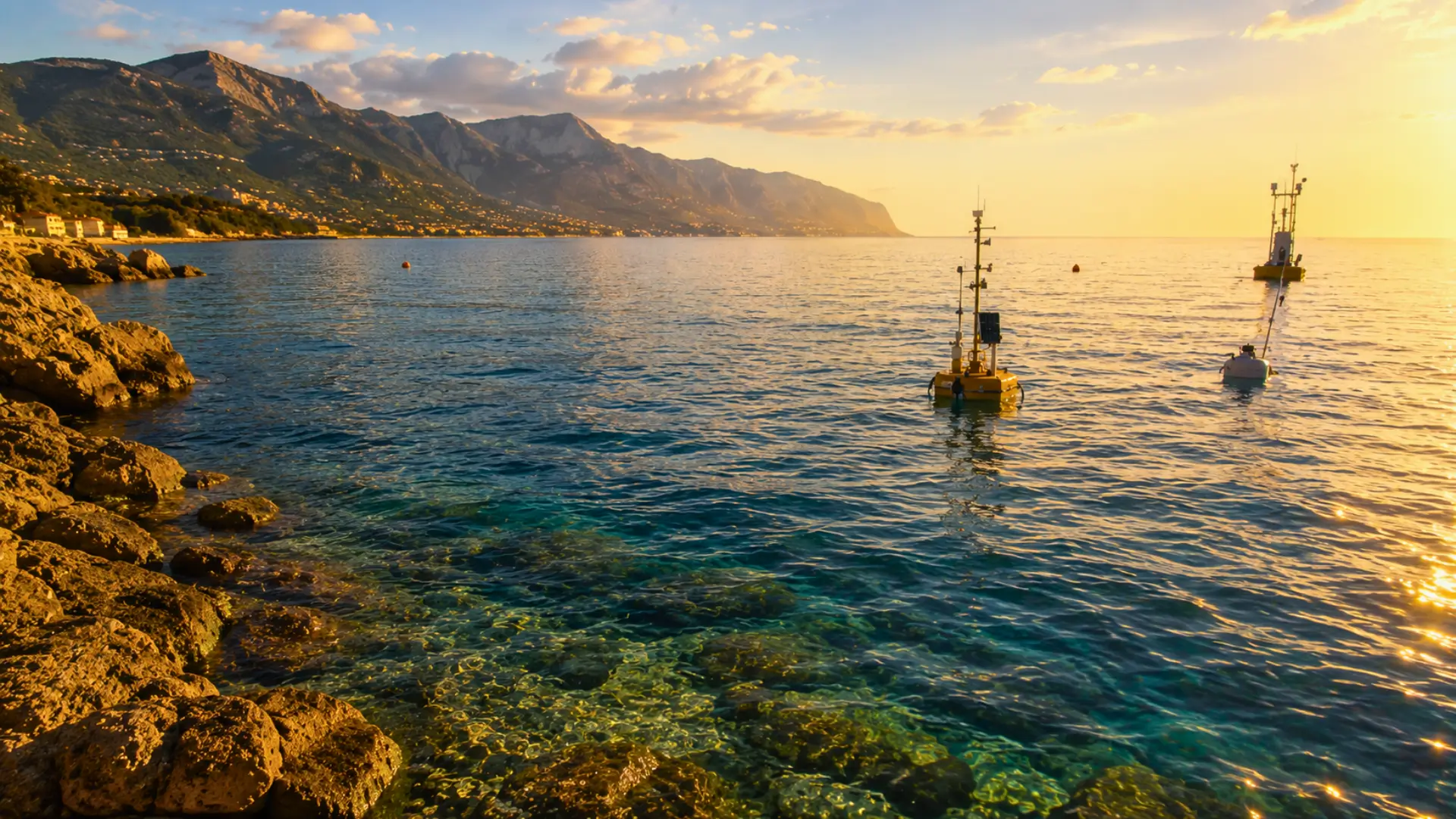
On the surface, the sea seems to absorb everything in silence. Yet this June told a different story: that of a global ocean hotter than ever, threaded with spectacular anomalies and signals that could already alter summers, storms, and living beings.
A World Record in June Reveals How the Ocean Is Entering a New Phase
In June, the mean surface temperature of the oceans outside polar regions reached 20.98 °C. It is a global record for this time of year. The figure may seem almost abstract, but it already tells a very concrete shift. Beneath this planetary average lies an ocean that stores, redistributes, and amplifies a heat now persisting.
The most troubling aspect is the speed with which this signal asserts itself. Indeed, data from the Copernicus program, supported by the European Centre for Weather Forecasts, suggest a system that no longer truly returns to equilibrium. Thus, for climatologists, this June is not merely a peak. It resembles a new threshold. Perhaps provisional. Perhaps lasting.
In this already tense backdrop, another actor returns to the stage: El Niño. When this episode strengthens, it often adds a push of heat to human-caused warming. Consequently, the mix is worrisome because it combines two powerful dynamics. It can prolong records rather than isolate them, as if the planet were gradually ceasing to see the exceptional as exceptional.
From the Mediterranean to the North Sea, regional anomalies strike with intensity
Locally, the story becomes even more striking. In certain areas of the Mediterranean, anomalies of +6 to +8 °C have been observed. At first glance, to a swimmer that might seem incidental. For ecosystems, it is nonetheless a massive thermal shock. It can displace species, weaken seagrasses, and disrupt entire food chains.
Further north, the North Sea is warming at a pace that surprises scientists. Its temperatures are now about 3 °C higher than those from thirty years ago. Moreover, along the Belgian coast, a marine heatwave has persisted for 144 days since February. Thus, the warm season now seems to refuse to leave the sea.
And then there is the North Atlantic, with the infamous cold blob south of Greenland. In an ocean that is broadly overheated, this cooler area is intriguing. It does not reassure, however. On the contrary, some researchers see it as an anomaly capable of perturbing atmospheric circulations. It could also influence extreme events even across the European continent.
Storms, Rain, Rising Seas: Ocean Heat Is Already spilling onto the continents
People often imagine the sea as a distant backdrop, separated from cities and the seasons. Yet that is not true. A warmer ocean keeps the atmosphere warmer for longer. It fuels more water vapor and can intensify the energy available for storms. In plain terms, what unfolds offshore often ends up in homes, in crops, and in calendars.
The increase in evaporation is one of the most feared mechanisms. More heat at the surface usually means more moisture in the air. The potential for intense rainfall and flooding rises accordingly. On the other end of the chain, this accumulation of heat also accelerates ice melt. It contributes to a more pronounced rise in sea level.
But the shock is not only meteorological. In reality, marine species live within narrow tolerance margins at times. An abnormally warm sea fosters die-offs, forced relocations, and ecological imbalances. Behind the colored maps and curves lie fragile reefs, fisheries under pressure, and shorelines that become more vulnerable year after year.
Behind This Extraordinary Month, a Global Oceanic Disruption Becomes Harder to Ignore
Scientists no longer speak of a mere thermal hiccup. The signals point to a broader ocean crisis, already highlighted by the UN. Human-caused warming remains the main engine, while natural oscillations can accelerate the phenomenon brutally. It is this combination that makes the current period so difficult to compare with recent history.
What also stands out is the contrast between the precision of measurements and the magnitude of the unknowns. Satellites, buoys, and models are getting better at describing the rise in heat. By contrast, regional consequences remain sometimes unpredictable. This is even more true when a local anomaly, such as the Atlantic cold blob, shifts the expected scenario.
Ultimately, June may not have merely set a record. It has shown more than ever that the ocean, long seen as a vast buffer, is starting to strike back. From now on, the coming summers may be read first on the sea’s surface, before they are written in the thermometers of cities.

Contact details
Address:
Farmers Forum,
36, Dominick Street,
Mullingar,
Co. Westmeath,
Ireland
Phone:
+353 (0)44 9310206
Or email us:
For technical issues please check out our FAQ's page or email - [email protected]
For general Queries email - [email protected]
Request to add event to our Calendar - [email protected]
Send us your mart reports - [email protected]
Suggestions and feedbacks - [email protected]
News Items / Press Release - [email protected]
To Advertise on Farmers Forum - [email protected]