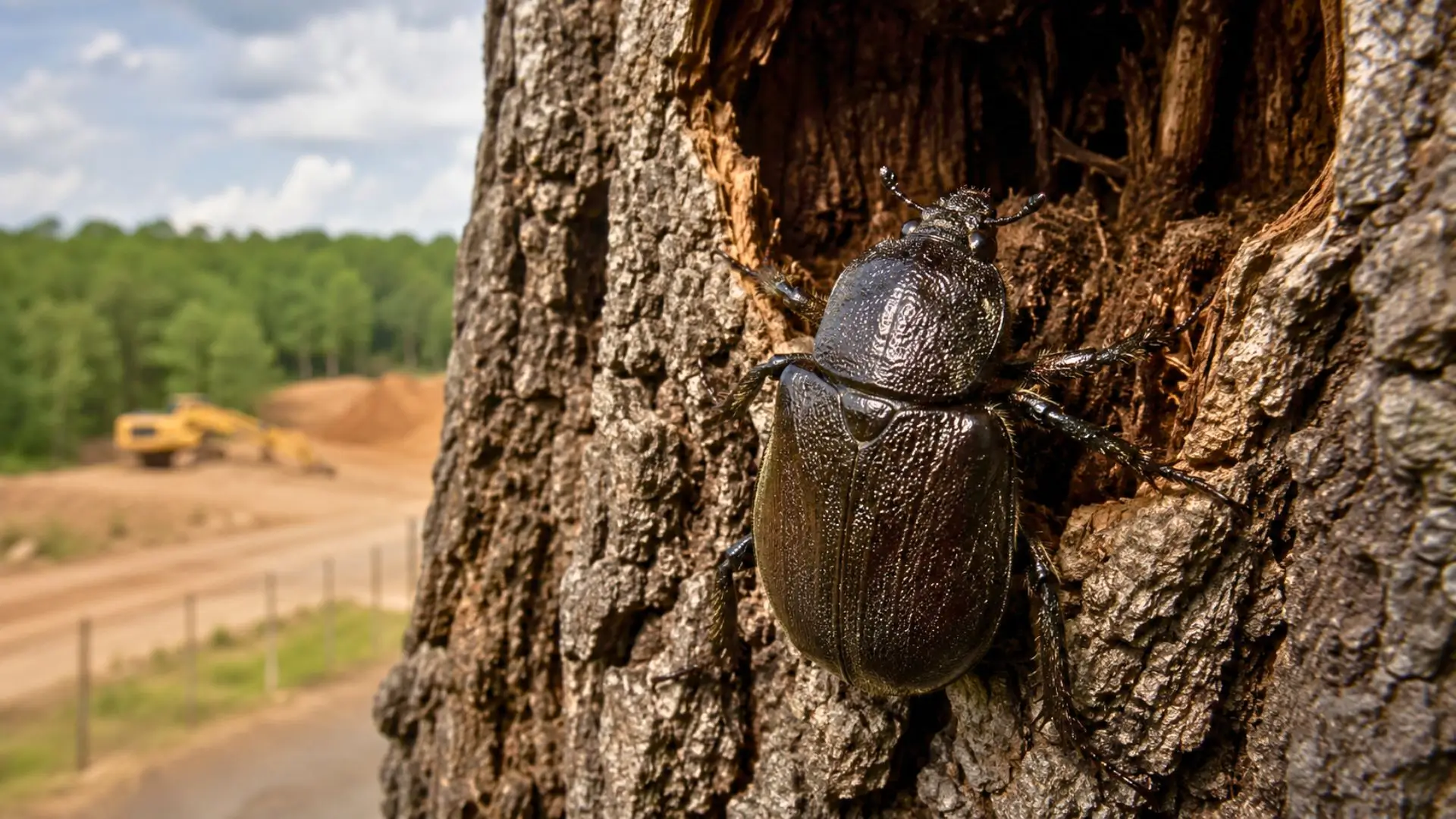
In Sarthe, the construction of the A28 motorway ran into an unexpected obstacle: the prune beetle. This small protected beetle halted work between Écommoy and Montabon for six years, forcing engineers to rethink the entire route to preserve its habitat.
A beetle protected by Europe halts Cofiroute’s excavators
It all began in 1996 when the prune beetle was spotted in Sarthe. This scarab beetle, measuring less than four centimeters, benefits from a powerful international legal arsenal drawn from the 1979 Bern Convention. As early as 1997, Cofiroute, the concessionaire, had to stop its machines between Écommoy and Montabon.
Scientifically named Osmoderma eremita, this sedentary insect rarely travels more than 300 meters during its adult life. Its larva grows for two to four years in the soil of ancient trees. For entomologists, its presence attests to the ecological health of old forests.
Local elected officials grow exasperated by a political puzzle that extends to the government
The halt of the machines provoked the anger of local representatives. Gérard Burel, then president of the General Council of Orne, regrets that this discovery arrived so late. In 1999, the Environment Minister Jean-Claude Gayssot even contemplated altering the initial route to bypass the area.
Activists from France Nature Environnement Sarthe actively defend the wooded sector, adjacent to the Bercé forest. The former president of Friends of the Forest, Christian Damenstein, recalls that the legal argument tied to the beetle remained their only means to obtain a shift in the highway project.
Faced with this administrative and environmental stalemate, the ministries concerned hesitated for a long time before deciding. It was ultimately the arbitration of Alain Lambert, Budget Minister, that unlocked the situation. The decision was made: the road infrastructure would bypass the wood hosting the beetle.
Engineers relocate entire trees to bypass the sensitive zone
To preserve the specimens without permanently interrupting the transport axis, unprecedented measures were deployed in July 2003. The builders altered the location of an interchange. They also sawed the bases of the ancient chestnut trees inhabited by the beetles to relocate them to a protected natural space.
The resumption of the project made it possible to complete the link toward Tours for a sum of 300 million euros. However, the teams had to contend with another late-emerging biological constraint. The discovery of the white-clawed crayfish imposed new local safeguarding measures.
Twenty years after the inauguration of the A28, ecological coexistence remains durable
The works were finally completed in 2005. Dominique de Villepin, then prime minister, inaugurated the final stretch on October 21. This event marked the culmination of a long overall project begun in 1987, profoundly transformed by the incorporation of biodiversity.
Two decades after its commissioning, the environmental framework remains fully active on the ground. A Natura 2000 site is subject to rigorous management by departmental services. This site guarantees the persistence of the standing snags necessary for the beetle’s survival.
Today, around ten farming operators voluntarily join this local conservation effort. They replant grafted young chestnut trees to anticipate the species’ future needs. The financing of this operation is supported by subsidies from the European Union.

Contact details
Address:
Farmers Forum,
36, Dominick Street,
Mullingar,
Co. Westmeath,
Ireland
Phone:
+353 (0)44 9310206
Or email us:
For technical issues please check out our FAQ's page or email - [email protected]
For general Queries email - [email protected]
Request to add event to our Calendar - [email protected]
Send us your mart reports - [email protected]
Suggestions and feedbacks - [email protected]
News Items / Press Release - [email protected]
To Advertise on Farmers Forum - [email protected]