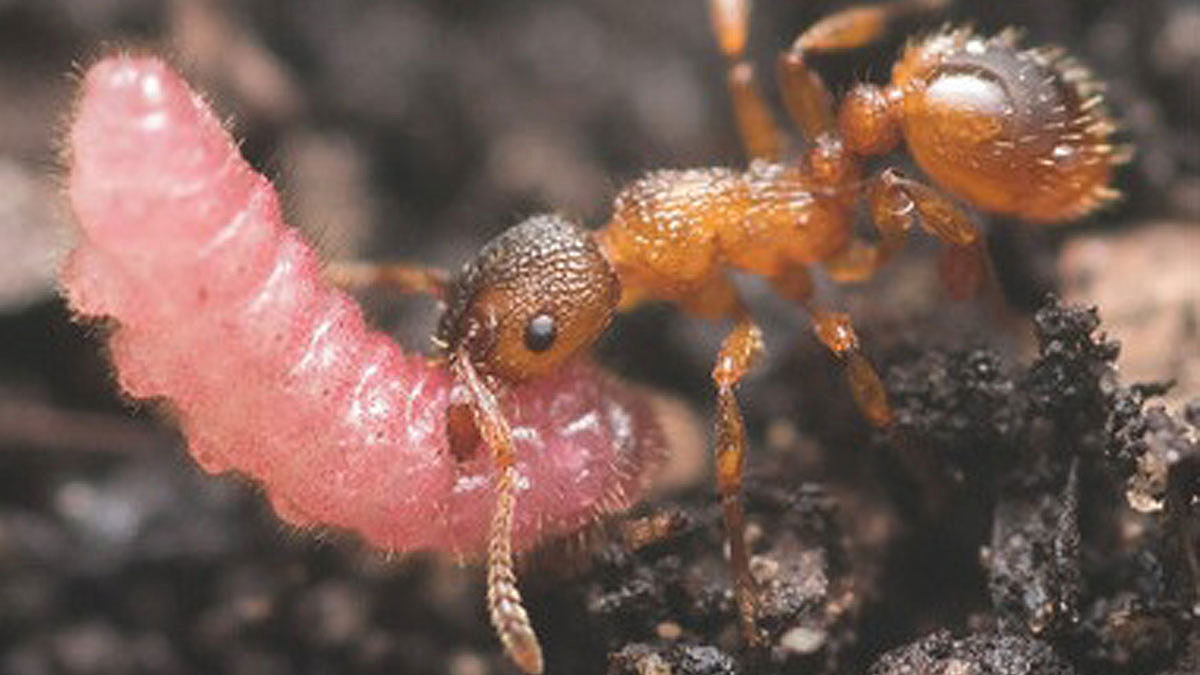
Protected, fed and carried by the workers. Thanks to astonishing mimicry, young caterpillars benefit from royal treatment by ant colonies, essential to their development.
Royal Treatment
The caterpillars of many butterfly species are “myrmecophilous”: their life cycle is tightly dependent on the ants. They can be parasitic or mutualistic; this relationship relies on the caterpillars’ ability to decode and use the host colony’s “language.” While the role of chemical and acoustic signals is well documented, Francesca Barbero of the University of Turin and her colleagues have made intriguing new discoveries.
Using a highly sensitive experimental device, the team recorded the vibrations produced by the queen ants of the genus Myrmica, as well as those of the larvae and pupae of nine butterfly species exhibiting different degrees of myrmecophily.
For all the species studied, the researchers identified a form of isochrony, or regular rhythm. But it turned out that among caterpillars most closely dependent on ants, the “rhythmic patterns” were of an unprecedented complexity for insects, comparable to the structure of vocal calls in certain primates.
“Thanks to these rhythmic patterns, species highly dependent on ants, such as Phengaris alcon and Plebejus argus, manage to convince the workers that they require the same attention as their queen,” comments James Mallet of Harvard University. “In these two cases, it is a form of parasitism, with caterpillars feeding on the ants’ larvae.”
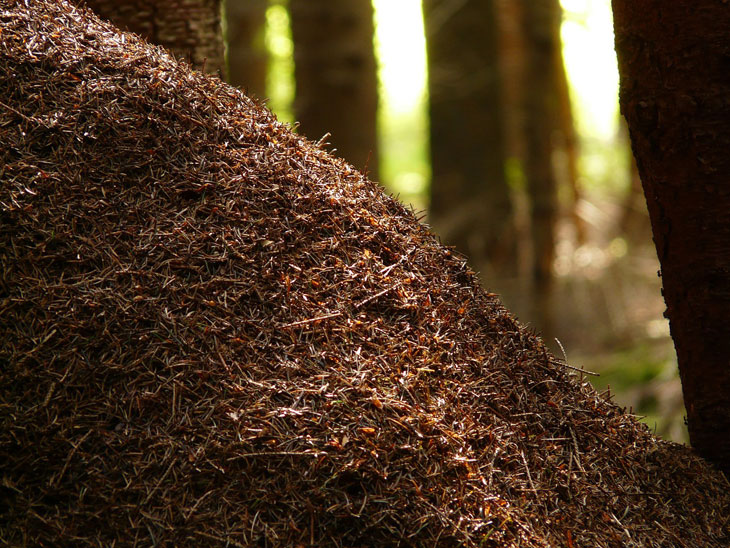
Des signaux confondants mais moins fréquents
Aussi confondantes soient les imitations des signaux rythmiques des reines fourmis, les chenilles les émettaient à une fréquence nettement moindre, que Barbero lie potentiellement à leur coût énergétique élevé.
« Être plus silencieux peut être profitable pour le futur papillon, qui émet ces signaux uniquement lorsqu’il a besoin de l’attention des fourmis », concluent les auteurs de la nouvelle étude, publiée dans les Annals of the New York Academy of Sciences.
Plus tôt cette année, des chercheurs avaient décrit une forme de « guerre chimique » chez les fourmis, avec des insectes parasites incitant les ouvrières à tuer leur reine, puis usurpant sa place.

Contact details
Address:
Farmers Forum,
36, Dominick Street,
Mullingar,
Co. Westmeath,
Ireland
Phone:
+353 (0)44 9310206
Or email us:
For technical issues please check out our FAQ's page or email - [email protected]
For general Queries email - [email protected]
Request to add event to our Calendar - [email protected]
Send us your mart reports - [email protected]
Suggestions and feedbacks - [email protected]
News Items / Press Release - [email protected]
To Advertise on Farmers Forum - [email protected]