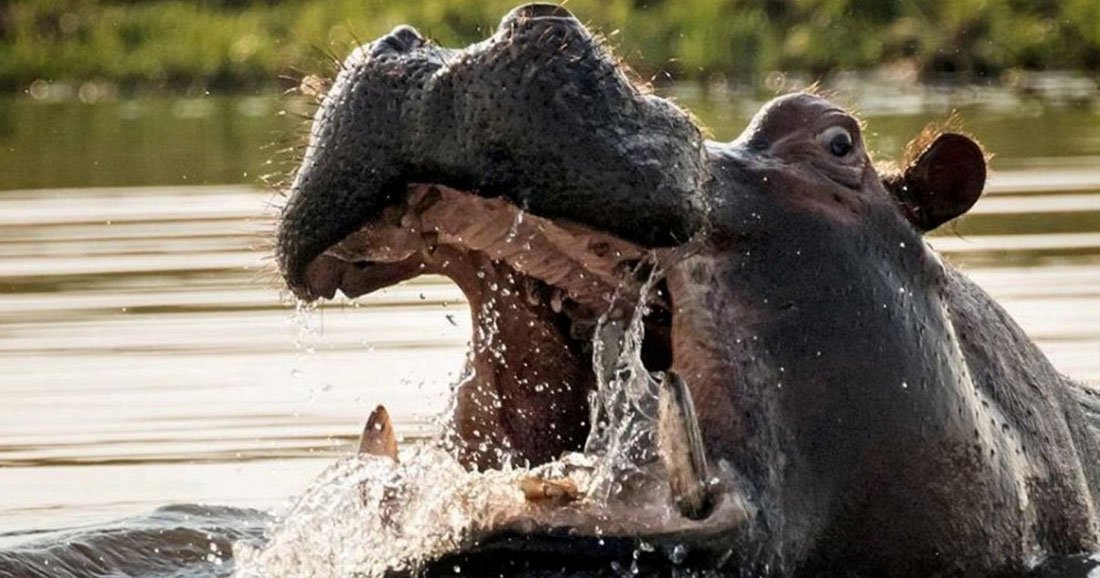
Often viewed as a peaceful herbivore, the hippopotamus can prove to be exceptionally aggressive and each year is responsible for hundreds of deaths across Africa. Yet as dangerous as it is, it also plays a crucial ecological role.
Contrary to popular belief that the hippopotamus is a placid creature that spends most of its time lounging in muddy tropical waters, the reality is quite different. Beneath its harmless appearance, it is unusually agile, it occasionally preys on other animals… and it can even attack humans, sometimes fatally.
According to Johan Eksteen, who has studied hippo behavior for nearly three decades, most Westerners are unaware of the extreme danger posed by these massive mammals.
“Tourists see a hippopotamus yawning and assume it is happy, when in fact it is a warning signal,” explains the South African ecologist. “There are also times when the animal emits a grunt that resembles a laugh, but it is, once again, the opposite.”
Leejiah Dorward, a PhD student at Oxford studying human–carnivore conflicts in Tanzania, notes another error often made by visitors. “People are persuaded that hippos are pure herbivores, but we have solid evidence that they do eat meat.”
In recent years, nearly a hundred hippos have been observed feeding on the flesh of impalas, kudus, gnus or buffalos, and there are even cases of them consuming the carcasses of their own kind.
Although they do not actively hunt humans, they can attack them under certain circumstances. This notably occurs when tourists venture close to their water hole or inadvertently step into their path.
Capable of charging at speeds up to 40 kilometers per hour, these animals prove to be far more deadly than the lion: they are estimated to cause more than 500 human deaths each year.
In 2014, thirteen people drowned in Niger after hippos capsized their boats, and similar incidents occur every year in Tanzania or Namibia.
Among the terrifying stories circulated across Africa, there is one about a man and his wife who were brutally killed and eaten by an animal that wandered near their dwelling.
But as researchers point out, the hippopotamus’s stomach is poorly suited to digesting meat. They say the animal mainly consumes meat only when it is nutritionally deficient.
“Most herbivores use their sharp incisors to pinch and carefully slice leaves. By contrast, hippos’ long canines and incisors are formidable defensive tools, and they actually use their lips to pull vegetation,” explains Eksteen.
While these African giants spend whole days in the water to keep cool, they can traverse several kilometers during the night, especially in winter when vegetation is scarcer. Large fans of leafy greens, they do not hesitate to raid crops.
Although electric fences have helped keep these hungry animals at a distance in some regions of Africa, many farmers have chosen to abandon vegetables in favor of citrus fruits.
A fairly prudent choice, since hippos pay little attention to oranges or mandarins and graze among fruit trees, effectively deterring thieves once night falls.
The substance secreted by hippos to shield themselves from the sun also possesses remarkable properties that cosmetics and pharmaceuticals industries could draw on. As Eksteen explains, “they lack sweat glands but have serous glands. In a few minutes, the viscous liquid they produce turns brown and acts as a highly effective sun shield and a potent antimicrobial.”
These creatures also play a crucial ecological role by vigorously churning the river beds and “enriching” them with their droppings, benefiting fish populations. Despite the danger they can pose to humans, these animals, threatened by poaching and habitat loss, remain essential links in their ecosystem.
Notably, hippos produce pink milk; they don’t swim in the strict sense, but it turns out they can… fly.

Contact details
Address:
Farmers Forum,
36, Dominick Street,
Mullingar,
Co. Westmeath,
Ireland
Phone:
+353 (0)44 9310206
Or email us:
For technical issues please check out our FAQ's page or email - [email protected]
For general Queries email - [email protected]
Request to add event to our Calendar - [email protected]
Send us your mart reports - [email protected]
Suggestions and feedbacks - [email protected]
News Items / Press Release - [email protected]
To Advertise on Farmers Forum - [email protected]