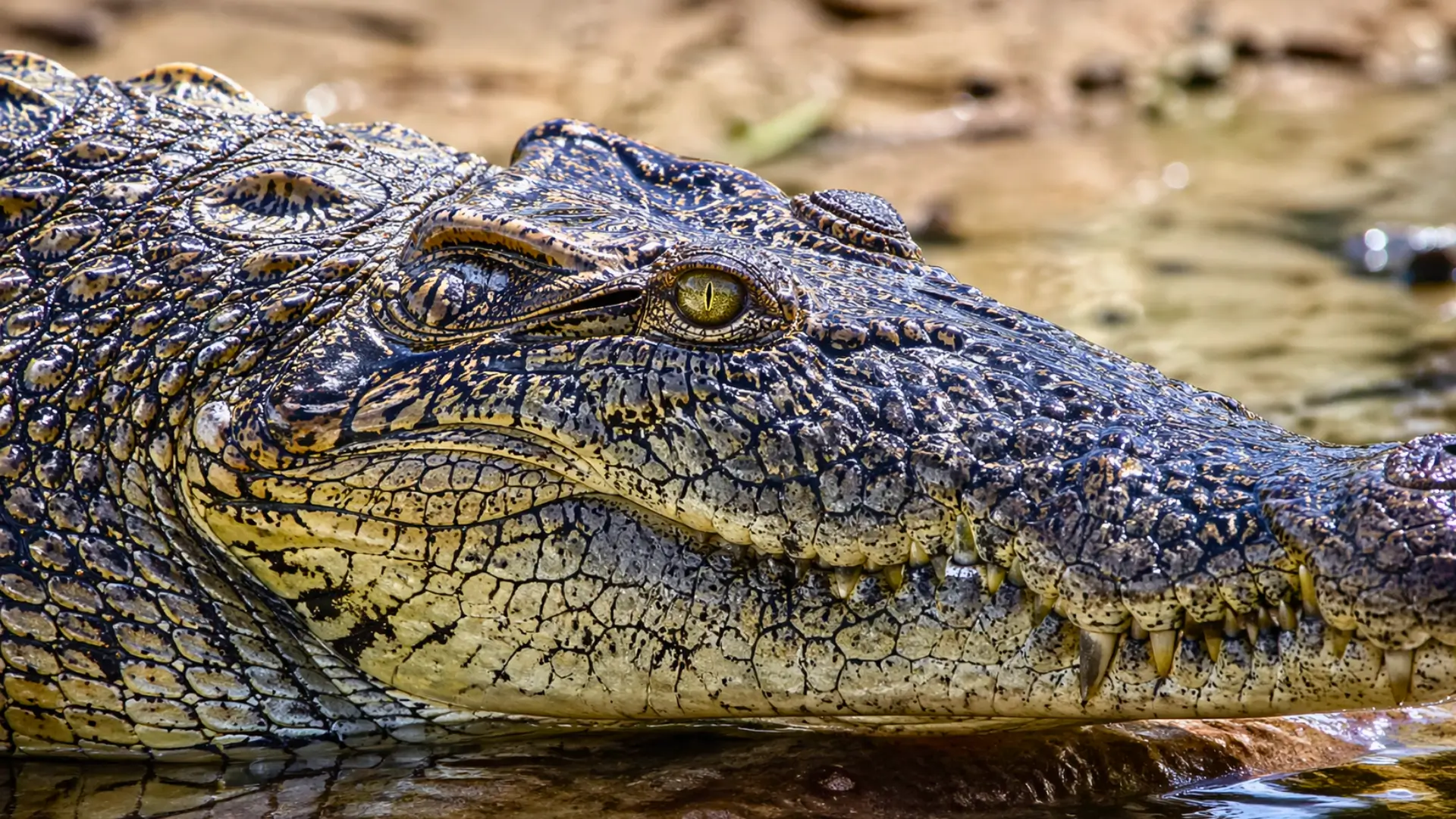
What if the intricate patterns on crocodile skin aren’t written in their genes? A recent study uncovers an unexpected mechanism where physics overrides biology, upending our understanding of living forms. A discovery that could truly change the game.
Atypical scale patterns that defy traditional genetic laws
For a long time, scientists have gazed with fascination at the irregular patterns that cover the heads of crocodiles. Yet, unlike snakes or lizards, whose scales follow precise schemata dictated by genetics, these reptiles exhibit a disordered mosaic that is nearly perplexing.
Thus, this seemingly innocuous detail fed a persistent question in developmental biology. Indeed, how can one explain such a difference within the same animal group? For decades, the answer seemed obvious: genes orchestrate everything. Yet this certainty has now been seriously unsettled.
A Key Observation Triggers a More Than Ten-Year Scientific Inquiry
First of all, everything starts with an almost accidental observation. While examining a Nile crocodile, a researcher notices imperfect polygons, some of which do not even fit together properly. From that moment, the detail intrigues, because it contradicts the classic models of scale formation.
Consequently, this visual anomaly becomes the starting point of a scientific investigation spanning more than ten years. Over time, by combining observations, embryology, and numerical simulations, researchers eventually develop an unprecedented model capable of explaining this phenomenon without invoking genetics.
Uneven skin growth creates folds and mechanical cracks
At the heart of this discovery lies an astonishingly simple mechanism. Indeed, in the embryo, the skin starts smooth, then undergoes an imbalance in growth between its layers. More precisely, the epidermis develops faster than the dermis, gradually creating tension.
Thus, under this constraint, the skin surface begins to crease, much like a squeezed sheet. This phenomenon, called compressive stress, generates fissures that eventually outline the contours of the scales. Therefore, the final form is not pre-programmed, but genuinely emergent.
A Discovery Redefining the Role of Physics in the Formation of Living Beings
To go further, researchers tested this hypothesis by altering the growth of the skin using a specific protein. Result: unexpected patterns emerge, sometimes reminiscent of brain convolutions, evidence that the system is extremely sensitive to mechanical conditions.
Moreover, this study, published in Nature and led by the University of Geneva, opens a new perspective. It suggests that certain forms of life could emerge without direct genetic instruction, simply under the effect of physical laws. Thus, this idea could transform the way we study evolution and morphogenesis.
Finally, one question remains. And what if other biological structures, in plants or animals, also obey these invisible rules? Behind the apparent complexity of life, the simplicity of physical laws could play a larger role than imagined.

Contact details
Address:
Farmers Forum,
36, Dominick Street,
Mullingar,
Co. Westmeath,
Ireland
Phone:
+353 (0)44 9310206
Or email us:
For technical issues please check out our FAQ's page or email - [email protected]
For general Queries email - [email protected]
Request to add event to our Calendar - [email protected]
Send us your mart reports - [email protected]
Suggestions and feedbacks - [email protected]
News Items / Press Release - [email protected]
To Advertise on Farmers Forum - [email protected]