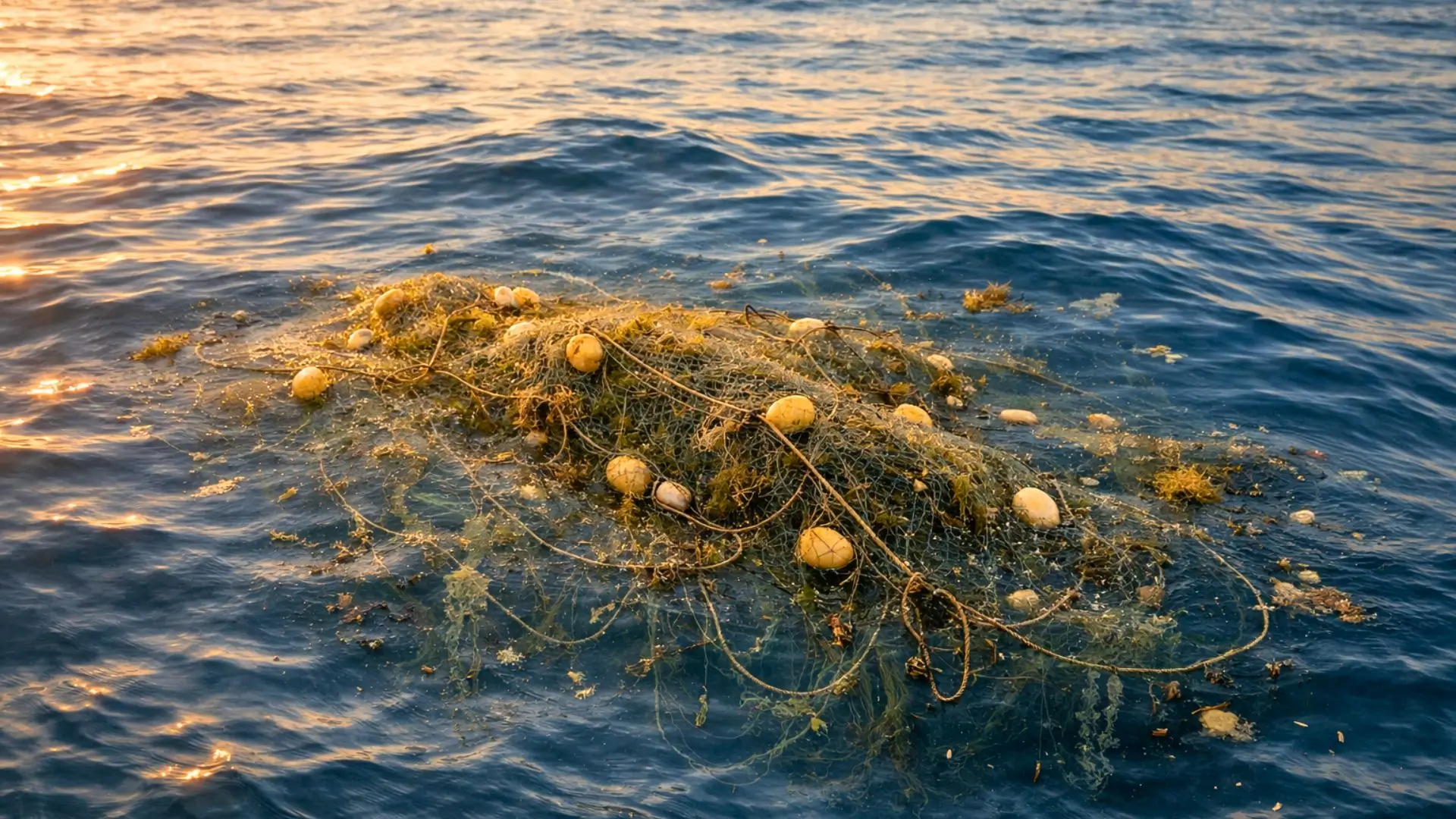
Each year, about 2% of all fishing gear used worldwide ends up lost or abandoned at sea. A study published in Science Advances reveals astronomical volumes. These tools continue to trap animals and ecosystems long after they are abandoned.
Thousands of kilometers of nets and lines vanish each year: here is what the figures really show
Researchers from CSIRO and the University of Tasmania interviewed more than 450 fishers from seven countries. They cross-referenced these testimonies with global data on commercial fishing effort. The result provides the first global, up-to-date estimate of the phenomenon.
Each year, roughly 740,000 kilometers of main longline gear reach the ocean floor. Put end to end, these lines alone would surpass the Earth’s circumference more than eighteen times. It’s a number that’s hard to visualize, yet scientifically established and confirmed by multiple independent sources.
In addition, around 3,000 square kilometers of gillnets, 218 square kilometers of trawls, and 75,000 square kilometers of sliding seines are accounted for. The researchers also tally more than twenty-five million crab pots and traps, as well as nearly fourteen billion longline hooks each year.
Storms, reefs and ship conflicts: why do these gear systematically end up at the bottom of the sea
The causes of these losses are multiple and well documented. Bottom trawls regularly snag on reefs or rugged seabed features. Severe weather conditions alone account for about 80% of losses reported by fishers themselves.
Intersections between gear also contribute to the phenomenon. A trawl net can become entangled with a drifting longline. Some losses also result from mechanical failures or conflicts between competing vessels. Global fishing effort increasing worldwide mechanically worsens the situation every year.
Ghost fishing kills species for decades: sharks, turtles and corals trapped in invisible nets
A lost piece of gear does not stop functioning. It continues to catch fish, marine mammals, turtles and sharks for months, sometimes years. This phenomenon is known as ghost fishing. According to WWF, these devices represent the deadliest form of marine plastic.
Ghost gear also directly damages coral reefs and seabeds. In some places it accounts for up to 46% of floating debris in the North Pacific Gyre. Their gradual breakdown into microplastics further worsens the long-term contamination of marine food chains.
Global populations of sharks and rays have fallen by 71% over the past half-century. Lost hooks and nets directly intensify this pressure. Cetaceans, such as dolphins and whales, also become entangled with often fatal outcomes.
FAO and the EU mobilize legal tools to curb pollution from lost fishing gear at sea
International organizations are already taking action. The FAO has developed targeted measures: mandatory gear marking, loss reporting, in-sea recovery and oversight of destructive practices. The European Union is calling for the collection of at least 50% of lost gear annually by member states.
The European Parliament is also pushing toward a real-time mapping and tracking system. These measures rely on the polluter-pays principle, notably targeting gear manufacturers. Tax incentives such as deposit systems aim to encourage fishers to return recovered gear to port.
These estimates do not include losses tied to recreational fishing, though they are significant. Regularly updating global data remains essential to calibrate large-scale solutions. The CSIRO study provides a unique reference base to guide forthcoming sustainable fisheries policies.

Contact details
Address:
Farmers Forum,
36, Dominick Street,
Mullingar,
Co. Westmeath,
Ireland
Phone:
+353 (0)44 9310206
Or email us:
For technical issues please check out our FAQ's page or email - [email protected]
For general Queries email - [email protected]
Request to add event to our Calendar - [email protected]
Send us your mart reports - [email protected]
Suggestions and feedbacks - [email protected]
News Items / Press Release - [email protected]
To Advertise on Farmers Forum - [email protected]