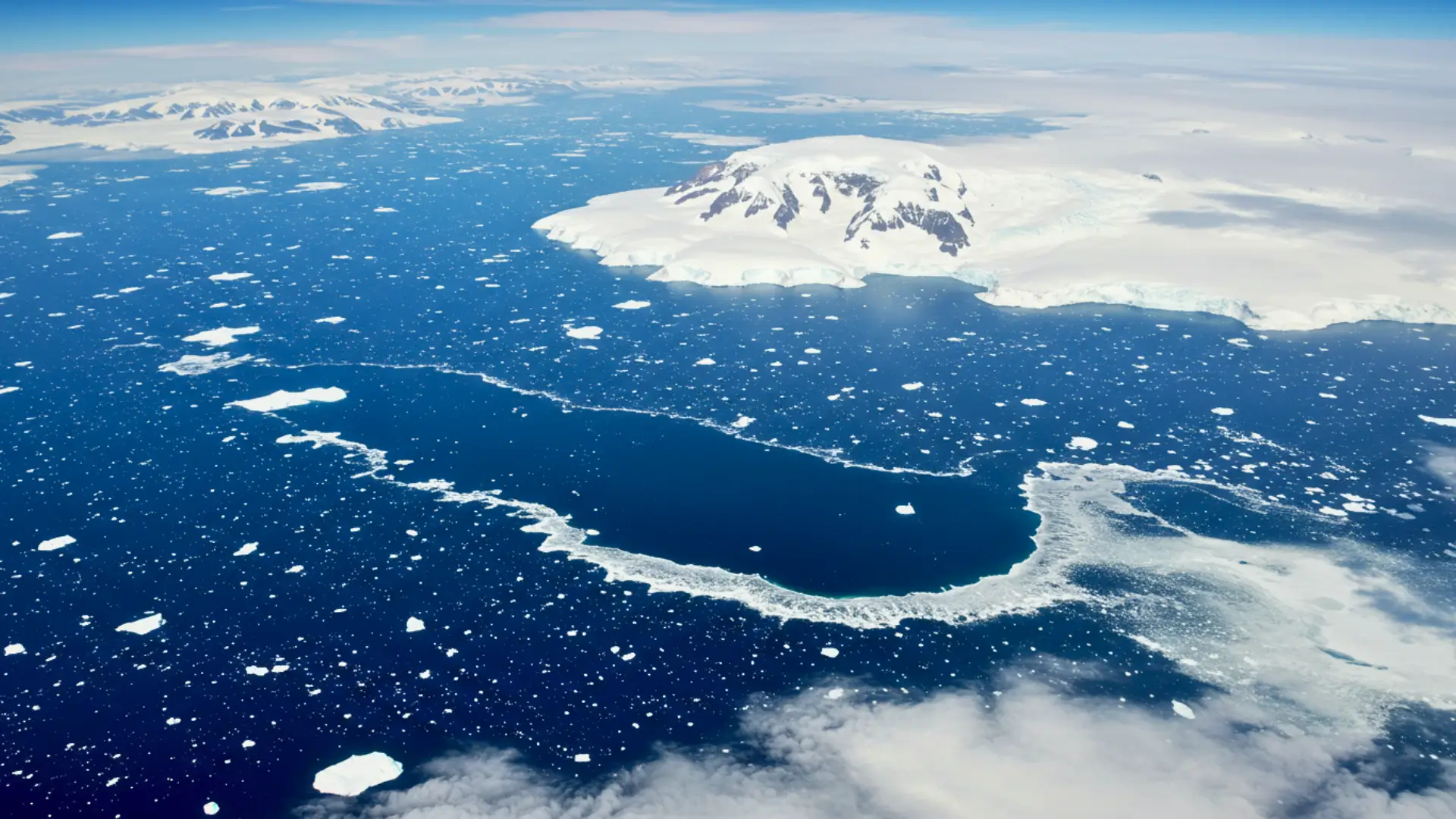
Every austral winter, the sea ice encircles Antarctica. Yet in recent winters, spectacular surprises have emerged. A vast hole, visible from space, has upended scientific certainties about the stability of these extreme landscapes.
Antarctic polynyas, open-water zones that disrupt the balance of the sea ice
In popular imagination, Antarctic sea ice appears as a static, uniform surface. Yet in reality, it is punctuated by open-water pockets called polynyas. These spaces thus act as genuine oceanic windows, allowing constant exchanges between the frigid air and the deep water.
These openings are not trivial phenomena. Indeed, they modify heat flux and foster the emergence of local microclimates. Moreover, through these zones, essential gases like CO₂ move actively. Thus, scientists view them as a key lever in understanding the polar climate.
Maud Rise Polynya, a gigantic opening that surpasses known scientific models
In 2016 and then in 2017, a colossal polynya formed in the Weddell Sea, near Maud Rise. From the outset, its size rivaled that of a European country. Consequently, this sudden appearance immediately drew attention, because it challenged the established models for Antarctic ice formation.
Typically, these openings remain modest and temporary. Yet here, the structure persisted through the heart of winter, despite extreme temperatures. As a result, this anomaly prompted researchers to reassess their hypotheses and to explore more complex mechanisms involving the deep-ocean dynamics.
Deep currents, winds and eddies, the invisible forces keeping the polynya open
Analyses have revealed a strengthening of the Weddell Current. This phenomenon has encouraged the upwelling of warmer waters toward the surface. This process, known as upwelling, directly weakens the surface ice and initiates a sustained opening.
However, that was only part of the story. In fact, oceanic eddies played a decisive role by acting as natural pumps. They carried saline waters to the surface, hindering rapid ice formation and keeping the giant polynya open.
Added to this is the wind’s effect, via a mechanism called Ekman transport. In parallel, this surface movement shifts water masses and intensifies the deep upwellings. Ultimately, together they create a self-sustained system where multiple invisible forces interact to maintain this spectacular opening.
A decisive phenomenon for the global climate and the balance of Antarctic ecosystems
The consequences of such a phenomenon extend far beyond mere scientific curiosity. Indeed, polynyas influence the global ocean circulation and participate in the thermal exchanges between the ocean and the atmosphere. Hence, they become valuable indicators of climate change.
These open-water zones also serve as biological refuges. Seabirds, mammals and fish find food and oxygen there. Thus, they play a structural role in the food chain, profoundly altering the balance of Antarctic ecosystems.
Studies published in Science Advances have helped improve understanding of these complex mechanisms. Moreover, they emphasize the importance of monitoring these rare phenomena. Through them, scientists hope to anticipate future changes in one of the planet’s most sensitive environments.

Contact details
Address:
Farmers Forum,
36, Dominick Street,
Mullingar,
Co. Westmeath,
Ireland
Phone:
+353 (0)44 9310206
Or email us:
For technical issues please check out our FAQ's page or email - [email protected]
For general Queries email - [email protected]
Request to add event to our Calendar - [email protected]
Send us your mart reports - [email protected]
Suggestions and feedbacks - [email protected]
News Items / Press Release - [email protected]
To Advertise on Farmers Forum - [email protected]