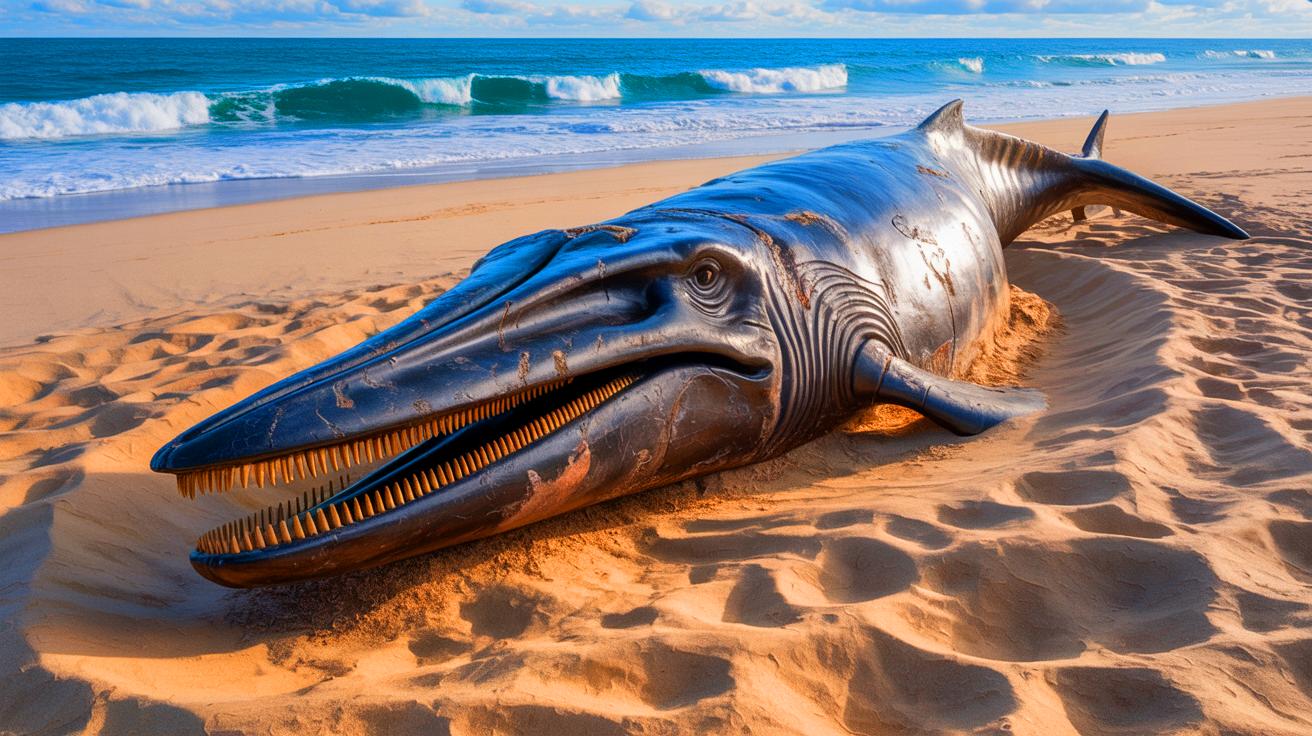
The discovery of ancient fossils offers a fascinating glimpse into the evolution of whales, these majestic giants of the oceans. Among these discoveries, Janjucetus dullardi stands out for its deceptively cute yet formidable appearance. Living about 26 million years ago, this whale hunted off the coast of Australia. Its fossils, found by chance on an Australian beach, allowed us to reconstruct a little-known chapter of cetacean evolutionary history. This species, far smaller than modern whales, possessed unique features that made it particularly well-suited to its environment. Researchers continue to explore fossil sites in the hope of discovering new species and deepening our understanding of whale evolution.
A Fortuitous and Valuable Discovery
The discovery of Janjucetus dullardi is credited to Ross Dullard, an Australian school principal, who found the fossils during a stroll on Half Moon Bay Beach. The fossils lay exposed at the base of an eroded cliff, a geological feature that often favors such remnants. The site yielded remains dating from 24 to 28 million years ago, offering a valuable glimpse into the Oligocene epoch.
The analyses performed on these fossils, notably using modern techniques such as photography and microCT scans, allowed us to determine that J. dullardi belonged to the family Mammalodontidae. This group of small whales inhabited warm and shallow waters around Australia and New Zealand, an environment rich in prey.
“The discovery of these fossils sheds light on a crucial aspect of whale evolution,” says a paleontologist.
Les tomates viennent-elles vraiment d’Amérique ? « Impossible ! » s’exclame un historien français stupéfait
This discovery also underscores the importance of public contributions to science, turning a simple walk into a major scientific advance.
The Unique Adaptations of Janjucetus dullardi
Janjucetus dullardi stands out for its small size, measuring about 2.1 meters in length, and its stocky body. These characteristics afforded it great agility in the water, a major asset for hunting. Unlike today’s baleen whales, J. dullardi possessed sharp teeth, suited to capturing prey.
Its cute appearance is deceptive, as its large eyes and pointed teeth made it a formidable predator. This species is a distant cousin of baleen whales, but it represented a distinct evolutionary branch, having explored different ecological niches.
Découverte terrifiante : un fossile géant bouleverse l’origine des premiers dinosaures révélée dans le désert
The fossils of J. dullardi allow scientists to better understand how whales evolved to adapt to various marine environments. This anatomical and ecological diversity testifies to the numerous strategies developed by cetaceans over time to survive and thrive in the seas.
The Geological Secrets of the Australian Coast
Australia, and more specifically the Victoria region, is known for its abundance of ancient whale fossils. The region’s particular geological conditions favored the preservation of numerous fossils in ancient marine sediments. The coastal cliffs, continually eroded, regularly expose new geological layers rich in fossils.
This region was once covered by warm, shallow waters, an ideal habitat for many whale species. Living conditions were optimal, with an abundance of food, allowing a wide diversity of species to thrive. This ecological richness is now visible through the numerous fossils discovered.
« Ces masses souterraines colossales annoncent une extinction imminente » : la planète au bord du précipice selon les experts
« Les découvertes dans le Victoria sont essentielles pour comprendre l’évolution des baleines », note un chercheur.
These sites offer a unique window into a distant past, revealing fascinating details about prehistoric marine life.
The Crucial Role of Citizen Discoveries
Discoveries of fossils like J. dullardi highlight the importance of the role ordinary citizens can play in science. By finding these fossils, Ross Dullard opened the door to in-depth research on whale evolution. His contribution is one example among others of how citizen discoveries can enrich scientific inquiry.
Researchers continue to explore the region, hoping to uncover additional fossils that could complement our understanding of whale history. These research efforts illustrate the importance of collaboration between amateurs and professionals in paleontology.
Thanks to these discoveries, scientists can reconstruct the complex evolution of cetaceans, adding essential pieces to the puzzle of their history. This synergy between science and citizen participation is crucial for advancing our knowledge.
The discovery of Janjucetus dullardi is a powerful reminder of the importance of chance and curiosity in science. Each fossil unearthed tells a unique story, contributing to our collective understanding of evolution. As researchers continue their investigations, what new discoveries will further enrich our understanding of the giants of the seas?

Contact details
Address:
Farmers Forum,
36, Dominick Street,
Mullingar,
Co. Westmeath,
Ireland
Phone:
+353 (0)44 9310206
Or email us:
For technical issues please check out our FAQ's page or email - [email protected]
For general Queries email - [email protected]
Request to add event to our Calendar - [email protected]
Send us your mart reports - [email protected]
Suggestions and feedbacks - [email protected]
News Items / Press Release - [email protected]
To Advertise on Farmers Forum - [email protected]