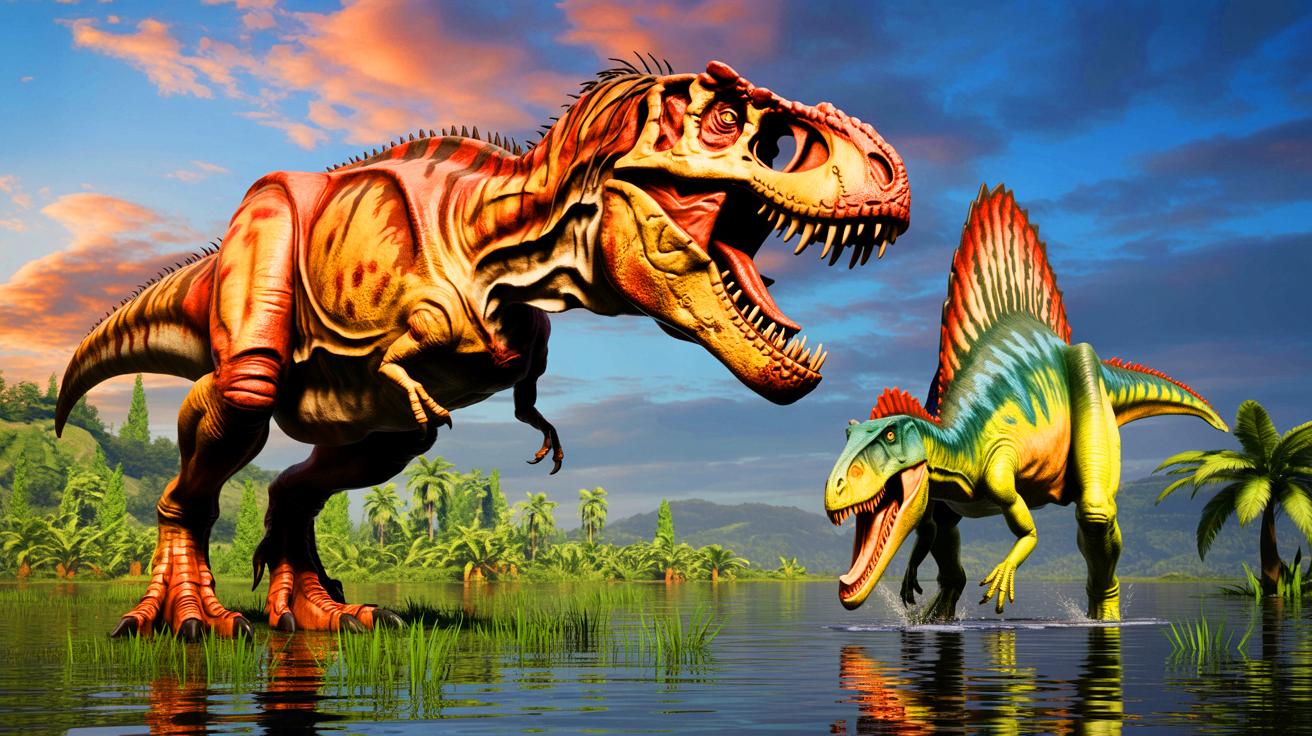
Carnivorous dinosaurs have fascinated scientists for decades. Thanks to technological advances, researchers can now study their hunting strategies with unprecedented precision. By employing technologies such as computed tomography and 3D scans, a new study has shed light on surprising differences among these prehistoric predators. Their findings reveal ecological specializations that shaped their evolution. Published in Current Biology, these results offer a captivating glimpse into the diverse roles these giants occupied in their ecosystems, and how they coexisted despite employing varied predation methods.
A Technological Analysis of Skulls
Researchers applied modern techniques to analyze the bite force across 18 species of carnivorous dinosaurs. Computed tomography and 3D scans enabled precise modeling of these creatures’ skulls, revealing fascinating details about their anatomy. The study focused on iconic species such as the Tyrannosaurus rex and the Spinosaurus. The T. rex, renowned for its power, possessed a skull built to crush the bones of its prey, a trait similar to that of modern crocodiles. This adaptation allowed it to exert incredible force, essential for its survival.
By contrast, other predators such as the Spinosaurus and Allosaurus had lighter skulls. They employed hunting techniques based on slicing and tearing flesh. This approach differed greatly from that of the T. rex, highlighting an evolutionary divergence. The results of these analyses demonstrate the diversity of feeding strategies among carnivorous dinosaurs.
Après l’humanité, cet animal va régner en maître et vous n’êtes pas prêts pour ça : « Les scientifiques prédisent un règne de 10 000 ans »
Divergences évolutives et spécialisations
The biomechanical divergence observed among the different carnivorous dinosaur species illustrates distinct evolutionary paths. Andrew Rowe, from the University of Bristol, explains that tyrannosaurids developed robust skulls for crushing bites, while other lineages opted for lighter skulls suited to varied hunting strategies.
This indicates an ecological specialization, reducing direct competition among these giants.
« L’arsenic n’a jamais eu de chance » : découvrez comment les premiers organismes ont défié cet ennemi mortel il y a 2,1 milliards d’années
This differentiation allowed a more harmonious coexistence within their shared habitats.
By comparing Allosaurus to the modern Komodo dragons, researchers demonstrate how weaker bites can be just as effective. This contrast with the T. rex challenges the notion of a universal skull design for giant predators. These ecological specializations explain how similarly sized species could develop very different predation methods, influenced by prey availability and environmental pressures.
Découverte terrifiante : un fossile géant bouleverse l’origine des premiers dinosaures révélée dans le désert
A Glimpse into Prehistoric Ecosystems
The absence of large living carnivores on two legs today, since the mass extinction at the end of the Cretaceous, makes this study valuable. It offers a unique insight into a vanished lifestyle. The findings underscore the richness of predator interactions within prehistoric ecosystems. Paleontologists can thus reconstruct ancient food chains. Tyrannosaurs, for instance, evolved to exploit hard-shelled prey. Spinosaurs, meanwhile, preferred aquatic environments, requiring different adaptations.
These nuances in hunting behavior allowed a diversification of roles within ecosystems. The coexistence of multiple giant predators fostered a complex ecological dynamic. This study helps explain how evolution shaped multiple adaptations in response to the same environmental challenges, and how these adaptations influenced relationships between species.
Implications for Understanding Evolution
The evolution of dietary strategies among carnivorous dinosaurs illustrates predation methods that varied according to environmental pressures. The specialized traits show how similarly sized species could develop distinct approaches. The tyrannosaurs and the spinosaurs, though giants, occupied different ecological niches. Tyrannosaurs evolved to exploit hard-shelled prey, while spinosaurs were adapted to fishing.
This study enriches our understanding of competition and cooperation dynamics in prehistoric ecosystems. Paleontologists can thus better grasp how different species coexisted. The results highlight the importance of studying predator interactions to reconstruct past ecosystems. What other discovery might still transform our view of these giants of the past?

Contact details
Address:
Farmers Forum,
36, Dominick Street,
Mullingar,
Co. Westmeath,
Ireland
Phone:
+353 (0)44 9310206
Or email us:
For technical issues please check out our FAQ's page or email - [email protected]
For general Queries email - [email protected]
Request to add event to our Calendar - [email protected]
Send us your mart reports - [email protected]
Suggestions and feedbacks - [email protected]
News Items / Press Release - [email protected]
To Advertise on Farmers Forum - [email protected]