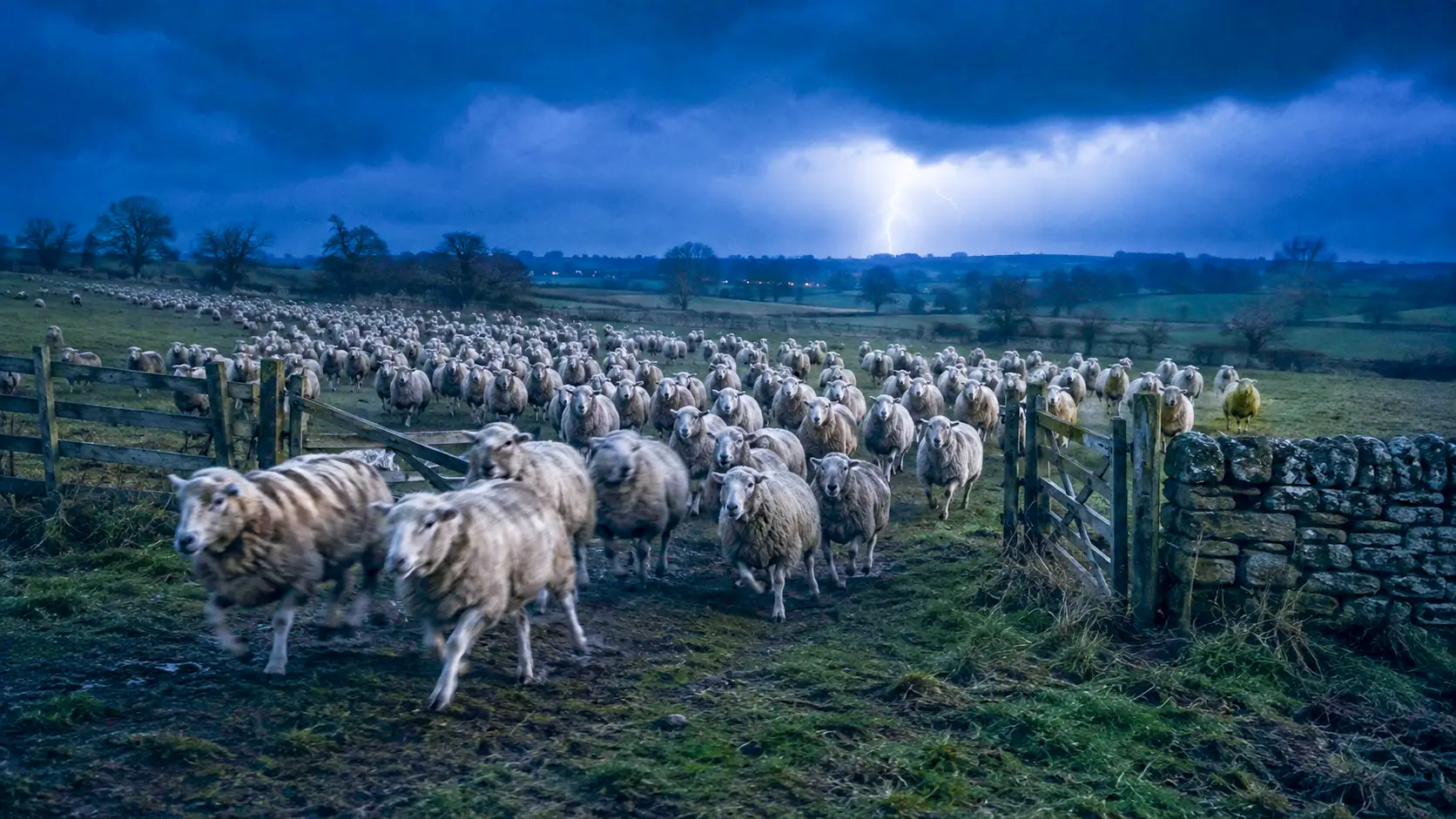
One November night in 1888, thousands of sheep suddenly began running in unison across Oxfordshire. No predator, no visible cue explained the sudden panic. More than a century later, scientists are still seeking a convincing explanation for this mysterious episode.
In Oxfordshire, tens of thousands of sheep panicked simultaneously on the night of November 3, 1888
On November 3, 1888, around 8 p.m., Oxfordshire plunged into an inexplicable upheaval. Suddenly, tens of thousands of sheep began to run with no predator visible in sight. Yet no immediate cause appeared at the moment. The affected area spans about 518 km² of English countryside.
The The Times of London reports the affair on November 20, 1888, several weeks after the events. This British daily describes a sudden panic affecting flocks to the north, east, and west of Reading. In fact, this collective upheaval strikes an entire region, not a single flock.
Fences destroyed and herds scattered for miles after this night of collective panic
This night of panic left tangible traces on the ground. The sheep, seized by uncontrollable terror, smash the fences that delimit their pastures. They trample across entire fields as they pass, nothing stopping them.
Some animals end up several kilometers from their original enclosure. Completely disoriented, they scatter to the four corners of the English countryside. The Times speaks of a night intensely dark, punctuated by occasional lightning, to explain this chaos. But this line of reasoning struggles to justify an effect this massive.
In 1893, the same phenomenon strikes Oxfordshire again and pushes an ornithologist to investigate
The 1888 episode might have remained an isolated accident. But in 1893, the same region experiences another outbreak of collective panic. The circumstances, this time, are close enough to alert an ornithologist named Oliver Vernon Aplin.
Intrigued by this recurrence, Aplin decides to investigate the phenomenon. He quickly suspects a recurring cause rather than a mere climatic accident. Eyewitnesses of the time describe a scene almost unreal, between 8 p.m. and 9 p.m.
A dark cloud is said to have swept across the landscape, plunging the countryside into intense darkness. Some witnesses compare this sensation to being locked inside a dark room. This detail would become central to the explanation later proposed by Aplin, decades hence.
Dark nights and herd instinct, Aplin’s explanation published in Nature in 1921 leaves a complete mystery
This reaction can be explained by the sheep’s fundamental nature. According to the RSPCA, this animal remains prey with no defensive strategy other than fleeing in a group. Introduced to the United Kingdom around 4000 BCE, sheep have upheld this gregarious instinct for millennia.
In 1921, the journal Nature published Aplin’s conclusions on this mystery. His hypothesis points to nights of unusually deep darkness, capable of disturbing the sheep’s night vision. Disoriented, the animals collide with one another, triggering a chain reaction of panic.
Yet this theory remains fragile on a key point. It does not explain how a mere obscurity could simultaneously affect flocks spread over more than 500 km². More than a century later, the mystery remains.

Contact details
Address:
Farmers Forum,
36, Dominick Street,
Mullingar,
Co. Westmeath,
Ireland
Phone:
+353 (0)44 9310206
Or email us:
For technical issues please check out our FAQ's page or email - [email protected]
For general Queries email - [email protected]
Request to add event to our Calendar - [email protected]
Send us your mart reports - [email protected]
Suggestions and feedbacks - [email protected]
News Items / Press Release - [email protected]
To Advertise on Farmers Forum - [email protected]