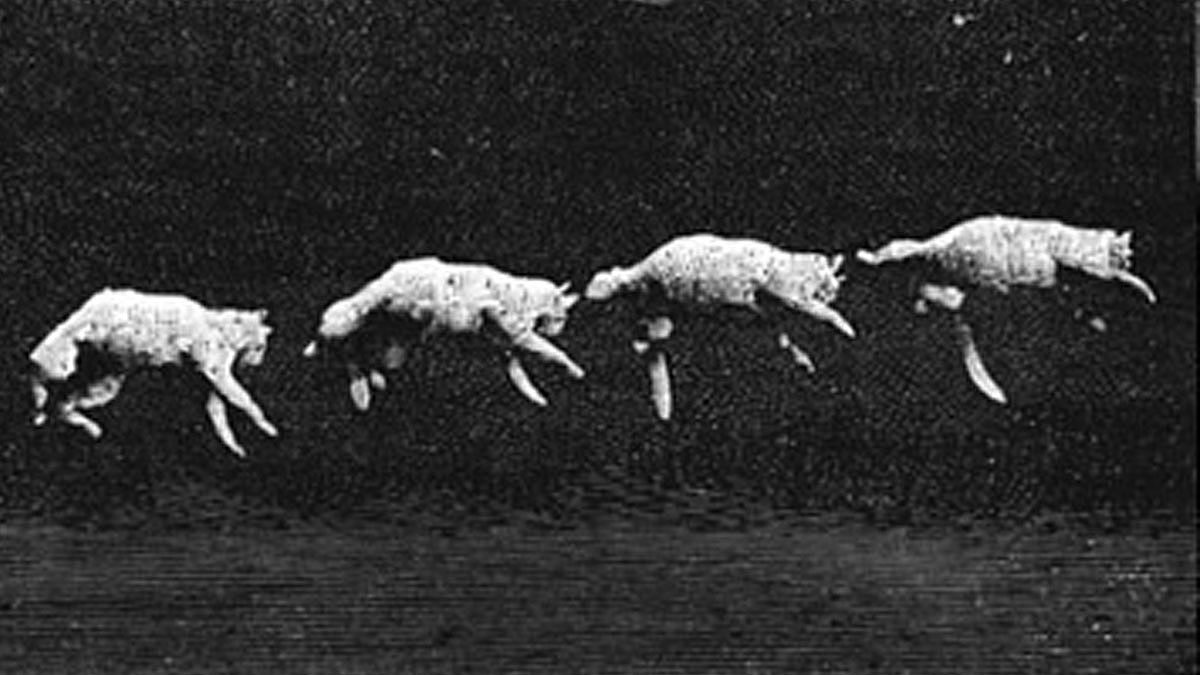
Real contortionists. A team of Japanese scientists has highlighted the crucial role played by a remarkably flexible section of the cats’ spine in their ability to land (almost) every time on their paws.
Superpower
If a cat is held with its head pointed downward and released, it winds its body swiftly through the air and lands gracefully on its four paws. For almost a century, several theories have been proposed to explain this “superpower.” Notably the swinging of the tail in the opposite direction to the body’s rotation, though this idea has been called into question by experiments involving felids lacking this appendage.
Another hypothesis suggested that the cat folds its body nearly at a right angle, then twists the front and rear sections in opposite directions, enabling its limbs to align properly before contact.
Finally, some researchers have proposed the possibility of a folding-and-rotating motion, starting with the hind legs extended and the forelegs folded, accompanied by a twist of the front portion of the torso, followed by the opposite sequence before the animal touches the ground.
An exceptionally flexible region of the spine enables falling cats to twist the front and back halves of their body sequentially to ensure a safe landing https://t.co/Gm8dpldpcb
— New Scientist (@newscientist) March 4, 2026
Today, scientists favor the two latter explanations, which do not necessarily exclude one another. “Cats are complex creatures that perform complex movements,” notes Greg Gbur, a researcher at the University of North Carolina and author of the book Falling Felines and Fundamental Physics.
New Clues
To learn more, Yasuo Higurashi of Yamaguchi University and his colleagues examined spinal columns from deceased animals to determine to what extent two key segments (the mid- and lower-back) could rotate without breaking. It turned out that the thoracic spine exhibited an angular range roughly three times greater than that of the lumbar spine.
Using high-speed cameras then allowed the researchers to scrutinize the contortions of two adult cats dropped from a height of one meter. In both instances, the rotation of the front portion of the felids’ bodies proved to be shorter by a few tens of milliseconds. “It seems clear that this part orients itself correctly first,” remarks Gbur.
During these experiments, the authors of the new study, published in The Anatomical Record, also observed that the first subject consistently twisted to the right during its fall, and the second six times out of eight. This could be explained by the asymmetric arrangement of their internal organs.
Last year, researchers had cracked the mystery of orange cats.

Contact details
Address:
Farmers Forum,
36, Dominick Street,
Mullingar,
Co. Westmeath,
Ireland
Phone:
+353 (0)44 9310206
Or email us:
For technical issues please check out our FAQ's page or email - [email protected]
For general Queries email - [email protected]
Request to add event to our Calendar - [email protected]
Send us your mart reports - [email protected]
Suggestions and feedbacks - [email protected]
News Items / Press Release - [email protected]
To Advertise on Farmers Forum - [email protected]