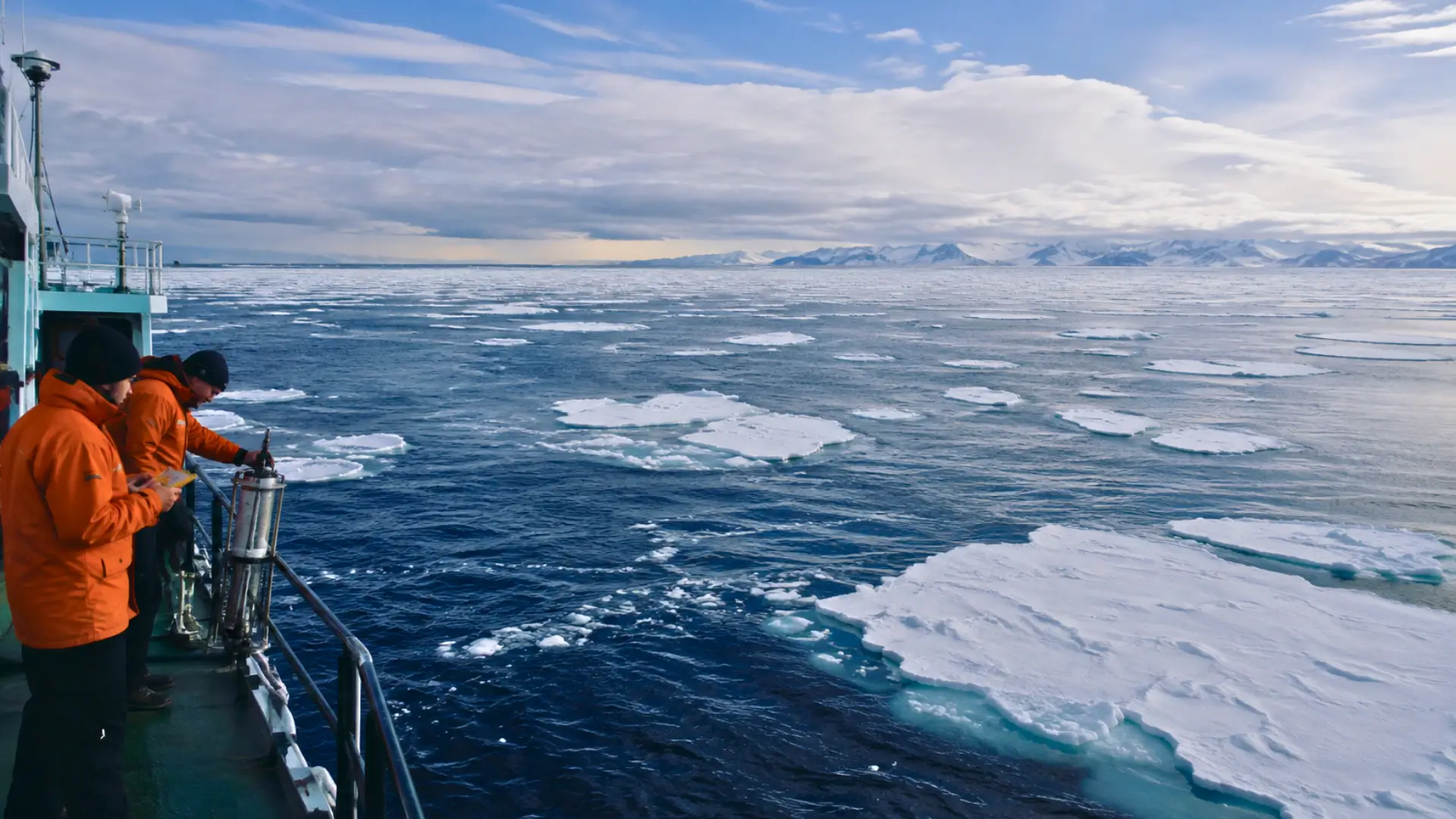
How can a region cool down while the planet is warming? A new study shows that the human footprint on the climate can remain invisible for decades, blurred by natural fluctuations, before dramatically reappearing in observations.
In 170 years of temperatures, researchers tracked an almost invisible signature
Picture a vast weather map spanning the globe since 1850. Some regions heat up quickly, others far less, and a few even turn briefly blue. Yet behind this apparent chaos hides a persistent human signature. Scientists from the Max Planck Institute for Meteorology have just traced it directly across more than 170 years of observations.
Their approach subtly shifts the perspective. Rather than asking climate models alone what regional warming should look like, the team links locally observed temperatures to the global mean rise. This “observed footprint” thus allows a finer separation between what is due to forced warming and what belongs to the natural chaos of the climate.
An ocean can cool down while human influence keeps intensifying
Here the story becomes counterintuitive. In the southeast Pacific, parts of the Southern Ocean or the subpolar North Atlantic did not follow the expected path. Some areas even experienced a temporary cooling. That does not mean the effect of greenhouse gases has mysteriously vanished.
Climate possesses its own oscillations, driven in particular by exchanges between the oceans and the atmosphere. These fluctuations can strengthen or obscure a trend for several years, sometimes decades. In other words, seeing a region warm slowly is a local snapshot, not necessarily the full movie of climate change.
The Arctic provides a striking example. Its warming accelerated sharply in the 20th century before slowing from the late 1990s to the early 2010s. According to the study, this relative pause is strongly shaped by internal variability, while the anthropogenic signal continued to act in the background.
The climate’s natural “noise” can hide the human signal far longer than expected
Climatologists speak of a balance between signal and noise. The signal here refers to the enduring external influence, notably that of human activities. The noise comprises the natural fluctuations that can temporarily raise or lower temperatures. The problem is that, in some regions, this noise can be strong enough to mask the underlying trend.
The finding highlights a weakness in simulations. Models can overestimate the time required to detect the human influence in certain regions, but underestimate it elsewhere, where natural variability dominates. In several oceanic zones, the forced signal remains difficult to discern in observations.
Published in Science Advances, the study reminds us that regional attribution requires long data sets and caution. This nuance does not call into question the human origin of global warming. The IPCC regards the human influence on warming of the atmosphere, the oceans, and the land as unequivocal. Between 2011 and 2020, global surface temperatures were about 1.1°C above 1850–1900.
Why this hidden footprint could alter how we read upcoming records
However, understanding the gap between the global trend and regional evolution becomes crucial for anticipating very tangible consequences. Agriculture, water resources, coastal infrastructure, or adaptation policies depend on a climate that is experienced locally. A region that seems stable today may be concealing a latent warming momentarily offset by natural mechanisms.
This reading could also weigh on debates about allocating climate damages. Researchers note possible implications for adaptation planning and certain legal issues. The more scientists can isolate the human footprint region by region, the harder it becomes to confuse a temporary pause with a real absence of change.
Satellites have not directly observed some climate variables for more than roughly four to five decades, a substantial span for human timescales but sometimes short for climate timescales. And what if some signals that science is actively seeking today are simply still buried in the noise, waiting a few more years to become impossible to ignore?

Contact details
Address:
Farmers Forum,
36, Dominick Street,
Mullingar,
Co. Westmeath,
Ireland
Phone:
+353 (0)44 9310206
Or email us:
For technical issues please check out our FAQ's page or email - [email protected]
For general Queries email - [email protected]
Request to add event to our Calendar - [email protected]
Send us your mart reports - [email protected]
Suggestions and feedbacks - [email protected]
News Items / Press Release - [email protected]
To Advertise on Farmers Forum - [email protected]