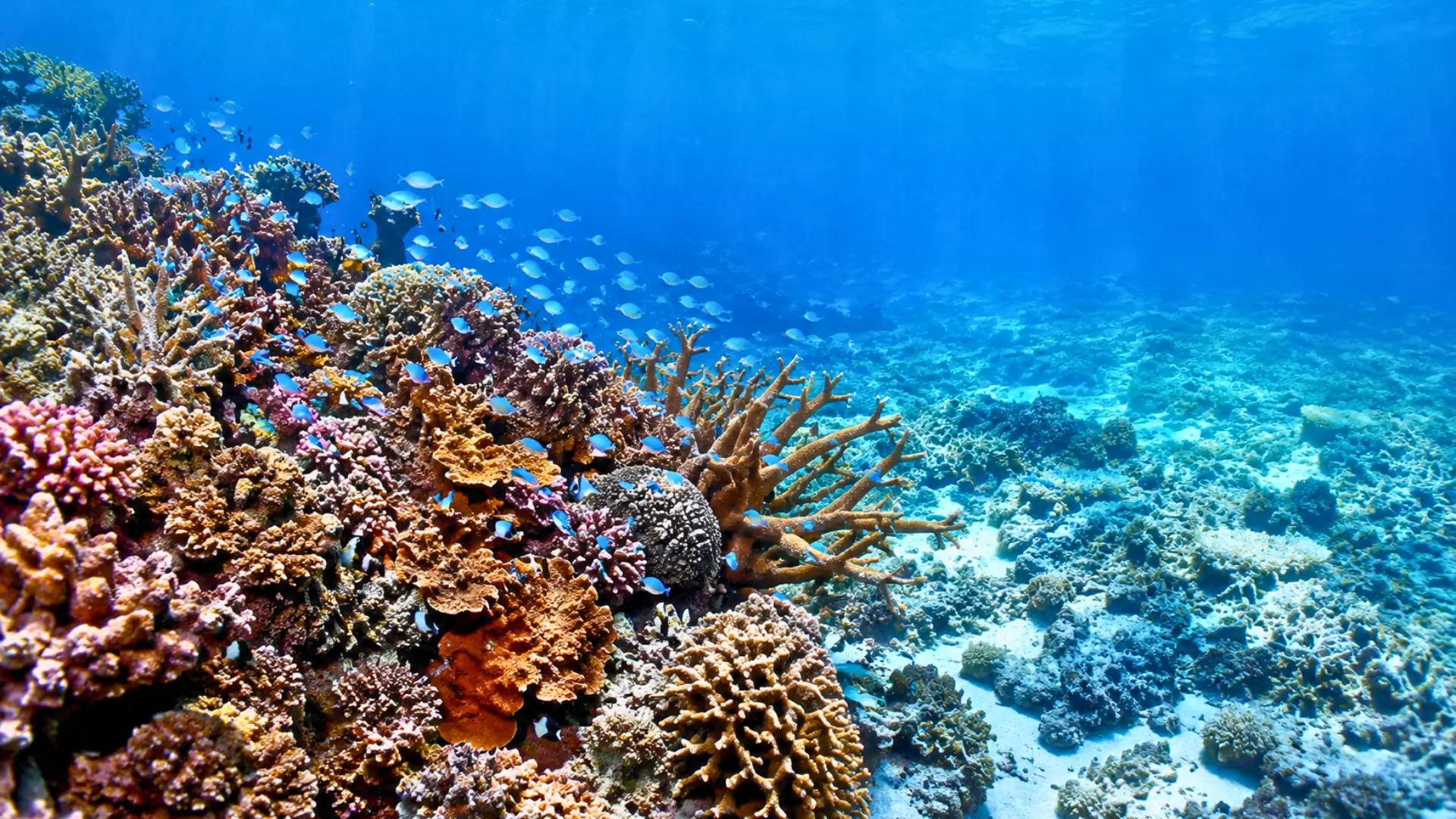
Under the sea, a healthy coral reef emits a din akin to a tropical forest. But when that sonic backdrop vanishes, young fish lose their bearings. Could this unexpected silence prevent the most fragile corals from regrowing?
Under the Surface, the Reef Reveals a Soundtrack Worthy of a Tropical Forest
At first glance, the reef appears silent. Yet just by dropping an hydrophone into its depths, one uncovers a universe of frenetic crackling, growls, and vibrations. The primary percussionists are pistol shrimp, whose claw shoots a microscopic bubble that collapses violently, producing a crackling sound reminiscent of a hot frying pan.
Fish round out this score with sounds that can be surprising. Some rumble to defend their territory, others produce pulses during reproduction. This acoustic signature varies according to the species present, the time of day, and the condition of the environment. A study published in the journal Science in 2021 even showed that these soundscapes can serve as reliable indicators of the reef’s overall health.
For Young Fish, This Clamor Becomes a Compass in the Blue Expanse
The birth of a reef fish initially resembles exile. After hatching, its larva drifts offshore, carried for several days by currents. When it becomes capable of swimming, it must find a micro-habitat within a vast ocean. A misstep in its trajectory can then become a matter of survival.
Light provides little guidance at night and odor molecules diffuse away. Sound, however, travels efficiently underwater. Experiments have shown that fish larvae—and even coral larvae—can orient themselves toward the sounds produced by a reef, long before they can discern its features. Studies have confirmed that this acoustic orientation ability plays a crucial role in the survival of the early life stages.
This attraction capacity influences larval recruitment, the moment when newcomers select their future habitat. So the reef is not merely a shelter or a feeding ground. It also emits a form of long-distance message: life thrives here, hiding places exist, and other organisms have already survived.
The Silent Reefs’ Silence Triggers an Almost Invisible Vicious Circle
When a heatwave triggers mass bleaching, the change is not only visible. Fish depart from degraded areas, invertebrate communities shift, and the biological roar diminishes. As the reef loses its inhabitants, it becomes acoustically less attractive, like a city whose lights go out all at once.
The trap then closes. Less noise means fewer young fish drawn in, hence fewer herbivores capable of curbing the algae that compete with corals. The reef receives fewer reinforcements precisely when it needs them. Degradation thus creates the conditions for its own acceleration, a phenomenon observed in several marine ecosystems.
Underwater Speakers Now Try to Waken the Silent Reefs
In 2019, researchers set up speakers near degraded reefs along the Great Barrier Reef. The experiment, published in Nature Communications in 2019, involved broadcasting the sounds of healthy reefs for several weeks. The outcome was surprising: the sound-enhanced zones attracted twice as many fish, with markedly greater species richness.
This method, known as acoustic enrichment, obviously does not magically resurrect corals. It can, however, accompany transplantation, fishing reductions, or the installation of artificial structures. A study published in Royal Society Open Science also found an increase in coral larval settlement when exposed to restored soundscapes.
One essential limit remains: attracting animals to an already polluted or overheated habitat is not enough. The speakers can facilitate the return of life, but they do not cool the ocean. They highlight, above all, a dimension long neglected in ecological restoration: to rebuild a reef, will we also have to recompose its music?

Contact details
Address:
Farmers Forum,
36, Dominick Street,
Mullingar,
Co. Westmeath,
Ireland
Phone:
+353 (0)44 9310206
Or email us:
For technical issues please check out our FAQ's page or email - [email protected]
For general Queries email - [email protected]
Request to add event to our Calendar - [email protected]
Send us your mart reports - [email protected]
Suggestions and feedbacks - [email protected]
News Items / Press Release - [email protected]
To Advertise on Farmers Forum - [email protected]