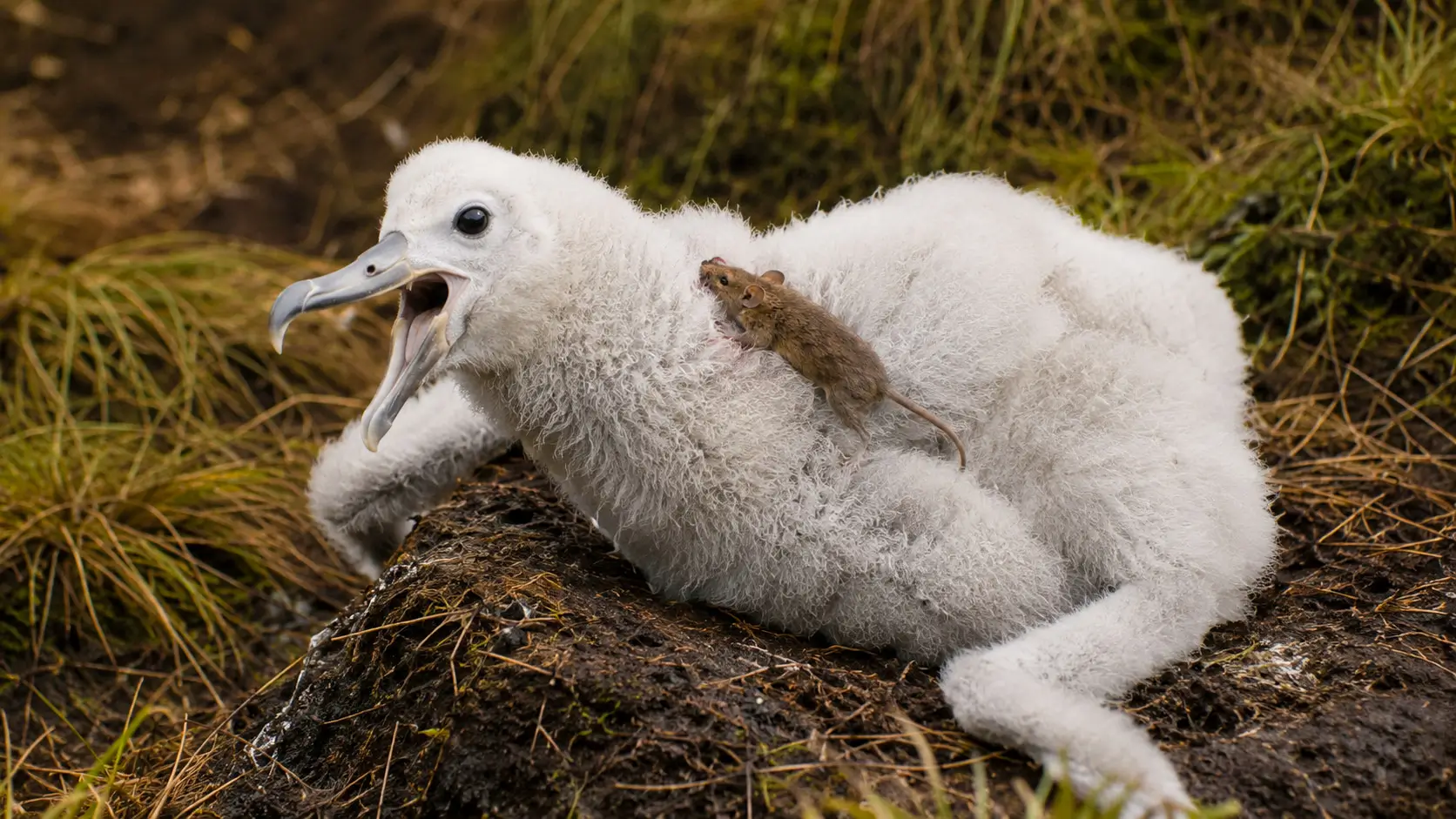
Isolated in the middle of the South Atlantic, the ecosystem of Gough Island is enduring the unforeseen devastation wrought by minuscule rodents. Introduced unintentionally, these creatures slaughter millions of albatross and petrel chicks, challenging even the most costly environmental eradication efforts.
How ordinary rodents rose to the peak of the food chain on an isolated island
In the 19th century, the holds of whaling ships inadvertently ferried European field mice to this treeless volcanic outpost. Devoid of natural enemies, these rodents quickly adapted to an environment inhabited by more than ten million seabirds that had never before encountered a mammal on land.
Their coexistence quickly turned into a nightmare for the local avifauna. Surveillance cameras capture chilling scenes where packs of rodents harass the night-time, motionless chicks. Unable to flee or defend themselves, the fledglings fall victim to the repeated assaults.
The aggression of these animals crosses a critical threshold when adult birds become targets. Researchers uncover dozens of breeding birds wounded or killed. The loss of these individuals threatens the demographic balance of the species across decades.
A sprawling, space-scale logistics operation deployed to cleanse a 91-square-kilometer territory
To halt the repeated slaughter, the British charity RSPB designs an unprecedented eradication project. Estimated at £9.2 million, the operation, initially planned for 2020, was delayed due to the global health crisis before finally getting underway in the austral summer of 2021.
Across this rugged, portless terrain, helicopters drop tonnes of cereal-based pellets impregnated with a potent rodenticide, brodifacoum. Meanwhile, scientific teams temporarily shelter certain ground-nesting bird species to ensure the area’s sanitary safety during the operation.
The invader’s unexpected return shatters the hopes of conservationists
The intervention initially appears to bear fruit in the early months. Silence settles over nesting sites and wildlife thrives under no apparent threat. Yet, by December 2021, a camera trap captures the passage of a living rodent silhouette, breaking the prevailing optimism.
In barely a few months, rodent numbers proliferate again across the terrain. Despite a method rigorously aligned with international best practices, a handful of stubborn individuals was enough to wipe out years of technical preparation and financial investments.
An independent inquiry is now examining the precise source of the failure. Experts analyze, among other factors, the distribution of pellets across the island’s rugged terrain, potential improper dosing of baits, or the presence of refuge zones inaccessible to helicopters during the aerial dispersals.
A temporary respite rich with lessons for protecting threatened island wildlife
Nonetheless, the attempt provides tangible evidence of the benefits of such regulation. During the lull, more than a thousand Tristan albatross take to the skies, while the MacGillivray’s prion’s breeding success jumps from 6 % to 82 %, confirming the initiative’s potential.
The urgency to prevent the disappearance of iconic species remains. Teams are currently reassessing their strategy for Gough. In parallel, the project on Marion Island is already adapting its protocols. The aim is to incorporate the lessons from this setback to finally eradicate the persistent threat.

Contact details
Address:
Farmers Forum,
36, Dominick Street,
Mullingar,
Co. Westmeath,
Ireland
Phone:
+353 (0)44 9310206
Or email us:
For technical issues please check out our FAQ's page or email - [email protected]
For general Queries email - [email protected]
Request to add event to our Calendar - [email protected]
Send us your mart reports - [email protected]
Suggestions and feedbacks - [email protected]
News Items / Press Release - [email protected]
To Advertise on Farmers Forum - [email protected]