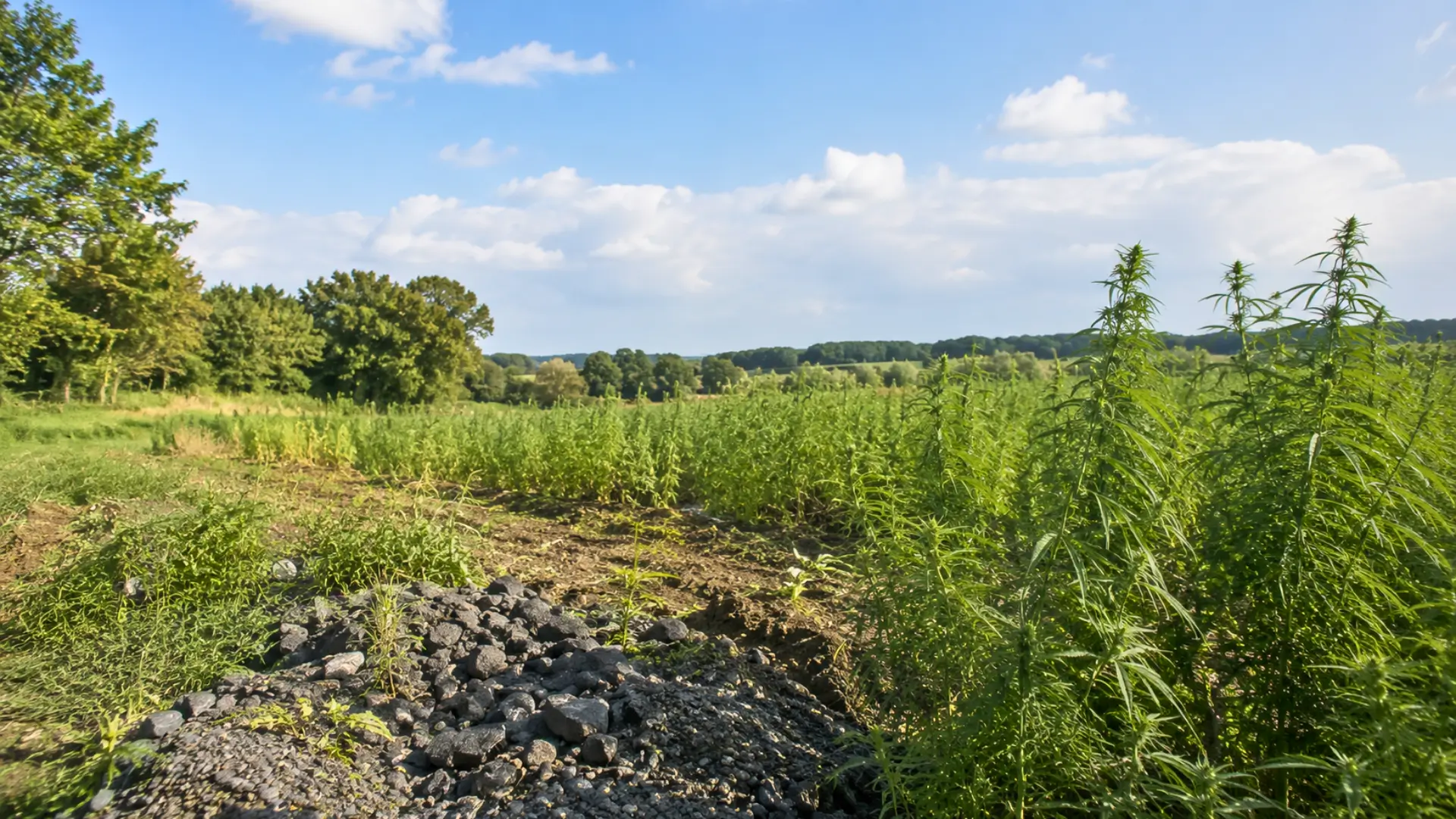
How to clean contaminated farmland without excavating or burning it? A Yale team offers a surprising answer: amend the soil with crushed rock, cultivate hemp there, then transform the harvest into biochar capable of trapping pollution.
Agricultural Biosolids Behind an Invisible PFAS Contamination
For decades, wastewater treatment plants supplied sludges used as agricultural fertilizers. Rich in nutrients, these recycled biosolids attracted many farmers seeking alternatives to petrochemical fertilizers. But wastewater also carried PFAS from factories, cosmetics, food packaging, or nonstick coatings. Fields thus accumulated, year after year, an invisible pollutant load.
The trap hits particularly hard small farms and some organic producers. Many chose these fertilizers for their natural image, before the contamination was identified. According to Jake Thompson, a researcher at Yale University, nearly 1.2 million hectares of cultivated land could be severely affected just in the United States.
A Staggering Cleanup Cost That Made Soils Nearly Untreatable
PFAS owe their nickname of “eternal pollutants” to their remarkable chemical stability. Their structure rests on a carbon–fluorine bond among the strongest in organic chemistry. In soils, these molecules persist for long periods, migrate into groundwater, and sometimes enter crops.
Current methods resemble heavy, destructive operations. Companies excavate contaminated soils, transport them, or heat them to very high temperatures. These processes often destroy the fertile topsoil and generate large carbon emissions. Their cost, ranging between 800,000 and 1.6 million dollars per hectare, makes them nearly inaccessible to farmers.
On the scale of the affected surfaces in the United States, estimates reach 8 trillion dollars. This dizzying figure explains why so many plots remain unusable. The study published in July 2026 in the Proceedings of the National Academy of Sciences proposes, however, a radically different trajectory, slower but far less destructive.
An Innovative Strategy Based on Mobilizing PFAS and Then Capturing Them with Plants
The first step rests on an counterintuitive idea. The researchers spread a thin layer of crushed alkaline rock, such as basalt or limestone, to raise the soil pH toward 7. Under these conditions, some PFAS become more mobile and more accessible to roots, rather than remaining bound to soil particles.
Then, scientists mobilize the plants. They grow hemp and certain perennial grasses capable of gradually absorbing PFOS and PFOA, two compounds studied in detail. Once harvested, this contaminated biomass undergoes oxygen-free pyrolysis. This process degrades the captured substances while producing biochar.
Researchers then reintroduce this biochar into the fields. Its porous structure catches a portion of the remaining PFAS and limits their circulation. The system thus forms a loop: the rock releases the pollutants, the plants concentrate them, and the biochar immobilizes them. Teams still need to test this scenario on the ground and over long periods.
A Twenty-Year Process That Gradually Transforms Contaminated Soils
The approach does not promise an immediate solution. Researchers estimate that the cycle must be repeated each year for nearly twenty years. The annual cost runs to about $1,460 per hectare, including crop losses. In the end, the total bill comes to just over $29,000, about 55 times less than the costliest conventional treatments.
This slow approach could also yield an unexpected climate benefit. Weathering of rocks and carbon storage in biochar could remove up to 10.5 million tonnes of CO2 per year, according to Yale’s models, if the method is scaled up across the United States. The depollution process no longer destroys soil; it helps it regenerate.
The concept remains theoretical and must pass field testing. Pyrolysis must in particular guarantee the complete destruction of PFAS without dangerous byproducts. But one question already arises: what if soil cleanup no longer relies on force, but on a slow alliance between rock, plants, and time?

Contact details
Address:
Farmers Forum,
36, Dominick Street,
Mullingar,
Co. Westmeath,
Ireland
Phone:
+353 (0)44 9310206
Or email us:
For technical issues please check out our FAQ's page or email - [email protected]
For general Queries email - [email protected]
Request to add event to our Calendar - [email protected]
Send us your mart reports - [email protected]
Suggestions and feedbacks - [email protected]
News Items / Press Release - [email protected]
To Advertise on Farmers Forum - [email protected]