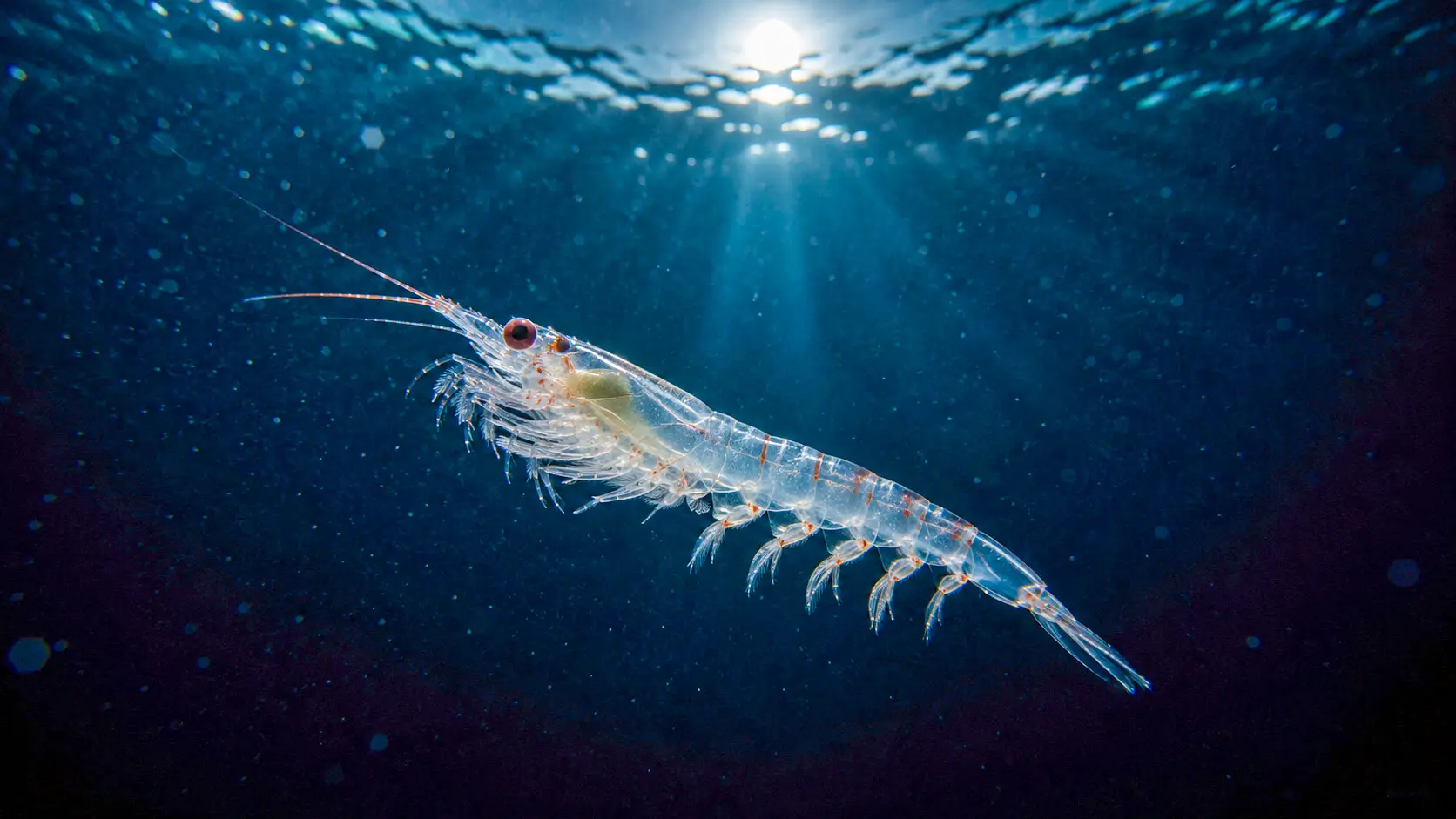
Each night, billions of tiny marine organisms rise toward the surface, only to plunge again at dawn. This quiet movement, the largest migration in the animal kingdom, also transports carbon to the depths and influences the planet’s climate balance.
The world’s largest animal migration unfolds every night, invisible to the naked eye, beneath the surface of the oceans
Below the ocean’s surface, a colossal movement repeats each night. Billions of microscopic organisms depart the depths to reach the sunlit waters, only to descend again before sunrise. In terms of the number of individuals involved, this vertical migration surpasses any other known animal movement on Earth.
By day, these creatures stay hidden hundreds of meters below, out of reach of predators that hunt by sight. When night falls, they rise to feed on phytoplankton, the microalgae that thrive on surface sunlight.
This daily ebb and flow follows an unchanging rhythm that has persisted for millions of years. It acts as a global oceanic breath, a cadence scientists are only now beginning to quantify with precision.
How this nocturnal ballet helps the oceans trap carbon away from the atmosphere, for the long term
This mechanism has a name: the biological carbon pump. While feeding near the surface, zooplankton absorb the carbon contained in phytoplankton, which itself is formed from carbon dioxide dissolved in seawater. By sinking again, these organisms carry that carbon to the depths.
Once in the abyss, this carbon is released through respiration, waste, or the death of the organisms. It then remains trapped far from the atmosphere, sometimes for centuries, rather than returning to the air and exacerbating warming.
Scientists finally manage to quantify a phenomenon that had long resisted precise measurement
For a long time, this process was hard to quantify with accuracy. Researchers knew it existed and suspected its importance, but its true scale remained unclear due to a lack of tools capable of observing it over expansive ocean areas, both day and night.
Advances in observation and modeling techniques are changing the game. They now allow estimating the amount of carbon exported to the deep ocean thanks to this nocturnal migration, with a precision that was previously out of reach for scientists.
This active transport, driven by the motion of the organisms themselves, adds to the simple sinking of dead particles to the bottom. Zooplankton thus do not merely accompany the storage of carbon: they constitute an essential pillar of it.
Warming oceans threaten this fragile and still little-understood climate mechanism
Zooplankton remains sensitive to changes in its environment. The warming of waters, ocean acidification, or shifts in ocean currents could disrupt this established rhythm, with direct consequences for the climate.
A decline in these populations would weaken the biological carbon pump and reduce the oceans’ capacity to absorb this gas. The smallest links in the living chain thus prove to be among the most decisive for climate balance.

Contact details
Address:
Farmers Forum,
36, Dominick Street,
Mullingar,
Co. Westmeath,
Ireland
Phone:
+353 (0)44 9310206
Or email us:
For technical issues please check out our FAQ's page or email - [email protected]
For general Queries email - [email protected]
Request to add event to our Calendar - [email protected]
Send us your mart reports - [email protected]
Suggestions and feedbacks - [email protected]
News Items / Press Release - [email protected]
To Advertise on Farmers Forum - [email protected]