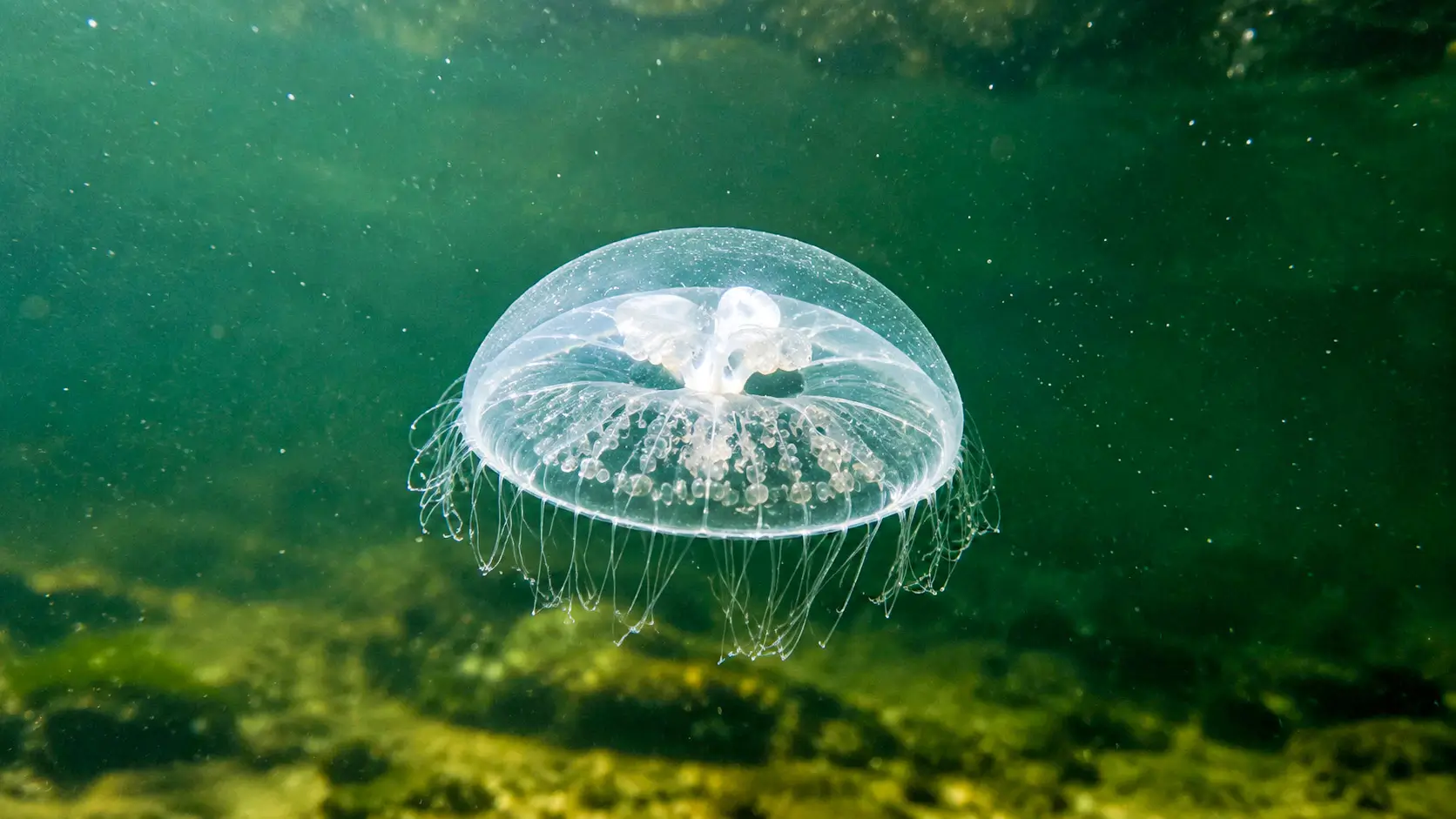
This summer, swimmers at Lake Orient in the Aube department encountered dozens of small translucent umbrella-shaped creatures. These are not mere debris: they are jellyfish, a discreet freshwater species that has been established in France for more than a century.
In Lusigny-sur-Barse, around a hundred jellyfish surprise swimmers without posing the slightest risk
On Monday, July 18, swimmers were training near the Lusigny-sur-Barse beach on Lake Orient, in the Aube. They encountered a dense swarm of small translucent shapes. One of the swimmers counted about a hundred, drifting between two currents, with no apparent aggression.
No cause for panic: these animals, named Craspedacusta sowerbii, pose no real danger to humans. Their venom, designed to capture microscopic plankton, almost never penetrates human skin. The encounter remains, above all, unexpected for most bathers.
It isn’t a first in the area. A nature guide from the Aube had already spotted these jellyfish in 2021, not far from Mesnil-Saint-Père. He explains that they develop mainly when the lake water heats up strongly, a near-seasonal rendezvous rather than an isolated accident.
Craspedacusta sowerbii, the sole freshwater jellyfish in Europe, established in France for more than a century
Craspedacusta sowerbii remains the only known freshwater jellyfish species in Europe. William Sowerby described it in 1880, in the ponds of the Royal Botanic Garden in London. It reached France in 1891, spotted by Chiffot in the Parc de la Tête d’Or, in Lyon.
Since the early 20th century, reports have multiplied: Lake Annecy, Lake Geneva, quarries in Nouvelle-Aquitaine, ponds in Mayenne. The species colonizes clear freshwater waters, calm rivers, lakes, and ponds, but also quarries and gravel pits converted into artificial water bodies.
A jellyfish the size of a coin, revealed by a discreet life cycle
Its size remains modest: the jellyfish form is hemispherical, with a maximum diameter of 25 millimeters. Numerous tentacles line the umbrella, and the whitish, almost translucent body reveals the gonads. A ghostly appearance that explains the confusion of those first moments.
The visible jellyfish is only the culmination of a discreet cycle. It buds from polyps anchored to the lake bed, which wake up as soon as the water reaches 25°C, from July to October, with a peak in late August to early September. These polyps can linger for years without producing any visible jellyfish.
Zooplankton, nematocysts and a rare sting case: what science says
Craspedacusta sowerbii feeds on microscopic zooplankton: rotifers of the genus Asplanchna, daphnids of the genus Ceriodaphnia. It thus hunts prey invisible to the naked eye, far from the predator profile often ascribed to marine jellyfish.
The question that haunts bathers remains: does it sting or not? Like all jellyfish, it possesses nematocysts with stinging capabilities in its tentacles, designed to harpoon its prey. In the vast majority of cases, this venom is too weak to penetrate human skin.
Yet there is an exception: researchers have documented the first French case of envenomation by this species, proof that prolonged contact can, very rarely, trigger a mild skin reaction. The best reflex, therefore, is to observe these translucent umbrella shapes without ever handling them.

Contact details
Address:
Farmers Forum,
36, Dominick Street,
Mullingar,
Co. Westmeath,
Ireland
Phone:
+353 (0)44 9310206
Or email us:
For technical issues please check out our FAQ's page or email - [email protected]
For general Queries email - [email protected]
Request to add event to our Calendar - [email protected]
Send us your mart reports - [email protected]
Suggestions and feedbacks - [email protected]
News Items / Press Release - [email protected]
To Advertise on Farmers Forum - [email protected]