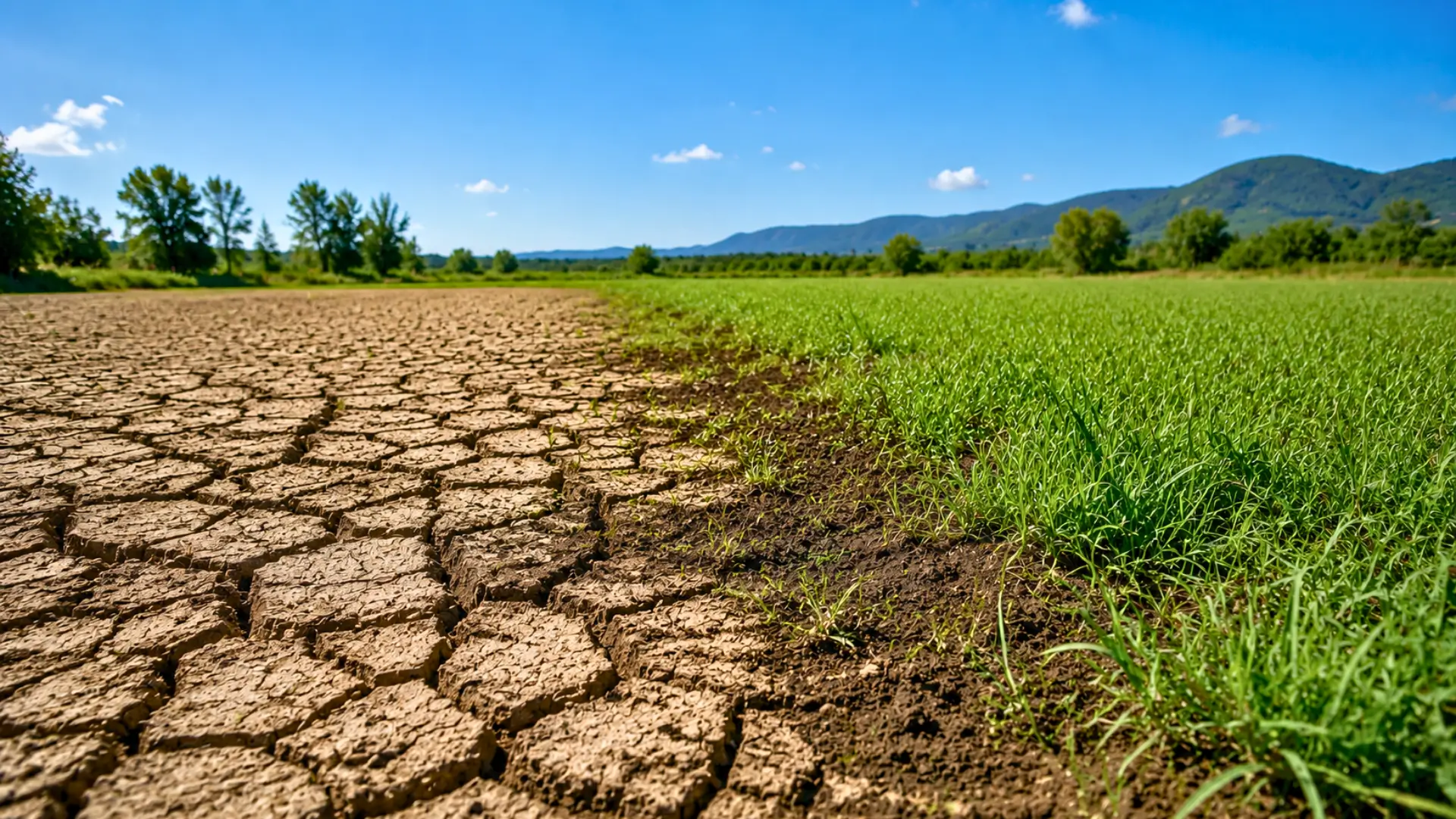
Why do two regions under the same sun not always reach the same temperatures? Part of the answer lies in the soil. When soil loses its water, its role as a natural air conditioner disappears, opening the door to significantly more violent heat spikes.
The key role of soil moisture in the natural regulation of temperature
A moist soil resembles a quiet air conditioning. Under the sun, the water it contains evaporates and carries away part of the energy received. This energy thus does not heat the air directly. The phenomenon may seem invisible, but it can make a real difference during the hottest afternoons.
Everything changes when the water reserves run dry. Without evaporation, solar energy is converted into sensible heat, the kind that immediately raises the air temperature. The surface becomes a giant radiator. Under comparable weather conditions, a dry terrain can heat up much more than a meadow still moist.
However, this switch is not perfectly gradual. Researchers at the University of Reading identified three regimes: very wet soils, intermediate soils, and extremely dry soils. It is in the intermediate zone that a small loss of moisture can trigger the most pronounced thermal response.
The measurable impact of soil drying on extreme heat peaks
A study, published in 2026 in the scientific journal Climate Dynamics, on New Zealand, concretely measured this influence. In regions where soil–atmosphere interactions are strongest, a moisture deficit can amplify extremes by 3 to 5 °C compared with moist soils.
The result is staggering. Two territories under a similar air mass can experience very different days depending on the state of the land. One releases part of the energy through evapotranspiration. The other returns almost all of it to the atmosphere, creating a local overheating that broad weather forecasts may underestimate.
The vicious circle between soil dryness and intensification of heatwaves
The danger mainly lies in the self-reinforcing loop that takes hold. A drier land warms the air, and this hot air accelerates the evaporation of the remaining water. Plants gradually close their stomata to survive and transpire less. The landscape then loses its primary cooling mechanism, exactly when it would be most needed.
This feedback can begin several weeks before the heat wave. A spring moisture anomaly is sometimes enough to prepare the ground for summer. The IPCC also regards the interactions between soil moisture and temperature as an important factor in the intensity of past and present hot spells.
The phenomenon affects not only the air. In Central Europe, soil temperature extremes have risen faster than those measured in the atmosphere, with an intensity increase of 0.7 °C per decade. This underground heat threatens roots, soil organisms, and the natural carbon cycles.
Soil-based solutions to limit overheating and safeguard the climate
Since the soil participates in the degree of heat, its condition becomes a lever for adaptation. Restoring wetlands, maintaining vegetative cover, or enriching soils with organic matter helps retain more water. The IPCC notes that certain agricultural practices and well-planned irrigation can mitigate hot extremes through evapotranspiration.
In cities, the same logic favors permeable soils, trees, and vegetated spaces rather than bare mineral surfaces. These solutions will never replace reducing greenhouse gas emissions. They nonetheless remind us of a striking truth: faced with upcoming heatwaves, part of our climate protection may lie in a few centimeters of living soil.

Contact details
Address:
Farmers Forum,
36, Dominick Street,
Mullingar,
Co. Westmeath,
Ireland
Phone:
+353 (0)44 9310206
Or email us:
For technical issues please check out our FAQ's page or email - [email protected]
For general Queries email - [email protected]
Request to add event to our Calendar - [email protected]
Send us your mart reports - [email protected]
Suggestions and feedbacks - [email protected]
News Items / Press Release - [email protected]
To Advertise on Farmers Forum - [email protected]