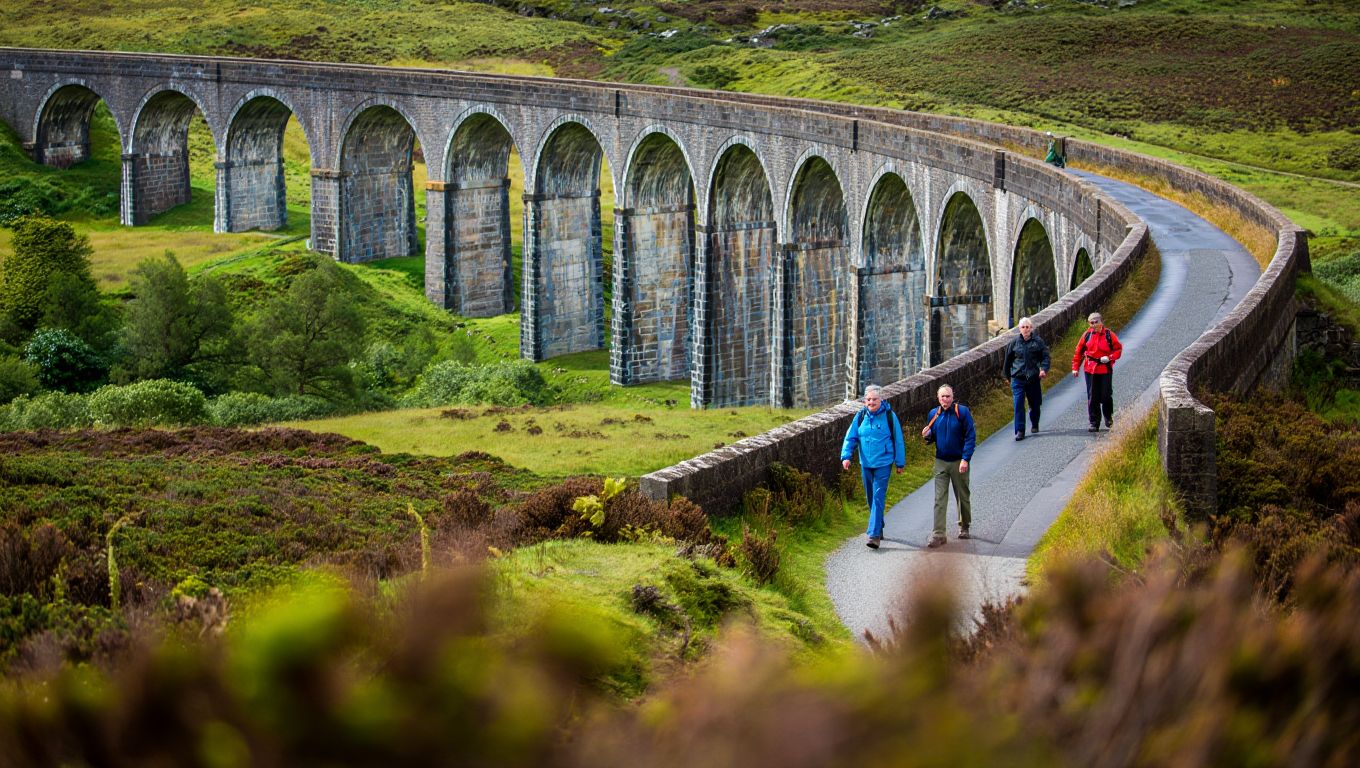
The sea air is bright with salt and story, and a sweep of masonry strides across the valley as if time had stopped to admire it. Walkers step onto its broad spine, pausing to look toward Roaringwater Bay, then down to the stream that once echoed with steam. They go quiet, then smile, because this is one of those rare places where craft, patience, and landscape clasp hands.
A bridge shaped by patience
It began as an act of faith, an answer to distance and weather on a hard western fringe of Ireland. The builders worked with granite knuckles and a surveyor’s calm, setting out curve and camber through winters that chafed. Ten years is a long spell of weathering, and stone remembers every struck chisel.
By the final keystone, twelve arches stood like a procession, their undersides catching light and lark song. “You can see the geometry if you stand still,” a local walker says, pointing to the tidy rhythm of spans that read like a poem.
From rail to ramble
Once, a light train threaded this corridor, a clatter of wheels meeting purpose as fish, milk, and mail moved with gentle insistence. The line is gone, but its appetite for connection is not, and the viaduct waits with a patience that feels almost human.
The rails gave way to grass, then to careful paths and parapets, and now the place has the democratic hush of a public room. “It’s the same route, only slower,” says a volunteer with a bright laugh, “and somehow you see more.”
How stone learned to breathe again
Restoration here was not a sprint but a conversation, one careful season speaking to the next with respect. Engineers tested mortar, teased out cracks, and let water go where water wanted to go. Lime breathed; hard cement did not; so methods followed what the stone would accept.
Each arch is a lesson in load, a quiet algebra of thrust and resistance. The crew worked between tides of tourism and weather, lifting, stitching, and stepping back until the bones felt right. “Our job was to interfere as little as possible,” a mason remarked, “and protect as much as we could.”
Walking the line today
Step onto the deck and the first sensation is height, not dramatic, but enough to lift you into a different scale. Low walls frame a broad, secure path, and gulls use the updraft like a lazy elevator. On a clear morning the bay is a patchwork of sparkle and shadow, and the past feels pleasantly close.
Underfoot, the surface is firm, kinder to boots and buggies than the old ballast ever was. There are pauses built into the route, tiny bays of stone where you can lean your elbows and look. Voices carry in a fond, local way, and even the wind seems to whisper rather than shout.
What to notice, and when to go
- Early or late light makes the arches glow, while midday gives crisp views to the islands.
The human thread
Structures like this are repositories of work, the kind that hides its hours inside a perfect radius or a cleaned joint. “You can’t rush a bridge,” says a guide with a clip-on badge, and the phrase lands with the weight of common sense. The team that renewed it stood on many shoulders, from Victorian draughtsmen to grizzled gangers and the nameless hands that quarried each block.
Local children run, then slow, then read the neat panel at the entrance and practice the word “viaduct” like a charm. A pair of hikers trade stories about storms and skylarks and the mildly heroic art of finding dry socks in West Cork.
A living landmark
The village has learned a new rhythm around the old span, with coffee steam meeting sea spray and rucksacks brushing painted doors. The viaduct funnels people out and then back, dispersing them kindly along lanes that smell of gorse and diesel and warm scones. Its presence feels anchored, not showy—big enough to command the eye, humble enough to soften into the ridge behind it.
In an age of speed, this is infrastructure for the pulse, not the pedal-to-metal agenda. It asks for a slower gait, offers a better view, and returns you to the street with a slightly altered heart. “I come up here to remember I’m small,” someone murmurs at the parapet, and the remark hangs, then settles like a bird.
Looking outward, looking on
From railhead to right-of-way, the viaduct has shifted its purpose without losing its character. It still carries what the district most needs: connection, perspective, and an honest, walkable line between past endeavor and present pleasure. The twelve arches are still counted, the decade of building still felt, and the summer footfall sounds like a welcome answer to both.
Stand a moment longer and let the wind do the talking. The curve of the valley, the heft of the piers, the flicker of boats beyond the furze—these are the quiet reasons places endure. Walk on, and let the old craft carry your steps the rest of the way.

Fabulous article,words weaved together with outstanding description ,well done!
Other than the article being factually incorrect on several levels and the photograph being a completely different bridge to the one the article is about, I don’t see anything wrong with it.
Beautifully written as always Liam. I really enjoy your articles. Poetic and descriptive you transport us to the scenes you observe unerringly.
This mighty village in my time has even tamed a few people from the now humble village of schull that community instead of status is what this place is about! The bridge is a good symbol of what strength in this village is about.
The Bridge is a beautiful piece of Poetry and the article is written with that in mind.
Well done to all concerned.
Well done mr Kennedy
Bad journalism.
WRONG PHOTO!
A photo of the bridge at Ballydehob would be a good accomanpiment to the article.
Don t remember it being closed at all in recent times ???
Great facility for many years.
Well done to people of Ballydehob