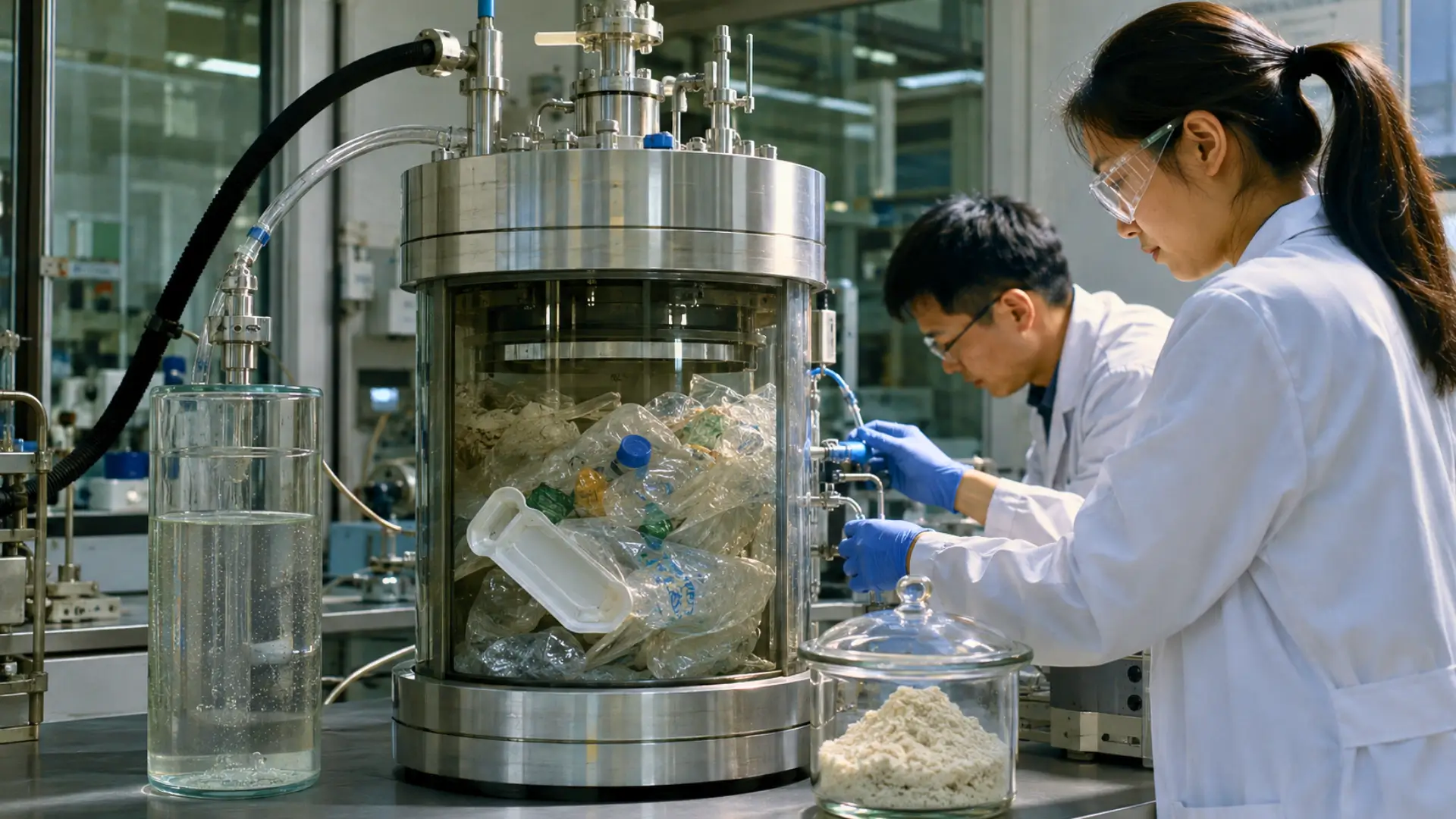
What if bottles, bags, and trays mixed at the bottom of a bin could become a source of energy? Researchers have managed to convert three very common plastics into hydrogen in a single reactor, while trapping carbon in a solid form.
Inefficient Global Recycling in the Face of Growing Plastic Waste
The yellow bin may sometimes give a reassuring impression. Indeed, one might think the problem is almost solved. Yet the reality is far less bright. For example, a study published in Science Advances estimates that only 9% of plastic waste produced up to 2015 was recycled. The rest ended up incinerated, landfilled, or abandoned in nature.
Moreover, recent OECD data confirm this worrying trend. In 2019, only 9% of plastic waste was recycled. Consequently, sorting remains a major hurdle. In fact, mixed, contaminated, or multi-layer polymers greatly complicate their industrial valorization and slow processing chains.
An Innovative Process Capable of Treating Several Plastics Without Pre-Sorting
In this context, a US-South Korean team claims to have broken through this barrier. Their process, described in the Proceedings of the National Academy of Sciences, treats PET, polyethylene, and polypropylene together. Thus, these materials dominate our bottles and packaging. Importantly, no sorting by plastic family is required before the reaction.
Next, the researchers named their method the alkaline thermal treatment, or ATT. In the reactor, they heat the plastics with sodium hydroxide. From there, the matter decomposes into several products. Among them, a gas contains more than 90% hydrogen, according to their results.
Furthermore, the carbon does not escape as carbon dioxide. On the contrary, the process traps it in solid compounds, notably sodium carbonate. Admittedly, this does not guarantee full carbon neutrality. However, carbon capture occurs directly during the reaction.
Chemical Challenges Linked to the Resistance of Polyethylene and Polypropylene
On the one hand, PET reacts quite readily. Indeed, its structure contains bonds that are sensitive to chemical treatments. By contrast, PE and PP are more resistant. Their long chains of carbon and hydrogen offer few points of attachment. Thus, in alkaline conditions, these very stable polymers react only slowly.
To overcome this problem, the scientists added a key step. They expose the plastics to moderate thermal oxidation. In this way, this treatment creates oxygen-containing groups on the molecular chains. These new reactive sites then facilitate the action of sodium hydroxide on PE and PP.
Finally, the process operates at a temperature much lower than some classical techniques. Consequently, it reduces energy demands. However, its efficiency will depend on pretreatment, product recovery, and large-scale management of reagents.
A Promising Technology Facing Industrial-Scale Deployment Challenges
Nevertheless, engineers will face several challenges. Real waste contains dyes, adhesives, and food residues. In addition, it also includes plastics not covered by the study. It will therefore be necessary to assess the cost of sodium hydroxide, the lifespan of equipment, and the value of the solid residues obtained.
Moreover, this technology does not replace efforts to reduce waste. It does not absolve from improving mechanical recycling. Nevertheless, it could offer a solution for blends that are difficult to process. Thus, the United Nations Environment Programme notes that plastic waste could triple by 2060 without strong action.
Finally, one prospect already sparks curiosity. The least valorized waste could feed industrial processes or fuel cells. Admittedly, the bin would not become clean overnight. But it could stop being a dead end. Transforming waste into hydrogen—will it change our relationship with plastic?

Contact details
Address:
Farmers Forum,
36, Dominick Street,
Mullingar,
Co. Westmeath,
Ireland
Phone:
+353 (0)44 9310206
Or email us:
For technical issues please check out our FAQ's page or email - [email protected]
For general Queries email - [email protected]
Request to add event to our Calendar - [email protected]
Send us your mart reports - [email protected]
Suggestions and feedbacks - [email protected]
News Items / Press Release - [email protected]
To Advertise on Farmers Forum - [email protected]