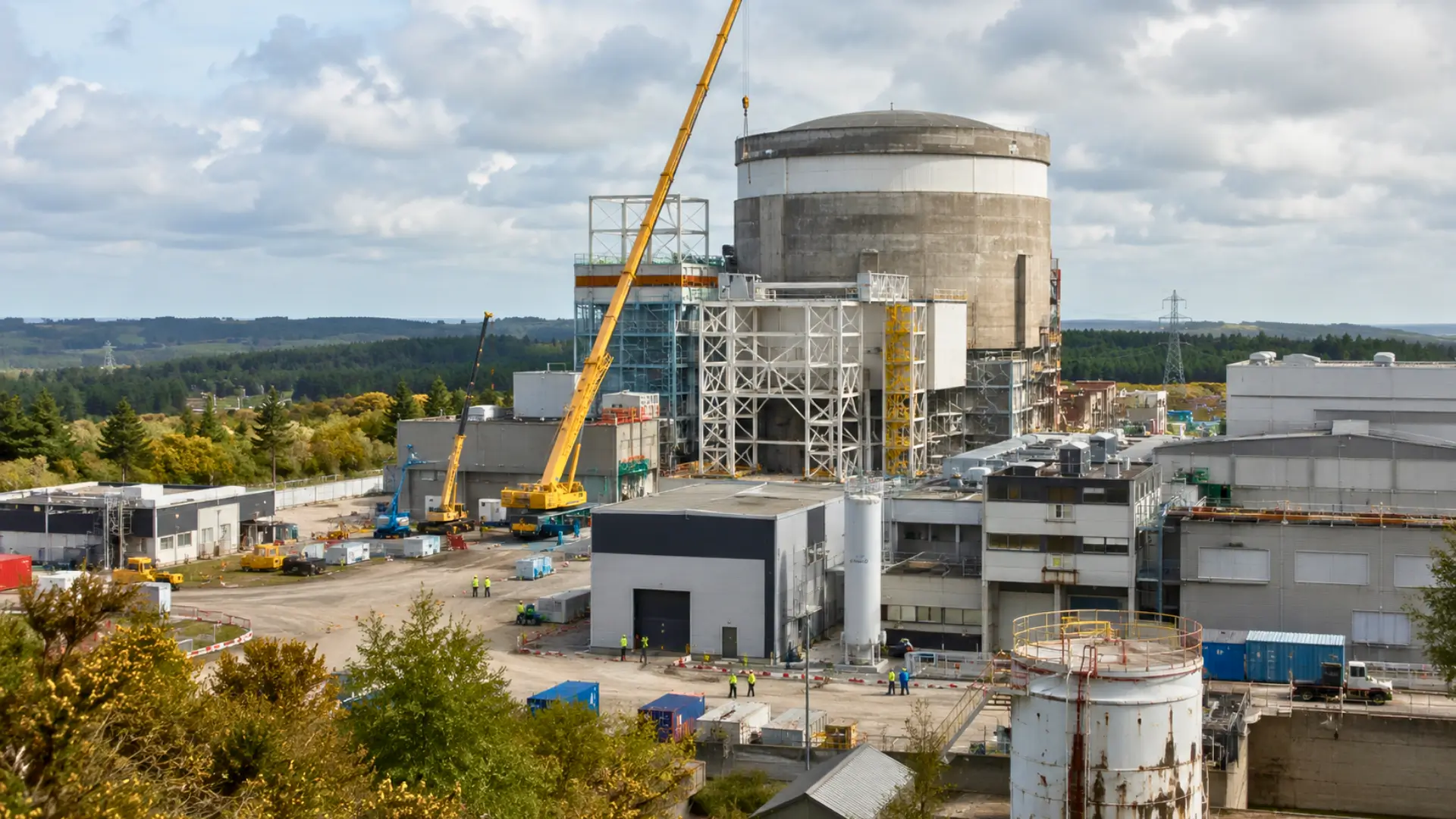
Eighteen years in operation, fifty-five years to erase its traces. In the Monts d’Arrée, the dismantling of Brennilis tells a vertiginous story, built on experimentation, procedures, and escalating costs. How did a small reactor become a half-century-long dismantling project?
Brennilis, a unique nuclear prototype conceived as an experimental industrial laboratory
Among the peat bogs of Finistère, the silhouette of Brennilis seems almost incongruous. Its EL4 reactor began service in 1967 with an ambitious mission: to test a French technology based on heavy water and carbon dioxide. With only 70 megawatts electric, the installation presents itself more like a full-scale laboratory than a modern power plant.
The experiment, however, was short-lived. In the 1970s, France chose pressurized water reactors, easier to standardize. Brennilis then became a prototype with no descendants. In 1985, after eighteen years of industrial existence, the site was definitively shut down, leaving behind a unique machine that no one yet knows how to dismantle piece by piece.
A dismantling slowed by technical, legal constraints and budget overruns
On paper, Brennilis was meant to showcase French know-how. The teams removed the fuel, razed several buildings, and dismantled the large heat exchangers. But when they approached the reactor block, the area where residual radioactivity concentrates, the plan grew brutally complicated. Each operation demanded specialized equipment and unprecedented precautions.
Obstacles were not purely technical. In 2007, the Conseil d’État canceled the initial decree authorizing full dismantling, notably due to insufficient public information. The project then endured several long interruptions. During those periods, the teams had to maintain site surveillance, ensure the upkeep of installations, and manage specialized crews.
The bill tracked the schedule. The Cour des comptes had already pegged the operation at €482 million in the mid-2000s. It then climbed to around €850 million. EDF’s 2025 accounts still mention potential €90 million in overruns linked to the reactor block, evidence that the total remains unstable.
Robotic technologies to operate at the heart of the most radioactive zones
The full dismantling decree obtained in September 2023 now allows tackling the most delicate portion. Shielded workshops will house teleoperated tools capable of cutting activated structures without directly exposing workers to the hottest irradiated zones. Here, movements borrow as much from robotics as from surgery.
This slowness does not imply that the entire site carries the same level of danger. A large portion of radioactive materials has already left the premises. The difficulty focuses on certain components that have endured years of neutron bombardment. According to the Nuclear Safety Authority, dismantling also entails cleaning the structures, sorting waste, and controlling the soils.
An emblematic project that redefines the notion of end-of-life for nuclear plants
EDF plans to demolish the reactor containment and then rehabilitate the surrounding terrain around 2040. Between the shutdown in 1985 and this anticipated return to a cleaned site, fifty-five years will have elapsed. The plant will thus require roughly three times longer to disappear than it took to operate and generate electricity.
However, the comparison is misleading. Brennilis was a standalone prototype, while France’s more recent reactors belong to standardized series. Engineers will be able to reuse certain methods, tools, and lessons learned. The ASN notes, however, that each installation has its own constraints and that 36 nuclear installations were already shut down or under dismantling by the end of 2023.
The Breton site acts as both a warning and a laboratory. Producing nuclear electricity is not limited to the years a turbine spins. One must account for the aftermath, the waste, the monitoring, and decades of work. Brennilis ultimately poses a simple question: at what moment does a plant truly cease to exist?

Contact details
Address:
Farmers Forum,
36, Dominick Street,
Mullingar,
Co. Westmeath,
Ireland
Phone:
+353 (0)44 9310206
Or email us:
For technical issues please check out our FAQ's page or email - [email protected]
For general Queries email - [email protected]
Request to add event to our Calendar - [email protected]
Send us your mart reports - [email protected]
Suggestions and feedbacks - [email protected]
News Items / Press Release - [email protected]
To Advertise on Farmers Forum - [email protected]