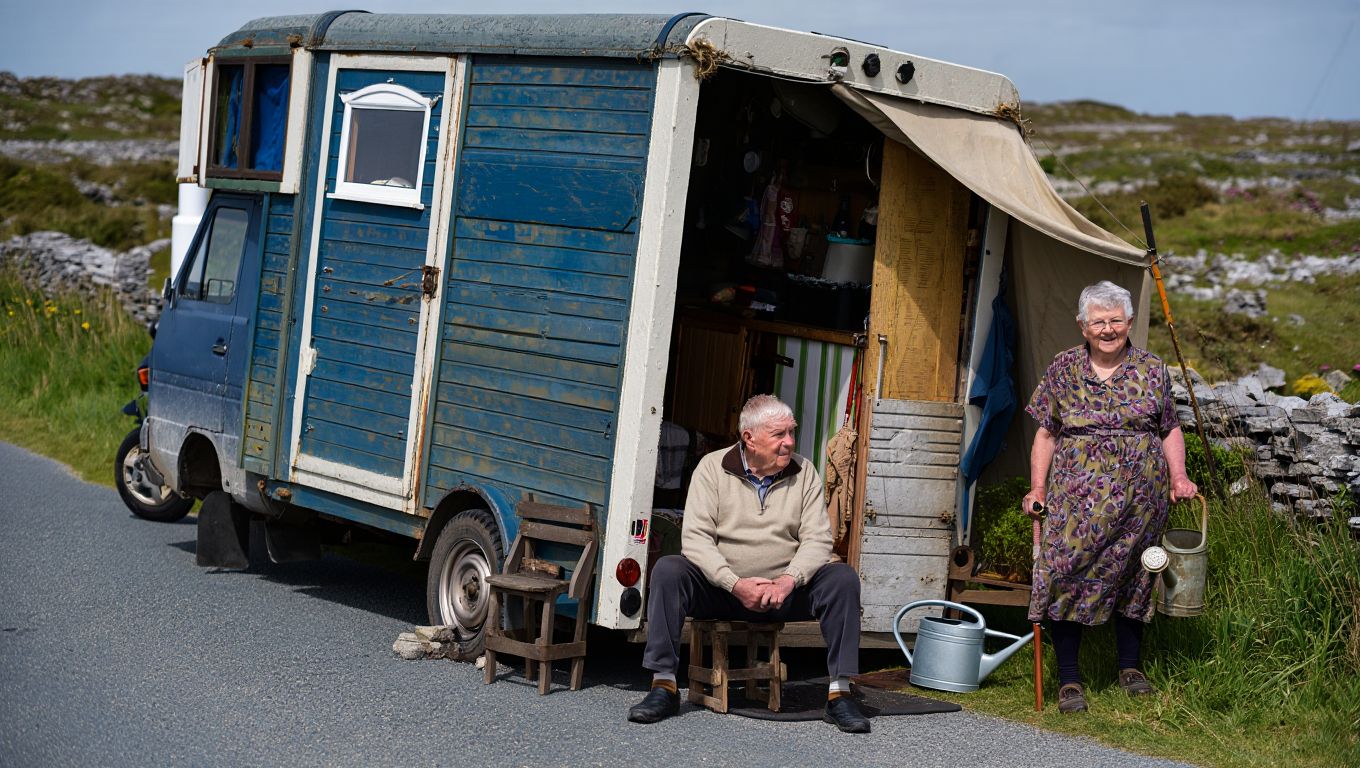
They arrived in late May with a map, a thermos, and a former horsebox painted the color of rain. By July, the limestone panels of the Burren felt like a library, each crevice a page they could read with slow, bare feet. The couple—Mary and Tom from Clonmel—weren’t chasing drama, only the quiet hum of side roads and the discipline of small days that look ordinary until you lean in.
A home hitched to a hedge
Their converted horsebox is neat as a tin clock. The bed folds into a bench, a tiny galley hangs its pans like bells, and a solar panel glints on the roof like a coin. They call it the Grey Mare, a nod to its past life and the steady pace it keeps when nudged along the smaller boreens.
“It’s a puzzle, living small,” Mary laughs, stacking two blue mugs that chip in exactly the same place. “But it’s a puzzle that fits—you learn what you need, and you carry only that.”
Back lanes as an address
They prefer the lanes that curl behind stiles, the ones the tourist maps ignore because the surface is rattled and the ivy ambitious. Evenings, they park by a field gate and listen to wind comb the hawthorn while cattle breathe in slow, comic chorus.
“We’ve had foxes for neighbors and once, a wet donkey,” Tom says, smoothing a battered road atlas. “And a chap on a bike who swore he’d seen us three times in one day because the lanes double back like a tangle of string.”
Why leave a settled house?
They were busy, even in retirement—busy with appointments, busy with the evening news, busy with the kind of busy that leaves a person hollow. One spring morning, they noticed the nectar on the blackthorn blossom and couldn’t smell it through the open window.
“So we changed the window,” Mary says, meaning they changed the view. “We wanted the sky to move, and for us to move with it.”
The Burren’s slow grammar
Here the stone writes in limestone, not ink. Gentians lift their blue like polite flags, and the grikes hide orchids that seem to invent a new definition of pink every week. Turloughs drain and fill, disappearing lakes that behave like seasons rather than things.
“We learned to look down more than ahead,” Tom says. “There’s a universe in one slab of rock if you give it time.”
People who find them
Even on forgotten roads, company arrives. A farmer swung his leg over a gate to argue about hurling and left them with six eggs warm as pockets. A German walker asked for water and stayed for tea, telling a story about a cliff and a misplaced ring.
“Most people say, ‘I wish I could,’” Mary notes. “We say, ‘You can,’ but not everyone wants to. There’s a humility to watching your kettle boil by sunlight.”
The art of carrying less
They pared their life into a glovebox-sized archive. In the horsebox is the barest kit—useful, stubborn, and well-loved. If an object can’t do at least two jobs, it earns a quick goodbye.
- A Kelly kettle; a tin opener with a corkscrew; a soft map; a sewing needle taped to a postcard from Kilrush; a whetstone the size of a toffee; two spoons that used to be four.
Domestic rituals in open air
Mornings, they angle the stove out the back door and fry mushrooms in a pan that belonged to Mary’s mother. The pan blackens like a moon, then gleams again with a rough wipe. Dishes are washed in rain caught from the horsebox roof, the suds drifting toward dock leaves like private weather.
“If it’s wet, we wait,” Tom shrugs. “If the wind is wild, we wait. You stop arguing with the day and join it like a choir.”
Road craft and risk
They’ve learned to read hedges, to spot the shy flicker of a lay-by before sunset. They never block a gateway and always knock on a door if they’re uncertain about stopping. Once, a gale frightened them enough to retreat behind a stone wall and fold inside the horsebox like cards.
“We made a rule,” Mary says. “No heroics. If it feels wrong, it is. We follow the crows to lower ground.”
Time as currency
Days lengthen not by hours but by attention. A spider stitches a web from mirror to mug, and they drink from the other cup. A bus rumbles through in the middle distance, ferrying someone else’s schedule. They wave without envy.
“Time tastes different now,” Tom admits. “Like bread when you wait for the butter to soften.”
What the summer changed
They have the habit of listening now, even when the world is clever and loud. They have the habit of apology to the field they borrow and the gate they touch. They have learned to measure wealth by the length of their shadow at six in the evening.
“We’re not trying to escape anything,” Mary insists. “We’re trying to enter it more fully.”
When the lanes begin to empty
Autumn pushes a small edge into the wind, and the evening light tilts earlier toward the sea. The Grey Mare will point itself toward Tipperary again, grudgingly, as swallows loosen their grip on the wires.
They plan to park the box by their modest town garden and keep the habit—boil water by sun, eat outside when possible, and save a corner of the week for the back road that threads past the old creamery.
“Home is a verb now,” Tom says, closing the atlas with a gentle pat. “Sometimes it’s a patch of gravel and a tune in the hedge. Sometimes it’s the smell of paint on an inside door. We’ll keep the wheels near the ground, wherever the ground is.”

A beautiful piece. Beautifully written.
It just makes me think it’s how we started off living no water electricity everything was natural eating from a pan being cooked on a fire no pollution if we grew out own hav chickens mayb there would bee less worry about bills houses going to bed when the sun goes down sounds v healthy for the body and mind I love this we all should bee doing as much of this as possible there should bee classes on it instead of always saying there’s a crisis we would have none just peace
So beautifully written I so can relate & enjoyed every word of their adventure 💖
So beautifully written I so can relate & enjoyed every word of their adventure 💖
Love your writing ….your unique similes…”eggs warm like a pocket” made me smile. I get more from your articles than reading entire books the writing is that nourishing. Siobhán
Neighbours spelled wrong. American spelling. This is Ireland. Is the story actually true
You desperately need a gray mare.
How petty can you be ?
An unusually harsh take imo, I’m dyslexic and stuff like this can slip by for any of us. I think (and obviously so do others) that this is a lovely piece. Perhaps more focus on the story and less on the structure would make more sense?
Really???????
God love you if that is all you got out of that beautifullywritten poetic piece.
In Ireland English is an imposed language. We can choose which spelling to use. That choice can give our writing color, and save us a little labor.
W
What a wonderful life you must lead, picking up on such detail. Well done Anne. Maybe you could give us a story. About spellings and the like.
Lovely story the simplicity of life learningto appreciate it n.knowing when your glass is more than half full
I really enjoyed reading this. We should all take stock and appreciate nature and the basic things in life a bit more.
Love it. You can’t beat country people. The heart and soul of this country.
This article is beautifully written. It transports the reader there, at the side of the road on a warm evening, smelling the warm smells of nature and hearing a choir of sounds, not man made, we’ll never be able to reproduce sounds so beautiful, thanks!
That’s beautiful writing. Loved the writing and the couple. Thank you.
It must be great to be able to live with yourself.
To do that you have to leave the selfishness behind you and forget about the people who think they are perfect, a hard job to do. Sure a man’s mind is his kingdom. 🧠
Wonderful story and happy days together.But how long will it last until some clown or nose assistant in politics will find or create a problem for lrish people like this happy couple in lreland where the lrish ordinary people are not allowed to be happy.
💯 true, they made laws that stopped the the Irish traveller from freedom of movement, telling them that they had to settle in houses, not every traveller wants to settle in houses, some do, but the ones who like to continue on travelling should’ve at least the choice to do so, that couple have it made godbless them.
Wow
Beautifully written Liam .. look forward to your colum every week. Brilliant story of how the simple things in life matter. A lesson to us all keep up your beautiful ramblings Liam .
A little gem of a story. And wonderfully written.
Thank you 🙏
Like the spiders Web from mirror to mug the writing of this article was pure poetic brilliance ..well done!
That’s just unbelievable this story and so nice like going back in time,great idea,very interesting couple,article that would make you smile,beautiful to read about this
again well written liam just wondering have you any novel’s etc published your articles are over to quick thank you
What a beautiful descriptive piece of writing makes me want to go find them and sit for a while for a cup of tea and a chat
Fantastic story and lots to learn. Live for the moment.
Lovely bit of poetry liam love the way you told this story .
Warmed my heart to hear how simple life can be if we would only take that leap of faith.
A beautiful read
What a lovely up lifting story.
A story to remind us all of the simple ways in life.. . And what we do ,and dont need.. written with respect Liam… well done…
Beautiful ly writing 👌
Reading this beautiful story makes smile
They gave you pearls and you strung a beautiful necklace. Beautiful work.
Oh .y god. What a beautiful life. I wish i had a horsebox and a companion.
Lovely young people take note
What a beautiful story told magically. Long may they enjoy their wonderful summers. Bridget
This is exceptionally written – you have a gift! The story in itself is beautiful, but your crafted words add emotional and movement and colour… I hope you never stop writing!
Masterful account of a mastery of a way of life unknown to many of us but admired by all of us. The richness of such a minimalist life living experience.
Amazing bit of poetry , and heartwarming story. Beautiful read thank you
Liam, your story and writing reminds me of the beautiful poem by Wendell Barry called ‘ The Peace of Wild Things’.
Mary and Tom, I admire you and wish you many more happy years travelling. You know the joy of living well.
Beautiful piece !
Another lovely piece, I’ve been offered up your columna few times and had to stop and comment for this one, you are an artist with your words. And what a great example those folks are of what is possible, I have a little van and take off occasionally for a little adventure, this inspires me to do more. Thank you
Thank you Liam for sharing Mary and Toms story. Beautifully written.
They have little and yet are more wealthy than the rich. Lovely article😊
Most nourishing story I’ve read in years. In my view, the best generation of people. Immediately this had me think of my grandparents. And if I could join them, count me in! Fantastic
This is a special piece liam,
A lovely read, reminding us of a slow Ireland.
This couple not only are they keeping their relationship a front, they are keeping things minimum, enjoying the sounds of nature and going with the flow it. A gentle reminder to us all.
Best friends no doubht and true love.
C.2m residential units owned by a tiny minority. Some landlords own 1,2 ,5,7,15, 100, up to the largest 4,000 rental units. No basic Housing Right ‘for all’ enacted in the constitution. Yet our Fourth ‘real’ Estate media churnalists can only find property owners holidaying in a converted van to write about!
I was on holiday once got corrected i the way I spoke, my reply was I speak hibernian English to a man who’s dictionary was written by a Scottish and an eccentric American so go figer🤣🤣🤣
Beautiful writing Liam .
The ‘best things in life are free and on our door step’
This a beautiful piece composed by a very talented journalist about two people who obviously respect and love each other very much❤️
Ireland 🇮🇪 is such a beautiful place and families should be encouraged more to live in the country where life is at a different pace.
I am green with envy. You are a very lucky couple to have in each other a shared view of life and the courage to do it. Keep enjoying it
I’m not one to comment often…that story made me smile and gave me goosebumps, great writer
What a lovely well written ,descriptive ,story of a happy couples adventure in the high ways and byways of the beautiful Burren. How you made me realise how we complicate our every day lives. I am rethinking my life going forward. A big thank you
I thoroughly enjoyed reading that beautifully poetic piece Liam. You’re gifted ,your writing reminds me of Niall Williamson’s style. As for the brave couple,I’m full of admiration for their courage and determination.
Iontach ar fad! Go raibh maith agat as an phíosa seo a scríobh. Bhain mé an-sult as. Nach maith iad! 👏
Very well written. Very interesting reading and simple comparisons
What a lovely story. I felt I was inside the horsebox sharing their life on the road. I would love to be so care free and was for the past few minutes. Thank you.