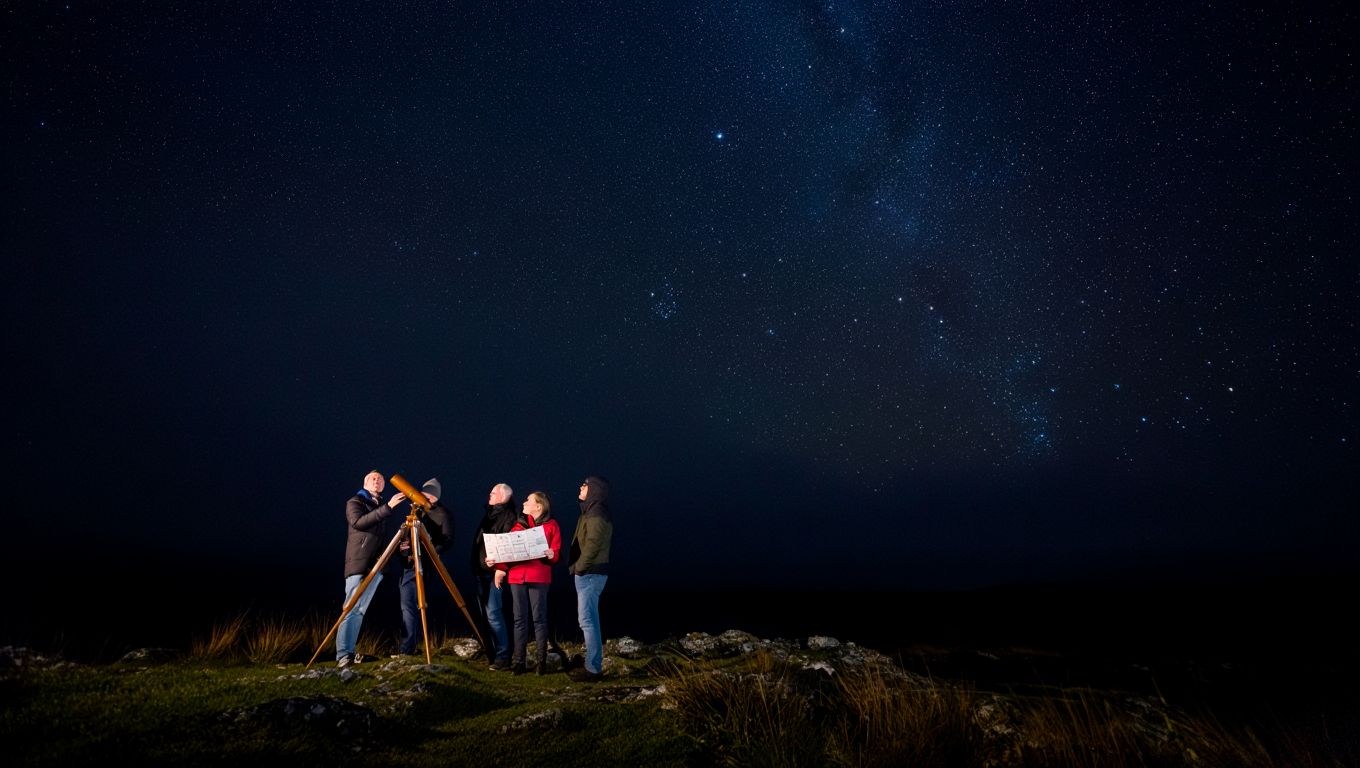
The far edge of County Kerry turns velvet after sunset, and the sea seems to hold its breath. On this wild finger of land, the lamps are few, the hedges are high, and the stars feel near enough to touch.
By midnight the Atlantic is a long murmur, the mountains are ink, and the roadway shines like a ribbon of graphite. Visitors arrive with red torches, flasks of tea, and a quiet that feels reverent, even to those who came only for a weekend break.
“Out here the sky is our theatre,” says a local guide, lifting a finger to the band of the Milky Way. “You don’t need a telescope, just time, darkness, and a bit of luck.”
A coast where night still feels ancient
Between ringed hills and blackwater bays, small communities face the Skelligs and the open ocean. They keep porch bulbs dim, shield farm lights, and let the lanes go shadowy after supper.
On clear nights the road past Ballinskelligs Beach looks cosmic, the sand a cool mirror for constellations. Valentia Island hums with wind and salt, and the bogs exhale an earthy, resin-dark scent.
It is a landscape that invites listening, the kind of dark that returns a person to their senses.
Why darkness thrives here
This peninsula sits inside a certified dark-sky reserve, one of the few in Europe recognized for exceptional night-time quality. The protections are simple but effective: shielded fixtures, warm-colored bulbs, and a culture that treats light as a tool, not wallpaper.
DarkSky International calls these zones rare, and the locals call them home. “We grew up with power cuts and long nights,” an older resident laughs. “Turns out that’s an asset, not a hardship.”
The mountains form a natural bulwark against distant glow, and the sea offers an edge where nothing artificial competes with the firmament.
A rush for rooms and telescopes
Come high summer the phones keep ringing, and small guesthouses in Waterville, Portmagee, and Cahersiveen are suddenly full of amateur astronomers and late-night dreamers. “We’re booked three weekends straight,” says one proprietor, showing a notebook thick with penciled names. “People ask about new moons, moonset times, even where to park without blocking a gate.”
Local cafes extend hours, serving quietly to flashlight-toting crowds, and rental cottages advertise blackout curtains and south-facing gardens. A tide of tripods rises after dusk, and by one in the morning the boreens are soft with careful, whispering footsteps.
Stargazers bring patience, but also business—a gentle, off-peak season that pays in camera straps and hot chocolate.
What the sky offers in midsummer
July nights are relatively short, but they have their own textured beauty. The Milky Way arches into view after the late twilight, threading Scorpius to Cygnus like a lantern-lit road.
You might catch noctilucent clouds—electric, high silver veils—floating above the northern horizon. Planets wander low and steady, and satellites drift like polite, clockwork guests.
Even when full darkness is brief, the quality is crystalline, with stars piled deep enough to make you feel weightless. On rare surf-still nights, the shoreline shivers with planktonic spark, and the sky seems to echo in the tide.
How to see it right
- Choose a moonless window or arrive after moonset for maximum contrast and a richer Milky Way band.
- Let your eyes adapt for 20–30 minutes; use a red-light torch to preserve night vision.
- Keep to lay-bys and signed viewpoints; avoid farm gates and respect private properties.
- Dress for damp Atlantic air; bring layers, a hat, and something windproof.
- Check a cloud forecast, but don’t give up too soon; gaps often open after midnight when breezes shift.
People who live by starlight
Guides talk about seasonal rhythms, and fishers compare constellations to old routes. “That bright one was our turning point,” says a skipper, pointing to Arcturus. “If it sat over the headland, we knew we’d stayed out too long.”
Artists bring sketchbooks to car bonnets, mapping Orion’s winter bones and the summer spine of the galaxy. Photographers plan shots weeks in advance, aligning stone circles with the galactic core and hoping the wind stays civil.
“There’s humility in this dark, a corrective to all our noise,” says a Dublin visitor, head tilted back in easy awe. “I keep forgetting to press the shutter.”
What remains after the lights go off
When the last car door clunks and the dew begins to glisten, there’s a sense of having touched something older than any itinerary or online map. The place does not perform; it simply lets the universe be loud, and the people be quietly small.
By dawn the lanes are damp with a pale sheen, the gulls are awake, and the guesthouse kettles chatter. Breakfast comes with local jam and stories from the night, stars still bright behind your eyelids like warm, closing embers.
The bookings will ebb with the weather, and then surge again at the next dark window. Out here, that’s not a trend, it’s a way of living with the sky—one careful lightbulb at a time.

Contact details
Address:
Farmers Forum,
36, Dominick Street,
Mullingar,
Co. Westmeath,
Ireland
Phone:
+353 (0)44 9310206
Or email us:
For technical issues please check out our FAQ's page or email - [email protected]
For general Queries email - [email protected]
Request to add event to our Calendar - [email protected]
Send us your mart reports - [email protected]
Suggestions and feedbacks - [email protected]
News Items / Press Release - [email protected]
To Advertise on Farmers Forum - [email protected]