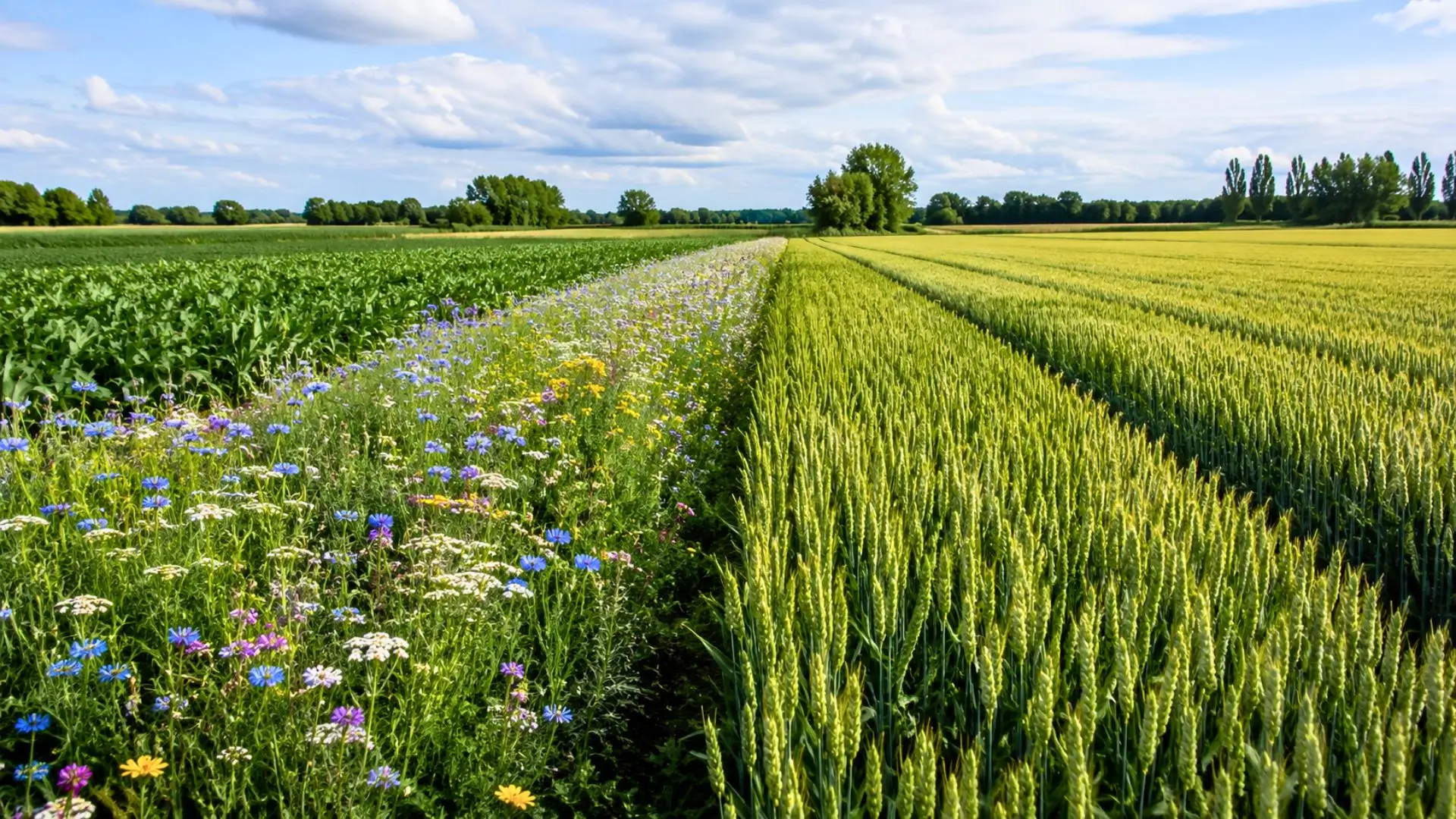
A productive and profitable farming system free of any plant-protection products is now possible. This is the outcome of a large-scale scientific study conducted in France over a decade. By dispensing with any protective chemistry, researchers challenge long-standing certainties about the economic profitability of farms.
The public institute validates the technical feasibility and financial profitability of zero-pesticide farming
The National Institute for Agricultural Research, Food and Environment led the experimental project named Rés0pest. Over ten years, scientists banned plant-protection products on nine sites in France. However, this approach still relies on mineral fertilizers, which sets it apart from the organic sector.
The study’s conclusions confirm the technical feasibility of this agricultural shift. Moreover, financial viability is on track for practitioners. The tested systems indeed generate income ranging from one to three times the minimum wage per farmer.
Nevertheless, the absence of chemical protection leaves crops more exposed to pests. Yields are therefore more variable depending on season and region. While wheat, sugar beet, and potato thrive north of the Loire, chickpeas faced difficulties in Occitanie.
Yields above the national average recorded at the heart of trial plots in the Somme
At Estrées-Mons, in the Somme, commercial success is taking shape on the ground. The manager of the site dedicated to arable crops expects an imminent harvest of 75 to 80 quintals per hectare for wheat. This local performance surpasses the French national average for the year 2025.
This result is achieved in a humid Picardy region, conducive to plant diseases such as downy mildew or yellow rust. The operation relies on Géopolis, a resistant wheat variety developed by Agri Obtentions, a subsidiary of the institute, which was brought to market recently.
Biodiversity and natural barriers replace the heavy use of chemical treatments
To replace the old chemical treatments, agronomists rely on natural mechanisms. Flower strips comprising 22 distinct plant species thus surround the cereal fields. These spaces shelter predatory insects such as hoverflies, which feed on aphids detrimental to crops.
Moreover, wildlife plays a protective role thanks to the return of birds of prey that regulate vole populations. This biological transition, however, requires overcoming weed proliferation, which represents the main technical challenge faced by the teams.
New mechanical weeding practices help offset the decline in yields
To control the weed flora without any product, farmers are employing new soil-management techniques. They combine notably longer crop rotations with mechanical weed control. The teams also adjust typical calendars by introducing a shift in sowing dates.
Indeed, overall cereal production remains lower than that of the conventional sector, even if it surpasses the organic sector. However, agronomists estimate that this volume reduction is largely offset by the major ecosystem services provided to nature.
The overall assessment of this agricultural model should ideally take into account its virtuous impacts on society. The sustainable regeneration of biodiversity, the improvement of human health, and the preservation of water resources help avoid massive public expenditures on environmental depollution.

Contact details
Address:
Farmers Forum,
36, Dominick Street,
Mullingar,
Co. Westmeath,
Ireland
Phone:
+353 (0)44 9310206
Or email us:
For technical issues please check out our FAQ's page or email - [email protected]
For general Queries email - [email protected]
Request to add event to our Calendar - [email protected]
Send us your mart reports - [email protected]
Suggestions and feedbacks - [email protected]
News Items / Press Release - [email protected]
To Advertise on Farmers Forum - [email protected]