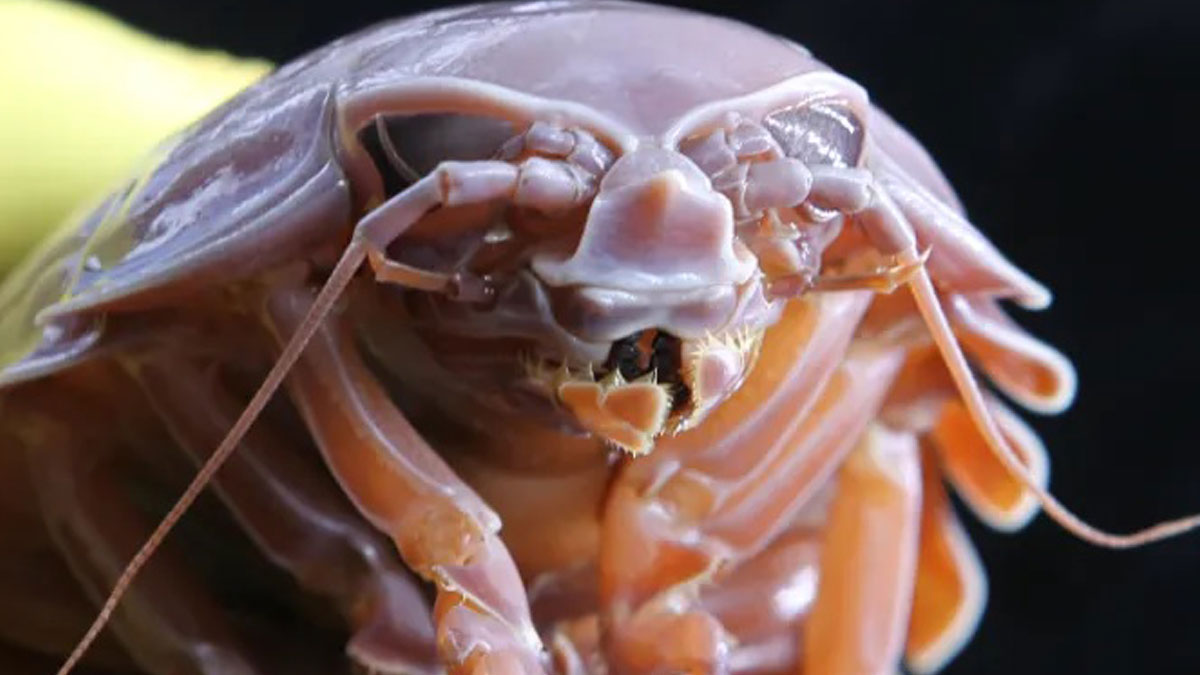
Marine creatures with a rather intimidating appearance, giant isopods can endure years without feeding. A recent study has unveiled the secrets of their resilience.
Giant Stomach
As their name implies, deep-sea giant isopods live at depths surpassing 2,000 meters. While food sources are scarce in these harsh environments, this does not prevent them from reaching truly remarkable sizes: up to 50 centimeters in length.
Because substantial amounts of nutrients are required to support such growth, researchers from the Chinese Academy of Sciences recently carried out a multi-omics analysis (an examination of an organism’s genetic, protein, and metabolic pathways) to explore their biology. The team then conducted a series of functional tests to determine whether the initially identified adaptations actually affect their survival.
It turned out that the deep-sea isopods possessed a stomach much larger than that of their counterparts living in shallow waters or intertidal zones. Accounting for roughly two-thirds of their body volume, it enables them to gorge almost to bursting when a providential feast—such as the carcass of a large cetacean—reaches the ocean floor.
The food is then broken down into a viscous mush, containing a relatively small amount of digestive bacteria called Firmicutes, but a significant concentration of Chlamydiae, linked to metabolism and lipid storage. Once our isopods are sated, their meal thus becomes a source of energy in the (very) long term. In this case, more than five years.
The Role of Gene ND1
By introducing the ND1 gene into the genomes of zebrafish and nematodes, the Chinese team confirmed that it plays a crucial role in markedly slowing the metabolic and mitochondrial activity of deep-sea isopods.
At moderate temperatures, ND1 stimulates metabolism and consequently increases energy expenditure. But as soon as temperatures were lowered to match the conditions experienced by the isopods, its inhibitory effect appeared, notably boosting the resistance to food deprivation by 37% in zebrafish.
“These studies help unravel the mystery of the remarkable famine tolerance in deep-sea isopods, and shed light on the delicate balance between growth and survival in extreme environments,” conclude the authors of the new study, published in the journal Cell.
Last year, researchers described a giant isopod nicknamed “Darth Vader.”

Contact details
Address:
Farmers Forum,
36, Dominick Street,
Mullingar,
Co. Westmeath,
Ireland
Phone:
+353 (0)44 9310206
Or email us:
For technical issues please check out our FAQ's page or email - [email protected]
For general Queries email - [email protected]
Request to add event to our Calendar - [email protected]
Send us your mart reports - [email protected]
Suggestions and feedbacks - [email protected]
News Items / Press Release - [email protected]
To Advertise on Farmers Forum - [email protected]