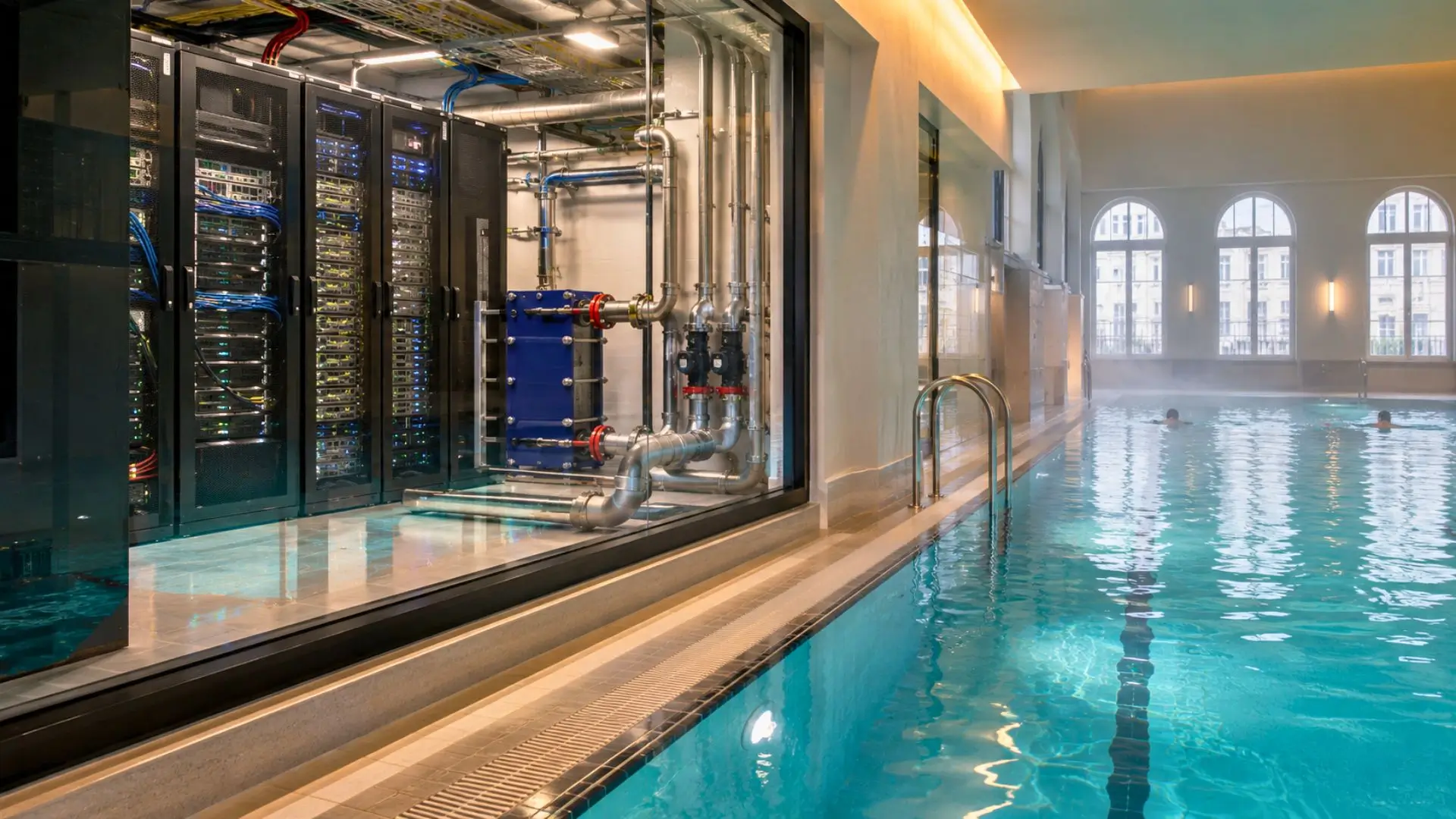
In Paris, the Butte-aux-Cailles swimming pool employs an unusual method to regulate its temperature: it recovers the heat emitted by computer servers. This technological transition, now a legal obligation, is gradually transforming the energy sector and urban heating in France.
An invisible technological installation capturing the thermal energy of computers at the heart of Paris
For several years, the Butte-aux-Cailles site, located in the 13th arrondissement of Paris, has hosted a singular installation. Indeed, the former boiler room now houses server bays that operate continuously to feed the pools.
Developed by the young company Stimergy, this system relies on digital boilers. The processors are immersed directly in a bath of insulating oil. Consequently, this heat-transfer fluid captures the heat emitted by the machines before transferring it efficiently to the water in the pools.
Optimal energy efficiency that significantly reduces carbon emissions
Specifically, this infrastructure provides 45 kW of power, maintaining the water at a constant 27°C. Although this system covers only 10 to 20% of the site’s overall needs, its efficiency reaches an impressive 95%.
Currently, the computing load mainly serves the 3D rendering needs of the animation studio Team To. Thus, the graphic designers generate thermal energy without realizing it. Furthermore, the supplementary supply is provided by the CPCU heat network.
Thanks to this eight-year collaboration with the municipality, the environmental footprint is notably positive. This clever mechanism prevents the emission of 45 tonnes of CO2 per year for heating, complemented by 20 tonnes saved on air conditioning.
From social housing to urban heating networks: the nationwide expansion of heat recovery
This Parisian innovation quickly inspired other cities across the country. For example, the city of Nantes uses a similar installation to supply hot water to 40 social housing units in the metropolitan area, proving the viability of the concept at the residential scale.
Similarly, Jean Moulin University Lyon 3 and a student facility in Grenoble benefit from this alternative energy source. These collective installations integrate these technological devices directly upstream of conventional boilers to guarantee the daily energy needs.
On a broader scale, the commune of Saint-Denis collaborates with the SMIREC network. This project recovers the lost heat from the Equinix data center to power a development zone. This extensive 90-kilometer network now serves the equivalent of 60,500 housing units in Île-de-France.
Tight regulation to govern an energy resource boosted by artificial intelligence
In light of these challenges, legislation has evolved significantly to constrain digital players. Indeed, the DDADUE law has required since October 2025 data centers larger than 1 MW to recycle their waste heat, under penalty of a 50,000-euro fine.
According to ADEME, the widespread development of artificial intelligence could push this reservoir up to nearly 13 TWh by 2035. Consequently, training a large model sometimes requires 650 MWh, a crucial opportunity that municipalities will have to seize.

Contact details
Address:
Farmers Forum,
36, Dominick Street,
Mullingar,
Co. Westmeath,
Ireland
Phone:
+353 (0)44 9310206
Or email us:
For technical issues please check out our FAQ's page or email - [email protected]
For general Queries email - [email protected]
Request to add event to our Calendar - [email protected]
Send us your mart reports - [email protected]
Suggestions and feedbacks - [email protected]
News Items / Press Release - [email protected]
To Advertise on Farmers Forum - [email protected]