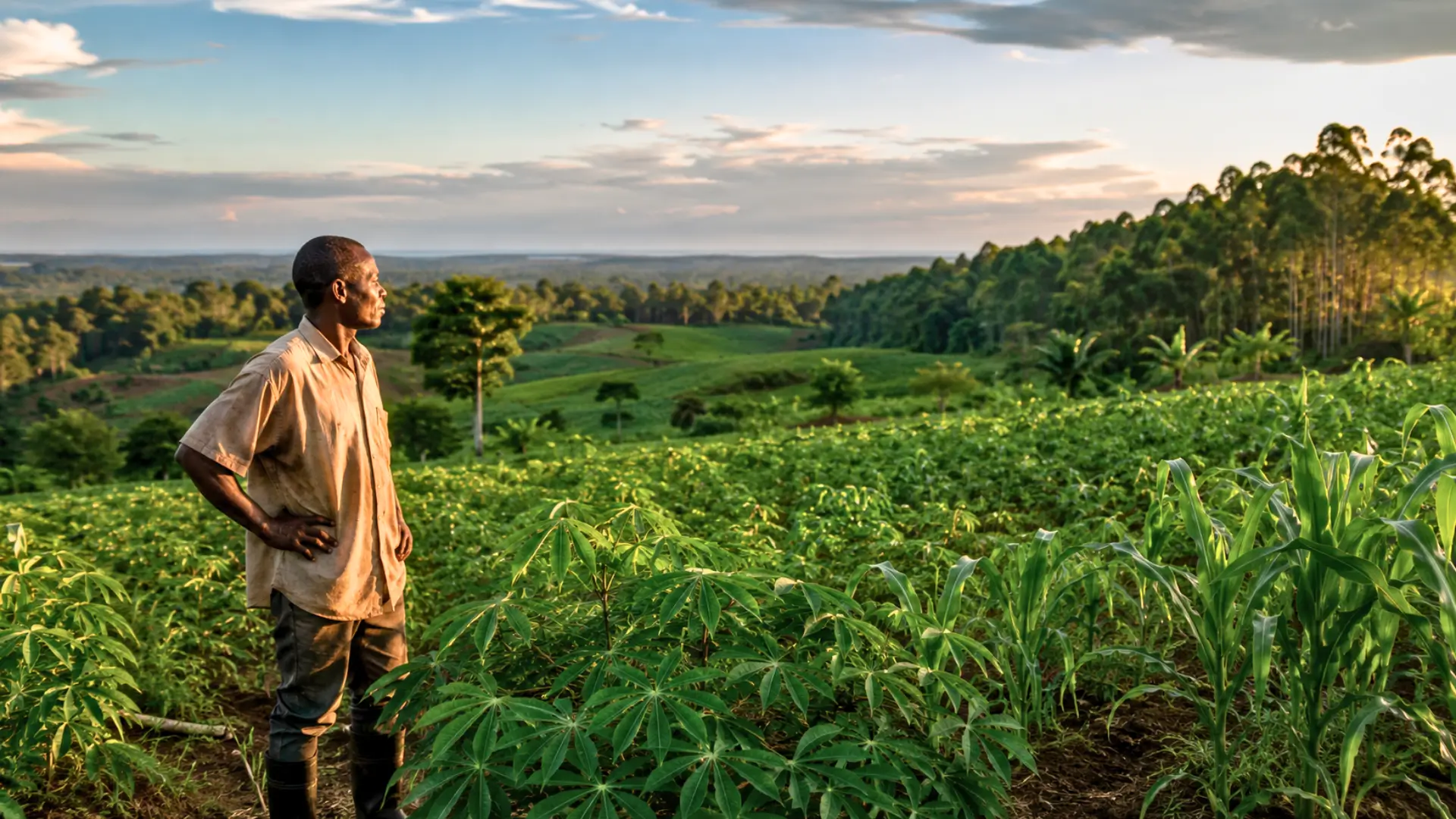
Under the feet of the Democratic Republic of the Congo lie cobalt, copper, and coltan. But on the surface, another treasure waits for its moment: vast lands, a planetary forest, and an agricultural power nearly untouched. And what if the country’s real future isn’t hidden underground?
Immense Arable Lands That Could Transform Congolese Agriculture
On a map, the DRC looks like a continent within a continent. It would encompass roughly 80 million hectares of arable land. Yet only a small portion is cultivated. The contrast leaves agronomists dizzy. In fact, the FAO and several development experts regard it as a vast agricultural reservoir for Africa.
The paradox is thus striking. Agriculture supports a large portion of the population, yet production remains fragile. It depends on roads, conflicts, and investments. Yet cassava, maize, rice, coffee, cocoa, and oil palm form an agricultural mosaic capable of weighing far beyond the country itself.
The Congo Basin, a Climate and Economic Reservoir Still Undervalued
The DRC houses a significant share of the Congo Basin. According to the World Bank, it is the second-largest tropical rainforest on the planet after the Amazon. Yet this is not merely a spectacular backdrop. It is a living machine that stores carbon, regulates rainfall, and safeguards immense biodiversity.
In 2025, the World Bank estimated the value of the services provided by these forests at more than $1,150 billion for 2020. Beyond this almost unreal figure lie tangible benefits: water, soils, climate, pollination, timber, food, and certain local pharmacopoeias.
Yet this green wealth remains difficult to convert into durable prosperity. Roads are missing. Illegal exploitation is growing. The pressure from charcoal also weighs on villages. Thus, the forest becomes at once an ecological shield and a survival resource, complicating every political decision.
Cobalt, Copper and Coltan Take Center Stage at the Expense of Agricultural Potential
On the international stage, the DRC is more often associated with cobalt than with cassava. This is no accident. The country provides more than 70% of global cobalt, essential for batteries and low-carbon technologies. Moreover, copper and coltan place Kinshasa at the heart of modern industrial chains.
Nevertheless, this strategic position exacts a human and economic toll. A portion of the mineral wealth escapes the producing regions. It moves through export circuits, imbalanced contracts, or regional smuggling. As a result, the Congolese soil seems to attract more for what it conceals than for what it nourishes.
The DRC Could Be a Pillar of Food Security If It Shifts Its Trajectory
The notion of an “Pivot State,” championed by the Club Deméter around C.U.B.I.T.A, takes on full meaning here. By its size, its resources, and its fragilities, the DRC can influence an entire region. Indeed, its future will weigh on food, energy, and even the climate.
The challenge becomes even more dramatic with demography. The country now counts more than 100 million inhabitants. It could approach, or even exceed, 200 million by 2050. Consequently, feeding, employing, and connecting this population will require far more than an extractive economy.
The Congolese future is therefore not about choosing between mining and forests. It isn’t limited to pitting agriculture against industry either. It will require crafting a rare equation: farming without depleting, extracting without sacrificing, protecting without excluding. Perhaps the country’s real treasure lies in its ability to reconcile what the world still opposes.

Contact details
Address:
Farmers Forum,
36, Dominick Street,
Mullingar,
Co. Westmeath,
Ireland
Phone:
+353 (0)44 9310206
Or email us:
For technical issues please check out our FAQ's page or email - [email protected]
For general Queries email - [email protected]
Request to add event to our Calendar - [email protected]
Send us your mart reports - [email protected]
Suggestions and feedbacks - [email protected]
News Items / Press Release - [email protected]
To Advertise on Farmers Forum - [email protected]