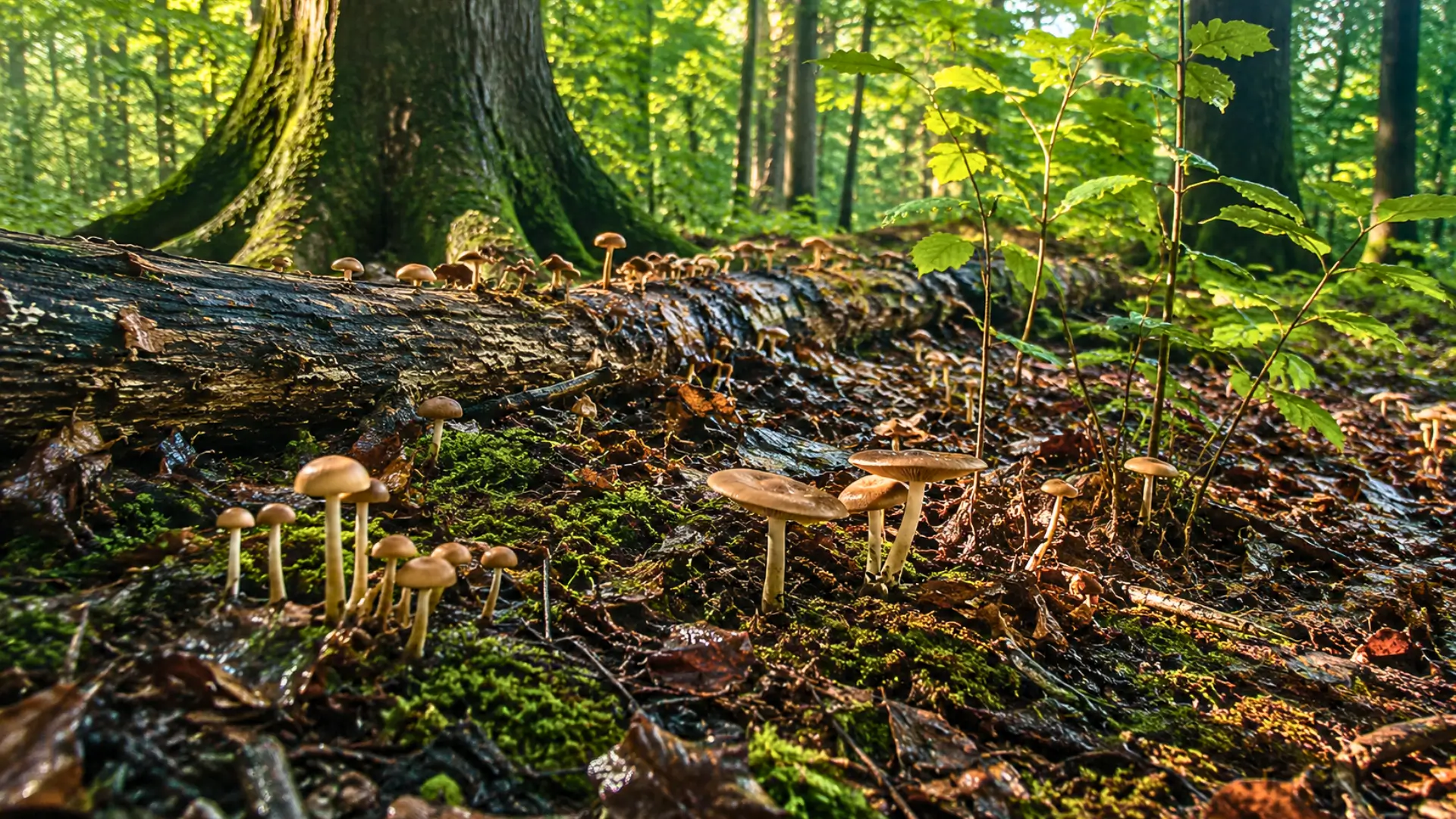
Under the fallen leaves and the roots, another forest is at work in silence. Filaments of fungi connect the trees, carry resources, recycle matter, and challenge our notion of a woodland populated by isolated individuals. But how far does this invisible network really extend?
Mycelium turns forest soil into a miniature living network
In a handful of forest soil, there isn’t merely humus, a few insects, and the reassuring scent of the undergrowth. There are also kilometers of microscopic filaments. Some are so fine that a single hair would look coarse by comparison. This network has a name: the mycelium, the true body of fungi.
On the surface, autumn caps tell only a small part of the story. They play the role of fruit, like apples on an apple tree. Below, the hyphae advance, circumvent rocks, envelop roots and build a living lattice that survives long after the visible fungi.
Fungi help trees exchange water, carbon, and nutrients
For millions of years, trees and fungi have practiced a discreet barter. The tree gives sugars produced by photosynthesis. In exchange, the fungus helps it absorb water, phosphorus, nitrogen and other minerals. Thus, the mycorrhizae become zones of contact where roots and hyphae negotiate relentlessly.
But the story becomes even more astonishing when several trees share the same fungal partners. Experiments with isotopic tracers tracked carbon from one tree to another. In 1997, in Nature, Suzanne Simard made a splash with her work on birch and Douglas fir, soon associated with the Wood Wide Web.
This expression lands with impact, because it reframes the forest as a network. Yet it does not mean trees are chatting in a secret forum. It indicates that measurable fluxes move underground along several possible paths: mycelium, roots, soil water, and interactions between organisms.
Old trees connected can feed the next generation
In a forest, some aged trees play a role far larger than their silhouette would suggest. Highly interconnected, they influence the life of nearby young plants. The University of British Columbia’s work popularized the idea of mother trees. The image remains powerful, but it points to an ecological reality: the big trees shape their neighborhood.
When a tree declines, it does not vanish from the system all at once. A portion of the carbon it stored returns to the surrounding environment. This is neither a voluntary will nor a conscious sacrifice. Instead, underground connections can accompany this transfer and give a boost to light-deprived new sprouts.
Under a dense canopy, these young plants often live in the shade. They photosynthesize little, grow slowly, and go through a fragile phase. Hence, an additional input of resources, even if limited, can make a difference. At this scale, the fall of a giant can become a relay handoff for the forest.
The Wood Wide Web fascinates researchers, but requires nuance
This story draws us in because it seems almost too good to be true. Yet researchers urge caution. In 2023, an analysis published in Nature Ecology & Evolution by Justine Karst and colleagues pointed to several excesses around the Wood Wide Web. Some quotations exaggerated the robustness of the evidence or attributed to trees intentions not demonstrated.
This reframe does not destroy the idea of a connected forest. On the contrary, it makes it more interesting. Nature does not need to be humanized to remain striking. The fungal networks exist, transfers too. However, their magnitude varies depending on species, soils, seasons and measurement methods.
In 2025, Suzanne Simard responded in Frontiers in Forests and Global Change. There she defends the ecological importance of these connections and recalls the diversity of exchange pathways. The debate thus forces us to view the forest differently: not as a green backdrop, but as a relational system that droughts, pesticides and brutal clear-cutting can tear apart beneath our feet.

Contact details
Address:
Farmers Forum,
36, Dominick Street,
Mullingar,
Co. Westmeath,
Ireland
Phone:
+353 (0)44 9310206
Or email us:
For technical issues please check out our FAQ's page or email - [email protected]
For general Queries email - [email protected]
Request to add event to our Calendar - [email protected]
Send us your mart reports - [email protected]
Suggestions and feedbacks - [email protected]
News Items / Press Release - [email protected]
To Advertise on Farmers Forum - [email protected]