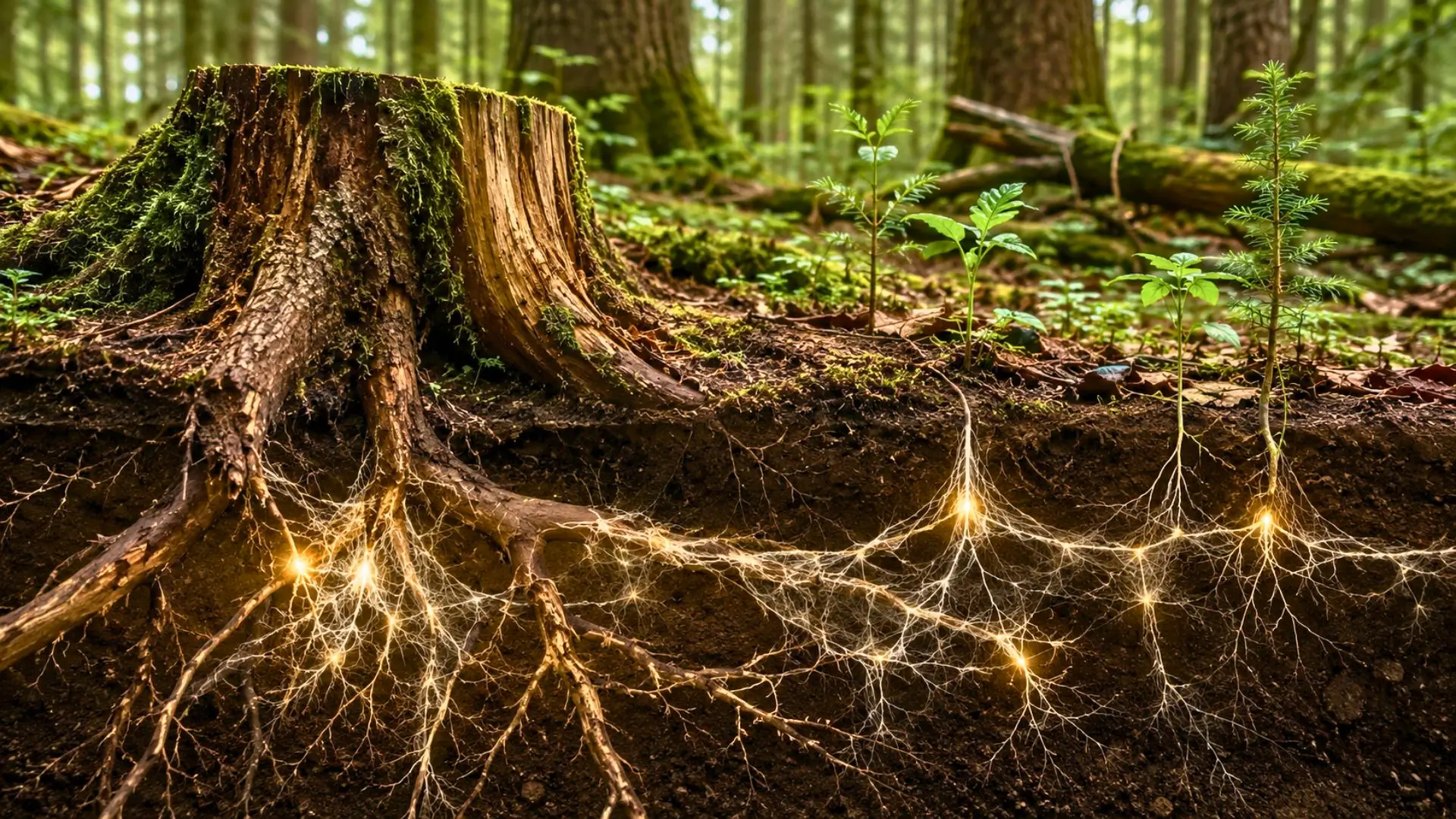
When an old tree falls, the forest loses not only a trunk. Under the moss, fungi still connect roots, young shoots, and the living soil. This circulation of carbon exists, but science now invites us to describe it with greater precision.
The fungal network that connects roots without turning trees into messengers
An mycorrhiza refers to the association between a root and a fungus. The fungus receives sugars produced by photosynthesis, while the tree gains better access to water and minerals. In certain soils, fungal hyphae form filaments finer than a hair.
These filaments can connect several plants, like extensions branched in the same room. Professor Suzanne Simard, a forest ecologist at the University of British Columbia, published in 1997 a field experiment showing a clear transfer of carbon between paper birch and Douglas fir.
What carbon measurements really say about these underground exchanges
Researchers track these fluxes with isotopes, recognizable forms of the same chemical element. This tagging works like a discreet label on a suitcase. It indicates where the carbon moves, but by itself does not prove an intention to give among trees.
Results vary by species, light, and soil. In the 1997 experiment, the Douglas fir received more carbon than it gave. Other studies suggest that the portion transferred remains often limited, sometimes retained in roots or fungi.
This nuance softens the image of a single, grand inheritance. Justine Karst, associate professor at the University of Alberta, reminded in 2023 that common networks exist, but that several public narratives exceed the evidence available on their effects for seedling establishment.
Why the death of a tree can alter carbon flow in the soil
A weakened tree shifts its internal balance. Its leaves produce fewer sugars, its roots grow less, and its reserves are no longer directed to the same tissues. The fungal network can then redirect the available carbon toward organisms still active around it.
This movement depends as much on the economy of the fungus as on that of the tree. The mycelium, the filamentous body of the fungus, seeks partners able to feed it. The old trunk then resembles an account draining into a communal fund.
What this science changes for forest and carbon management
FAO estimates global forest carbon stocks at 714 gigatonnes in its 2025 assessment. The soil contains 46%, living biomass 44%, and litter and dead wood 10%. Roots therefore count as much as the visible trunks.
This fact weighs on restoration. Replanting trees is not always enough if the soil has lost its fungi, organic matter and moisture. Forest ecology researchers now propose integrating mycorrhizal associations into restoration projects.
Clear-cutting illustrates the practical challenge. It removes trees, but also weakens underground connections that help some seedlings settle into the shade. Between 2015 and 2025, FAO still estimates global deforestation at 10.9 million hectares per year.

Contact details
Address:
Farmers Forum,
36, Dominick Street,
Mullingar,
Co. Westmeath,
Ireland
Phone:
+353 (0)44 9310206
Or email us:
For technical issues please check out our FAQ's page or email - [email protected]
For general Queries email - [email protected]
Request to add event to our Calendar - [email protected]
Send us your mart reports - [email protected]
Suggestions and feedbacks - [email protected]
News Items / Press Release - [email protected]
To Advertise on Farmers Forum - [email protected]