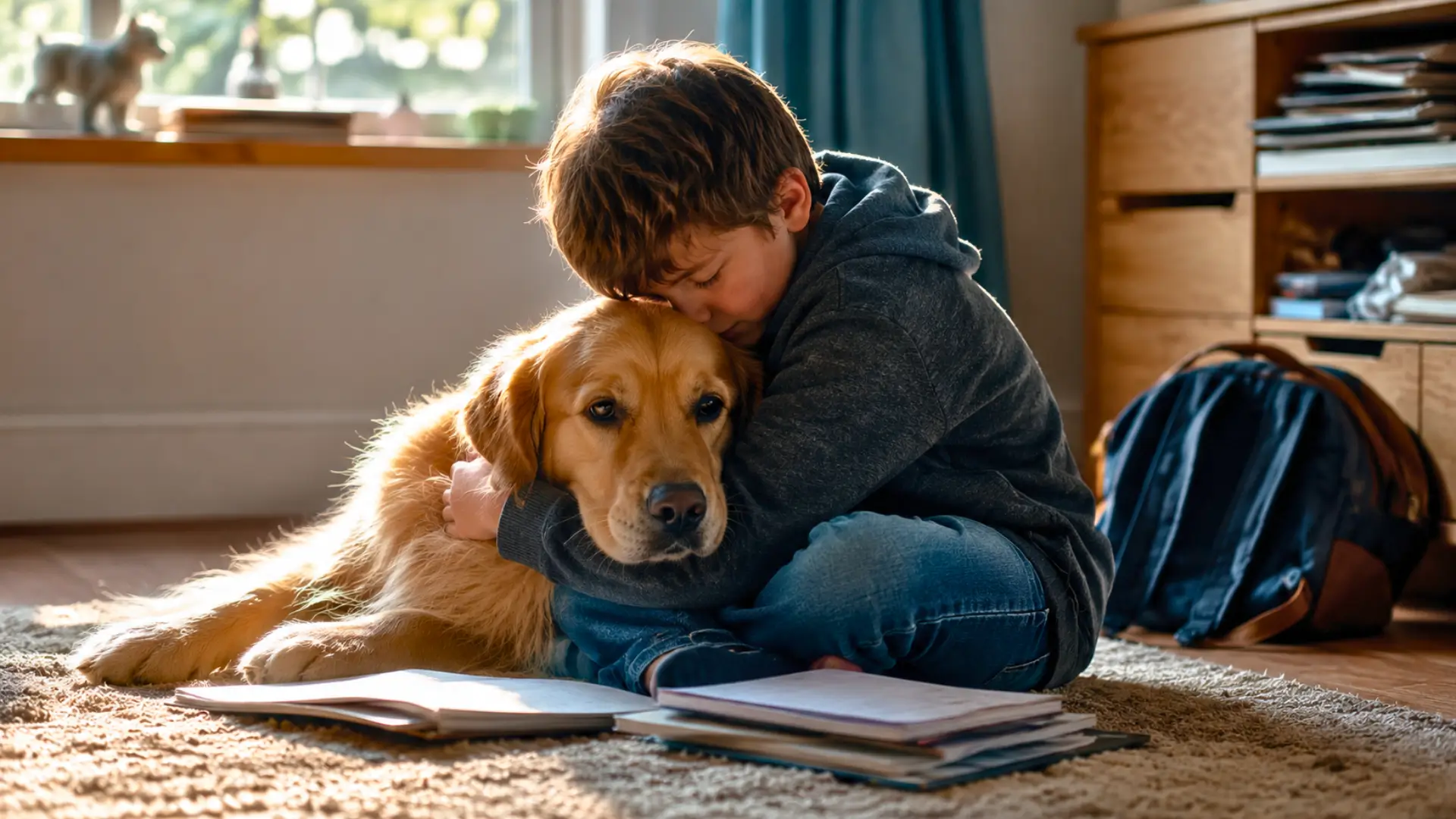
A dog that listens without interrupting, a cat curled up for hours… A study from the University of Cambridge reveals that children often find more comfort in their pets than in their siblings. An emotional bond that today intrigues researchers.
Pets occupy a unique emotional place in childhood
In many families, scenes tend to look the same. After a quarrel or a tough day at school, the child does not necessarily turn to their parents. They sometimes seek the silent presence of a dog or a cat. This instinctive reaction has long intrigued experts in emotional development.
Researchers at the University of Cambridge wanted to understand this surprising closeness. The team studied 77 families with multiple children and at least one pet. The results, published in the Journal of Applied Developmental Psychology, show that children often describe their relationship with their animal as more satisfying and less conflictual than the one they have with their siblings.
This finding is all the more striking because bonds between siblings typically play a central role in social development. Yet animals seem to occupy a special place in the emotional world of the youngest. Their calm presence acts as a kind of neutral zone, far from rivalries, comparisons, or ordinary family tensions.
The absence of judgment often transforms the animal into the ideal confidant
The explanation offered by the researchers hinges on a paradox. Animals do not understand words the way humans do, but it is precisely this lack of judgment that strengthens trust. According to psychiatrist Matt Cassells, involved in the study, children feel in their presence an emotional security rarely matched.
Unlike a brother or sister, an animal does not criticize, does not mock, and does not reveal the secrets shared. This neutrality creates a space where the child can express their fears or frustrations without fearing a hurtful reaction. For some teens, this silent support even becomes a form of daily emotional stability.
Scientists also observe that physical contact plays a major role. Petting a dog or feeling a cat snuggle up against you promotes stress reduction and stimulates the production of oxytocin, often dubbed the hormone of attachment. This phenomenon would explain why some children instinctively seek animal companionship after a strong emotional moment.
Dogs forge a particularly strong emotional bond in adolescence
Not all animals evoke the same degree of attachment, however. Cambridge’s study shows that dog owners report the highest levels of satisfaction. The dog has a unique ability to invite interaction, to follow human emotions, and to maintain a near-constant presence in daily life.
This social closeness matters greatly during adolescence, a period often marked by isolation or a feeling of being misunderstood. A dog requests walks, responds to gestures, and seems attentive to the slightest mood change. This constant availability creates an impression of a reciprocal relationship, very different from a mere decorative pet.
Researchers also noted differences between boys and girls. Girls report talking more to their animal and developing a more complex emotional relationship. They also mention more small conflicts or frustrations with their companion, a sign of a deeper, more nuanced emotional bond.
Scientists uncover the lasting impact of animals on emotional well-being
For a long time, animals were mainly viewed as playmates or simply pleasant family presences. Today, scientific studies paint a much deeper picture. Behavior experts believe these relationships could have a lasting influence on the development of social and emotional skills.
Early interactions with an animal are thought to help some children better manage stress, develop empathy, and strengthen their emotional self-confidence. In a context where anxiety disorders among adolescents are rising in many countries, this line of inquiry is drawing increasing interest from psychologists and mental health professionals.

Contact details
Address:
Farmers Forum,
36, Dominick Street,
Mullingar,
Co. Westmeath,
Ireland
Phone:
+353 (0)44 9310206
Or email us:
For technical issues please check out our FAQ's page or email - [email protected]
For general Queries email - [email protected]
Request to add event to our Calendar - [email protected]
Send us your mart reports - [email protected]
Suggestions and feedbacks - [email protected]
News Items / Press Release - [email protected]
To Advertise on Farmers Forum - [email protected]