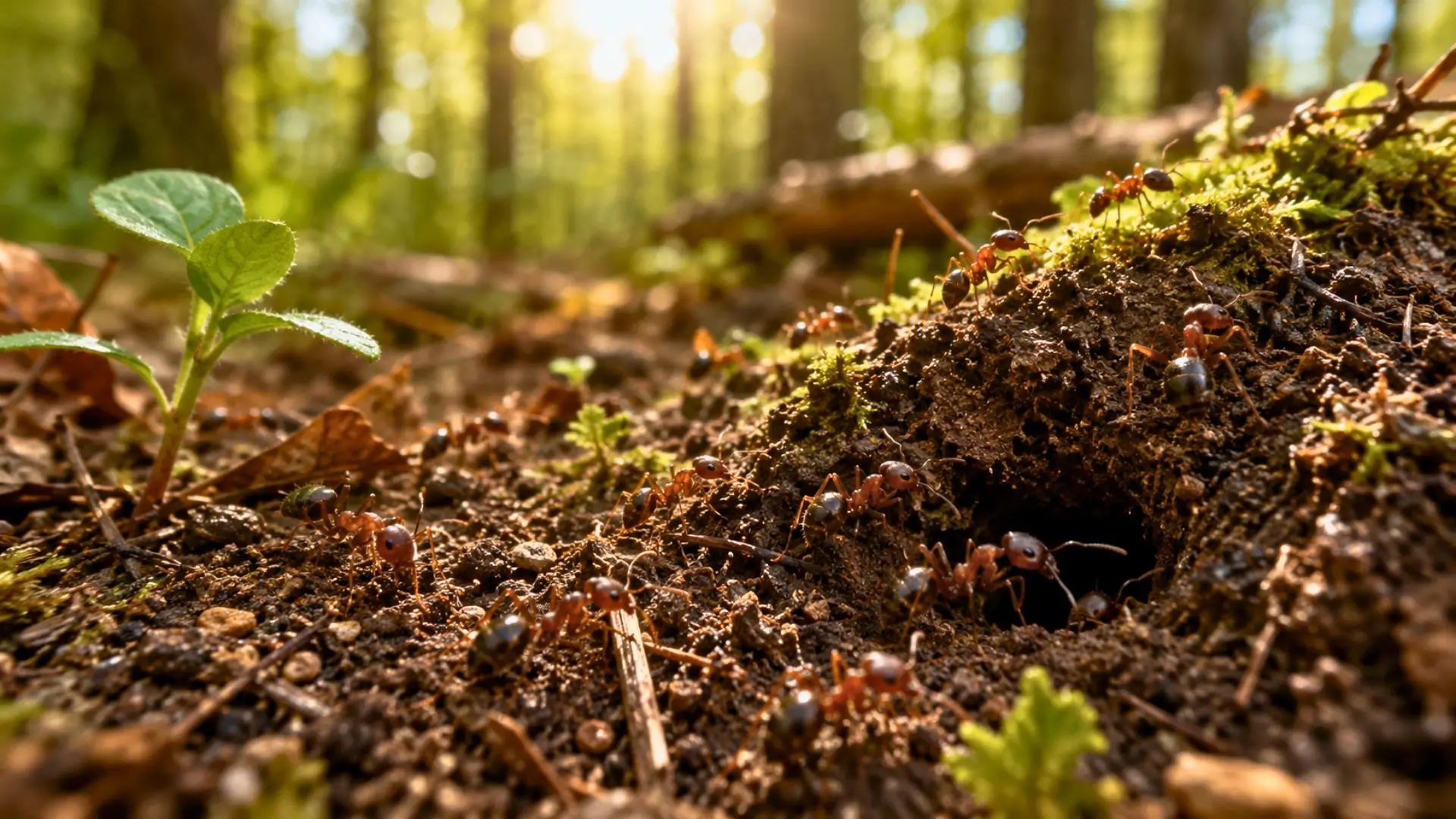
Ants do not dominate the global balance. Yet a study published in PNAS estimates their number at nearly 20 quadrillions of individuals, enough to exceed the dry mass of wild birds and mammals combined.
A global balance where 20 quadrillions of ants shift the scale
The team led by Patrick Schultheiss, then a researcher at the University of Hong Kong, and Sabine Nooten, affiliated with the University of Würzburg, compiled field counts across several continents. Their result places the ant population at about 20 quadrillions, i.e. 20 followed by 15 zeros.
This figure comes from a bottom-up approach, that is, a calculation that starts from local observations and then scales up to a global level. By contrast, older estimates started from an assumed total number of insects, like a recipe whose final quantity had been guessed before the ingredients were known.
Their biomass of 12 megatonnes remains below ours, but it surpasses many animals
Biomass refers to the total mass of living beings within a given group. For ants, researchers express it in dry carbon, a measure that removes water from the body to compare very different organisms by the same standard.
The authors estimate this biomass at 12 megatonnes of carbon. It accounts for about 20% of the human biomass, yet it surpasses the combined biomass of wild birds and wild mammals. A single ant weighs a few milligrams, yet their collective weight forms a massive ecological mass.
The contrast speaks louder than any chart. On the scale of a household, a crumb seems negligible, but millions of crumbs fill a bag. This is how ants operate in the living world: each individual matters little, yet their density transforms soils, leaf litter, and forests.
Ancient, abundant insects, and highly unevenly distributed across environments
Ants belong to the Formicidae, the biological family that groups these social insects with elbowed antennae. Their history goes back to the Cretaceous, long before Homo sapiens. AntWeb, a database maintained by the California Academy of Sciences, currently lists thousands of documented species.
Their distribution does not resemble a uniform layer spread across the planet. Tropical environments often host more individuals and more species than cold regions. This map remains incomplete because underground, arboreal surveys and certain areas of Africa or Asia are still lacking.
Under the surface, 13 tonnes of soil per hectare can be moved without the hum of engines
Their role is not limited to numbers. Ants dig, transport, sort, and deposit. PNAS notes that they can excavate up to 13 tonnes of soil per hectare per year, effectively a continuous earth-moving operation driven by mandibles rather than machines.
Ecologists also refer to myrmecochory, the term describing seed dispersal by ants. Some plants produce an elaiosome, a small nutrient-rich reserve attached to the seed. The ant carries the seed, consumes the nutritious part, and then leaves the seed in a place often favorable for germination.
This activity helps explain why scientists monitor them as ecological indicators. Pollution, urbanization, or intensive agriculture alter their communities. When certain species disappear from a soil, the signal speaks not only about insects: it informs on aeration, seeds, and organic matter.

Contact details
Address:
Farmers Forum,
36, Dominick Street,
Mullingar,
Co. Westmeath,
Ireland
Phone:
+353 (0)44 9310206
Or email us:
For technical issues please check out our FAQ's page or email - [email protected]
For general Queries email - [email protected]
Request to add event to our Calendar - [email protected]
Send us your mart reports - [email protected]
Suggestions and feedbacks - [email protected]
News Items / Press Release - [email protected]
To Advertise on Farmers Forum - [email protected]