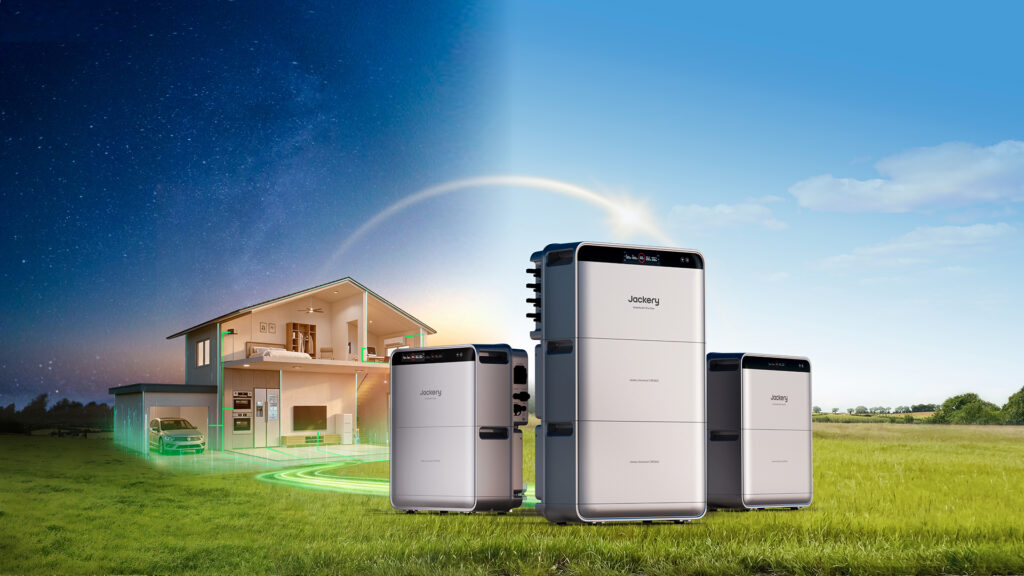
The promise of residential solar power that is truly accessible—without a professional installer, without drilling a single wall, and most importantly without needing an electrical engineering degree—has been a hallmark claim by many brands in recent years. Jackery, previously known chiefly for its portable power stations for camping and van life, pushes beyond that niche with the SolarVault 3 series. The maker shifts from nomadic use to home-scale solutions, and the result is genuinely convincing. We installed the SolarVault 3 Pro Max at our home in the Paris suburbs, pairing a 500 W bifacial panel with four 200 W panels, and pushed it to the limit for two weeks. Scooter charging, AI energy management, and grid injection: here is what we learned.
Jackery SolarVault 3 Pro Max: Technical Specifications
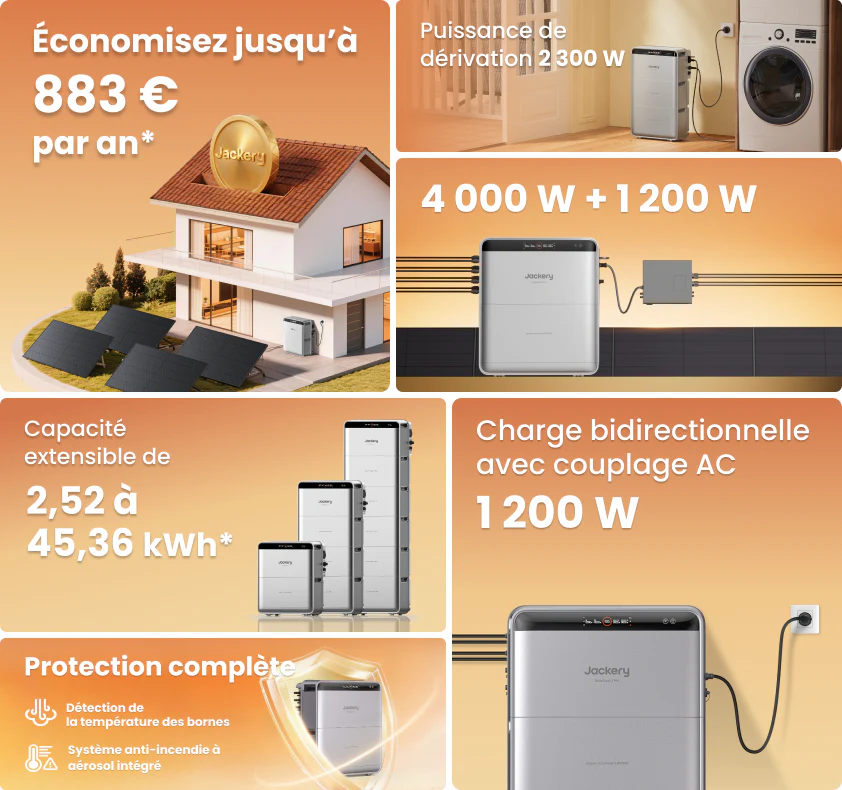
The SolarVault 3 Pro Max sits at the top end of the SolarVault 3 line, which also includes the Pro (entry-level with a 1,200 W output) and the Pro Max AC (retrofitted version without a direct PV input). The Pro Max combines the maximum output capability of the family with the option to connect solar panels directly, making it the most versatile variant.
At the heart of the system lies a 2.52 kWh LFP (Lithium Iron Phosphate) battery. This chemistry is widely preferred over traditional NMC for residential storage: it is thermally more stable, supports around 6,000 charge-discharge cycles compared with 500 to 1,000 for NMC batteries, and presents virtually no risk of thermal runaway. The nominal battery voltage is 41.6 V, with an operating range between 32.5 V and 45.5 V.
On the solar input side, the SolarVault 3 Pro Max features four independent MPPT trackers, each capable of handling up to 1,000 W. The total PV input capacity thus climbs to 4,000 W. The acceptable voltage range for each MPPT channel is 16 to 60 V, with a maximum current of 28 A per channel. The fact that each tracker is independent is a major advantage: if part of a panel array is shaded or oriented differently, it does not penalize the others. This is a technical benefit typically found on far pricier systems.
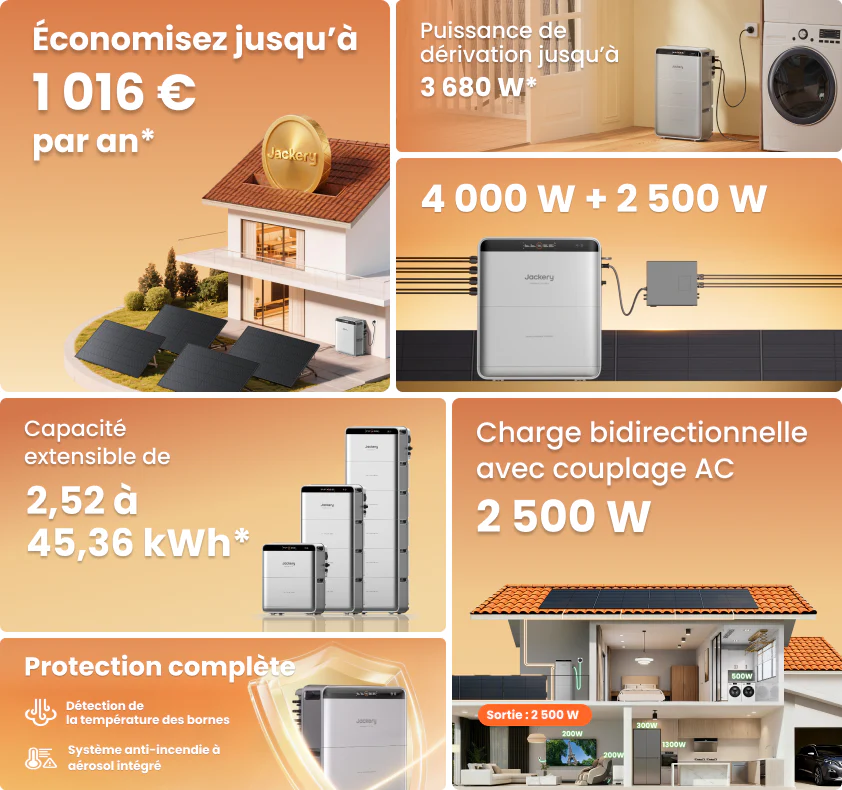
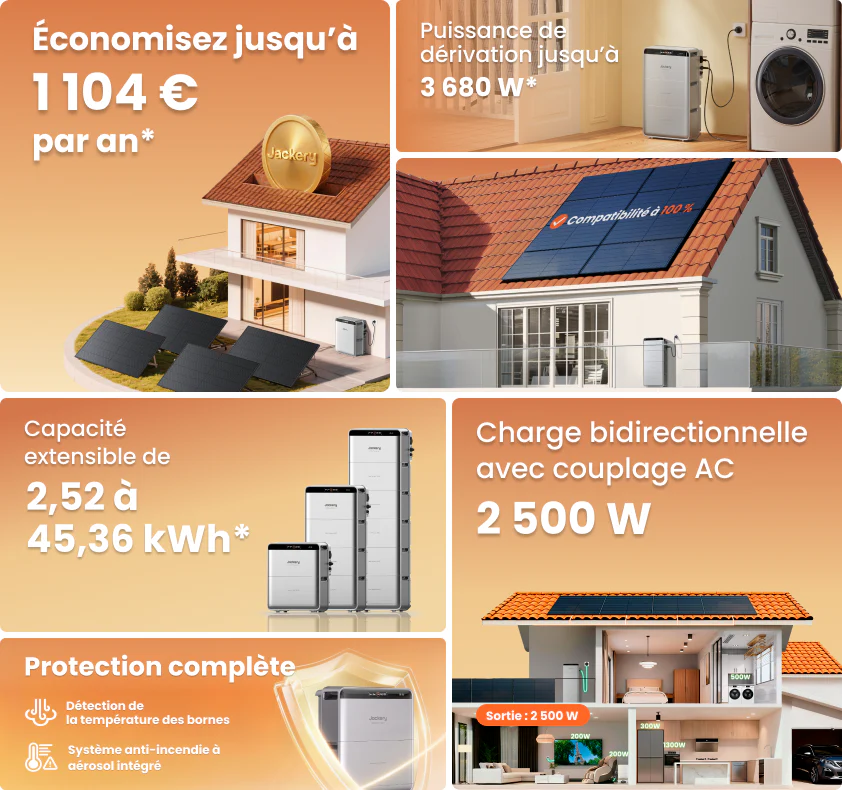
The bidirectional AC output power reaches 2,500 W, allowing it to power demanding appliances like a washing machine, a dishwasher, or an air conditioner. In bypass mode, this power rises to 3,680 W, which is the maximum draw of a standard 16 A outlet. The integrated inverter manages both grid injection and off-grid output, with a battery-backed transfer in under 20 ms in the event of a power outage. This responsiveness is enough to ensure that a computer or refrigerator does not even notice the interruption.
The connectivity is provided by Wi-Fi, Bluetooth and an Ethernet RJ45 port, ensuring a stable connection regardless of the household configuration. The unit carries an IP65 rating, making it dust-tight and resistant to water spray. It can operate in temperatures from -20 °C to +55 °C, with automatic battery preheating for cold weather.
On the safety front, Jackery announces more than 100 protection mechanisms and tests across more than 1,000 reliability scenarios. The system includes a temperature sensor on PV and grid terminals, as well as an automatic aerosol extinguishing device in case of critical overheating. The V-shaped cooling design lowers internal temperature by roughly 4 °C compared to a conventional layout, which also helps keep noise levels under 30 dB. In practice, the system is inaudible at a distance of one meter.
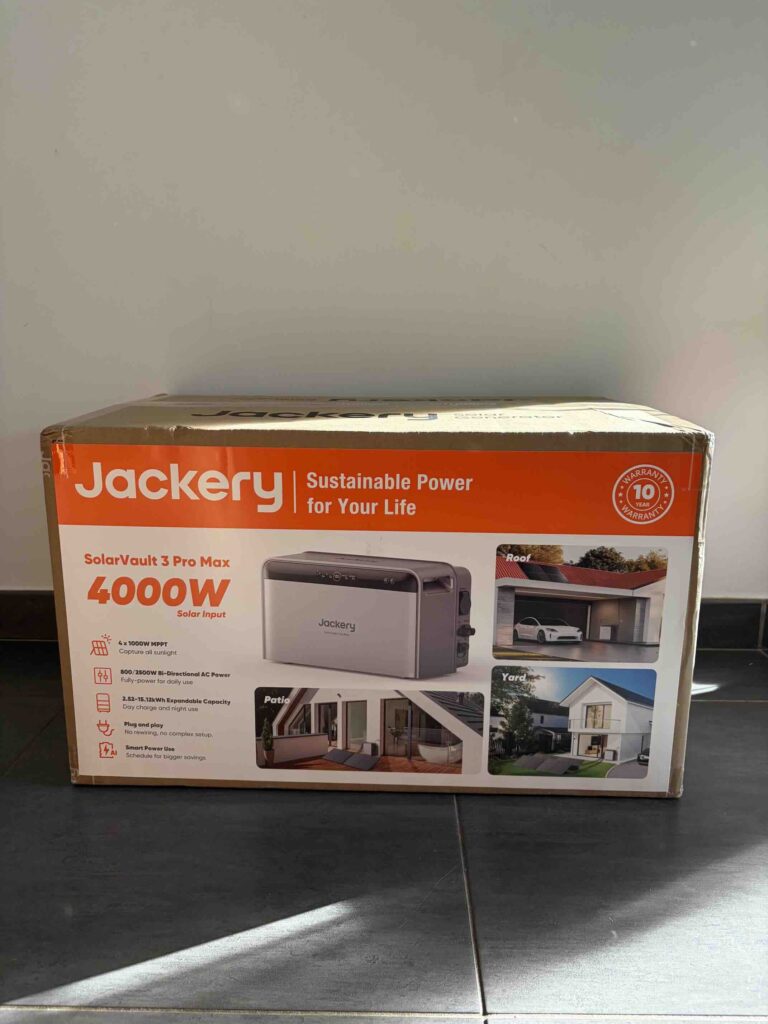
In terms of scalability, storage can be expanded from 2.52 kWh to 15.12 kWh by stacking up to five additional BP2500 batteries. It is even possible to connect three Pro Max units in parallel wirelessly to reach a total of 45.36 kWh of storage, 12 kW of solar input and 7,500 W of AC output. Jackery targets a public price of €1,379 for the Pro Max alone, though launch offers have briefly brought it down to around €1,079.
The manufacturer’s warranty is 10 years, with an expected lifespan of 15 years. The BP2500 extra battery weighs around 21 kg, which remains manageable for stacking without professional assistance.
Our Test Setup
For this test, we deliberately chose not to push a maximum configuration. The goal was to replicate a realistic scenario for a suburban Paris household new to residential solar and looking to start without a prohibitive upfront investment.
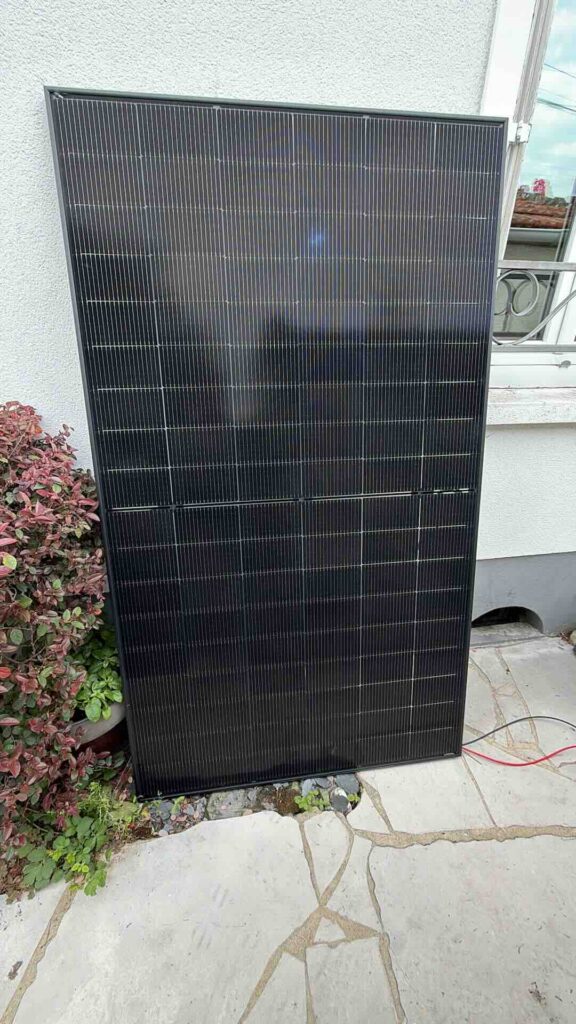
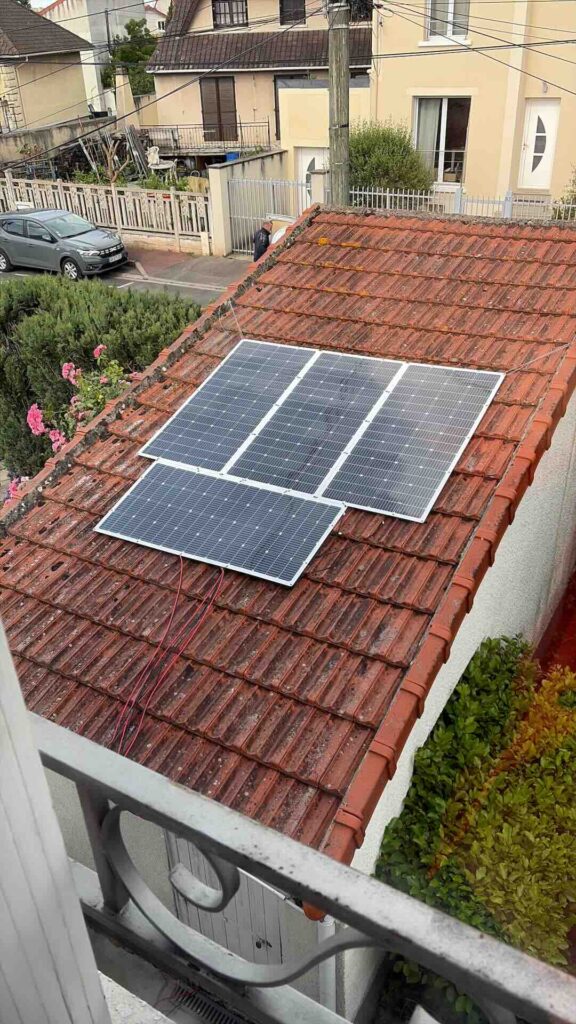
Our setup included the SolarVault 3 Pro Max by itself (no BP2500 extra battery), a 500 W bifacial double-glass solar panel and four 200 W solar panels. The total theoretical input capacity of the panels was 1,300 W, well below the system’s 4,000 W intake. We distributed the panels between a garage roof and a terrace space, with slightly different orientations, which allowed us to test the MPPT trackers functioning independently under real conditions.
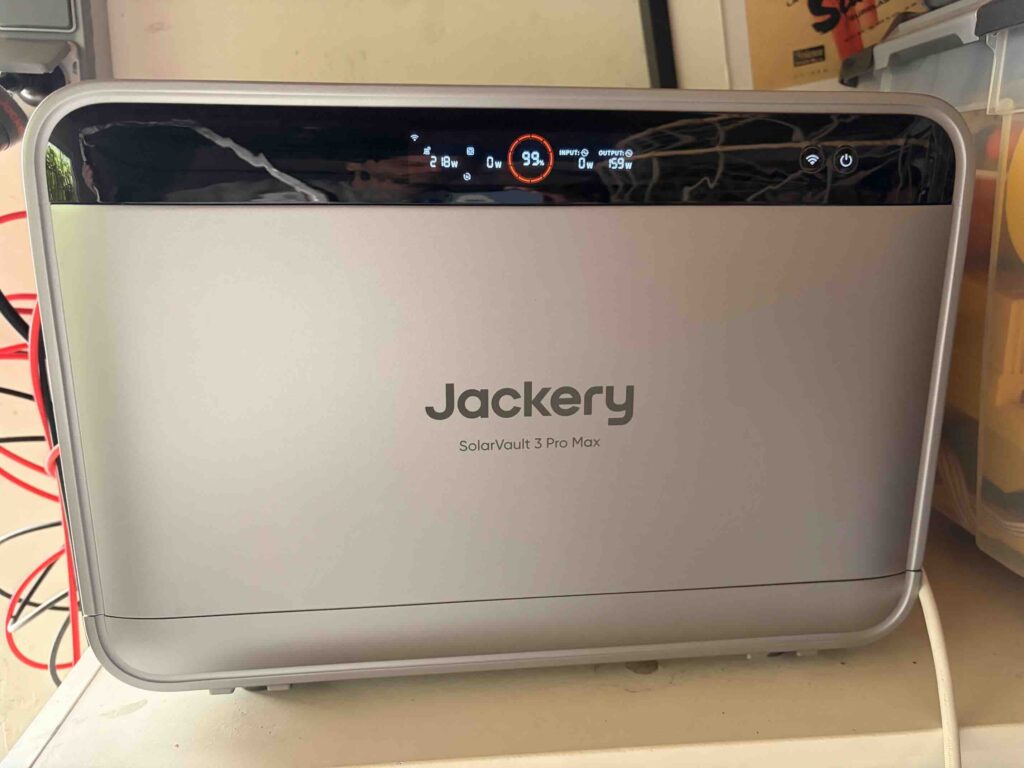
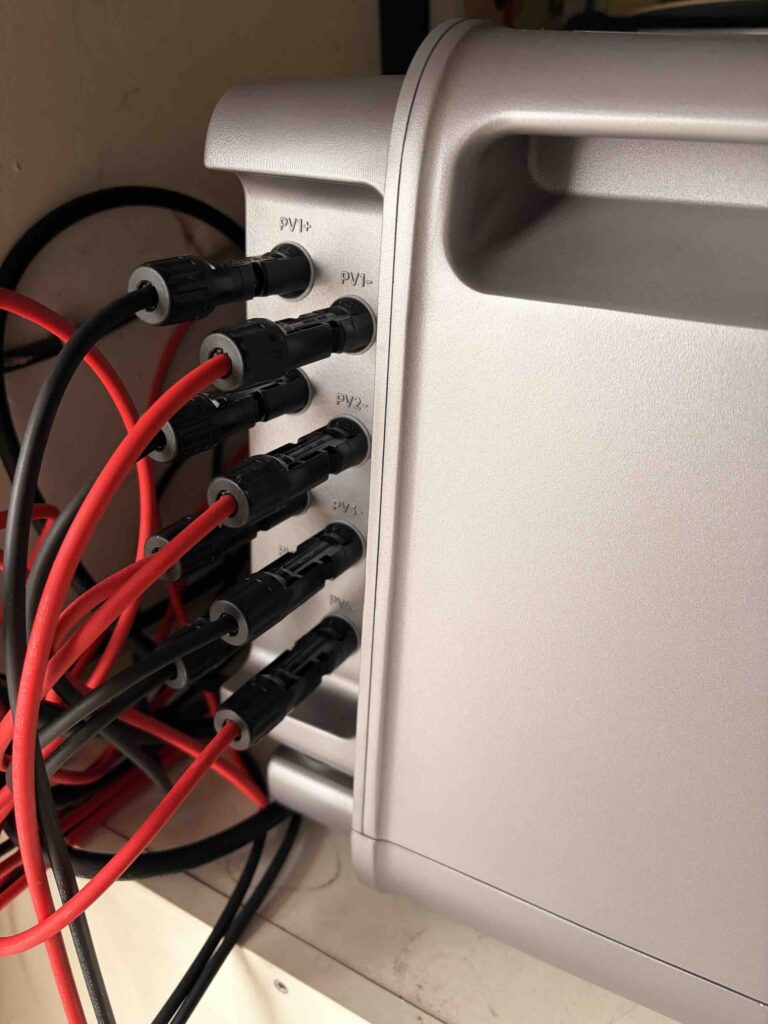
All of this connected to our home grid via a standard wall outlet, with no electrical work required. The installation took roughly an hour, including downloading the app, creating an account, and performing the initial Bluetooth pairing. Cables arrive preconfigured and labeled, and the MC4 connectors from the panels plug directly into the system’s MPPT inputs. It truly feels like a consumer-friendly setup, comparable to plugging in a home appliance.
Everyday Use: From the Electric Scooter to Full Household Management
The first practical test was charging our electric scooter directly from the SolarVault 3 Pro Max’s off-grid output. The 2,500 W output easily handles a standard scooter charger, and we found the 2.52 kWh battery capacity sufficient for a partial charge of the vehicle. This is a very tangible use-case for anyone who owns a lightweight EV: instead of pulling energy from the grid, you can plug in the scooter during the day and let it charge from the sun. It’s quite satisfying to see the vehicle move under solar power produced at home.
But the real standout feature of the SolarVault 3 Pro Max is its AI mode. This intelligent energy-management system creates a daily operating plan by cross-referencing three data streams: real-time electricity tariffs (the system supports more than 860 European providers, including EDF and Engie via Nord Pool and Tibber), weather forecasts to anticipate solar production, and your household consumption habits. The result is fully automated control: the battery charges during off-peak hours or when sun is available, and discharges during price peaks to power the home.
In practical terms, during May in the Île-de-France region, we observed roughly 10 hours of effective solar capture per day on sunny days, albeit with a lot of rain during our test period. With our 1,300 W configuration, the 2.52 kWh battery fills in a few hours, and any surplus is injected into the home network to power devices in use. The system continuously optimizes the balance between what to store, what to consume immediately, and what to export.
The Jackery App: The Real Differentiator
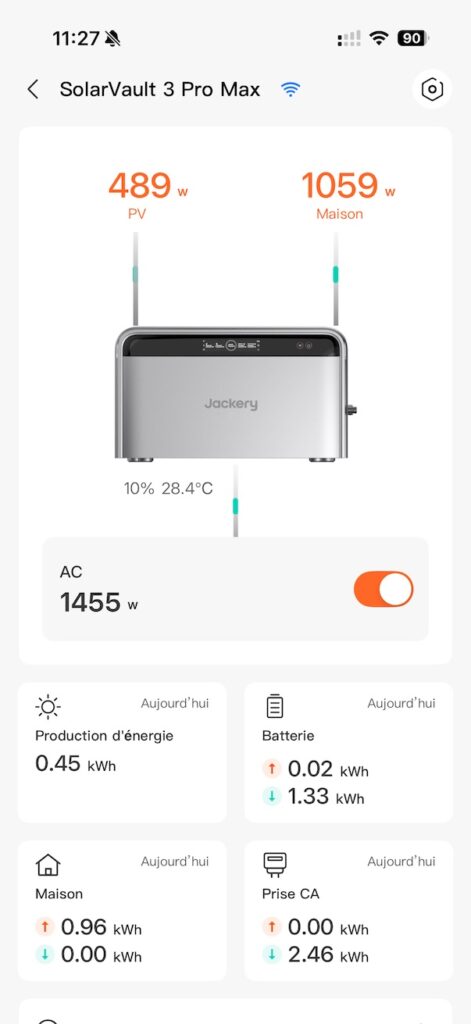
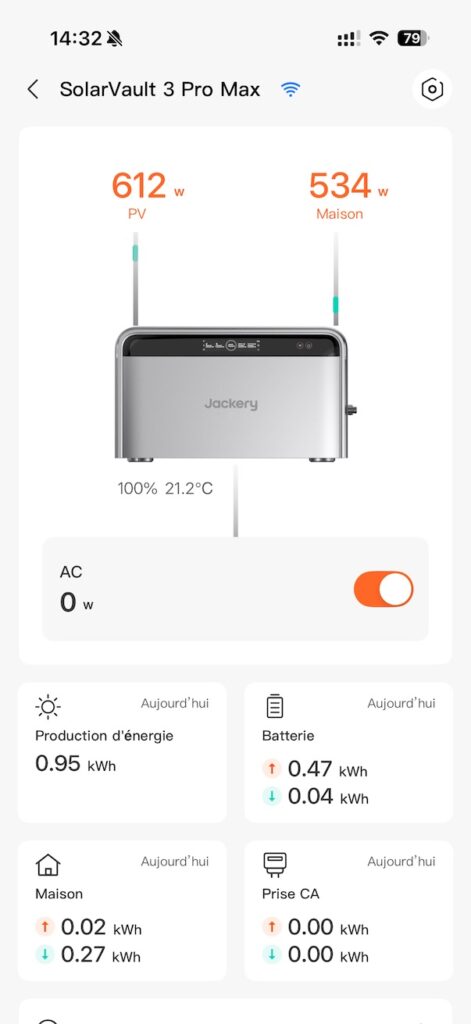
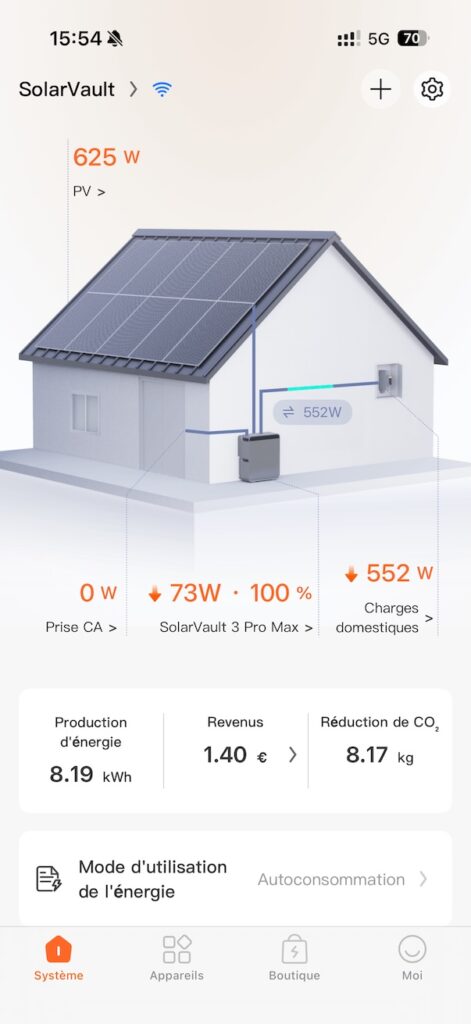
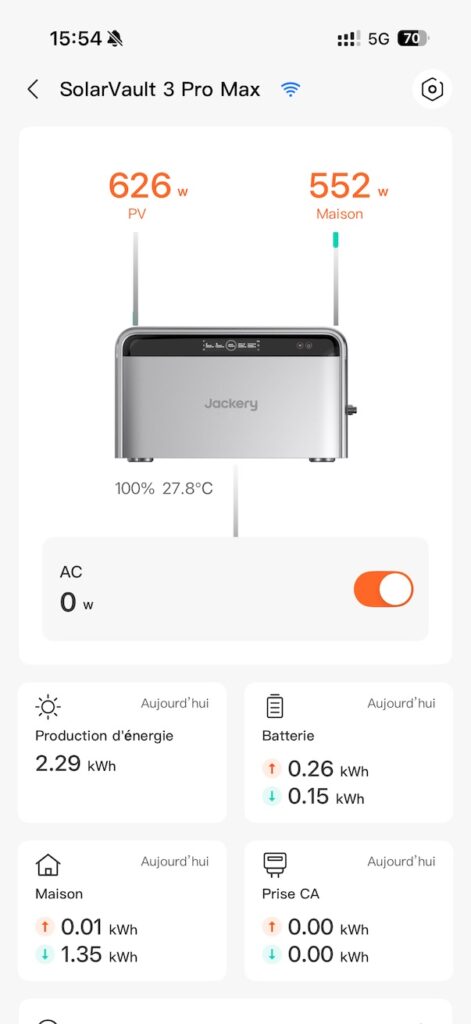
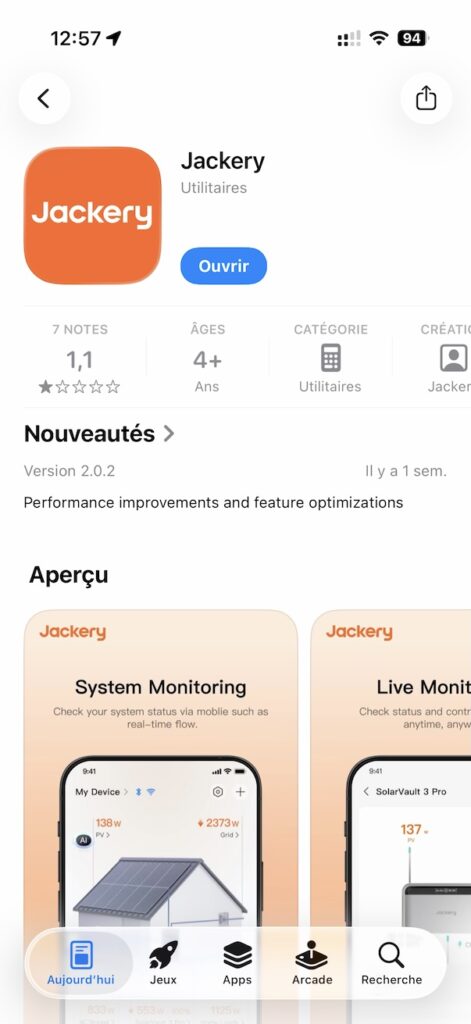
If there is one standout aspect of the SolarVault 3 Pro Max, it is the Jackery app. We have tested many connected products, and often the app is the weak link: a clunky interface that does the bare minimum. Here, the opposite is true. The app is remarkably well designed, both visually and functionally, and it genuinely transforms the user experience.
The home screen displays, in real time, the full energy flow: solar production, battery charging, household consumption, and grid injection. You can literally watch energy circulate, and that has a powerful effect on behavior. After a few days, you find yourself rescheduling the washing machine to exploit the solar peak, or checking whether the battery is sufficiently charged before turning on the oven. It isn’t a constraint; it becomes a game, a spontaneous gamification of energy consumption.
Mode control is straightforward. You can switch to AI mode (fully automated), manual mode where you set your own charge/discharge thresholds, or power-saving mode which puts the system to sleep while staying ready to react instantly. The history of production and consumption is accessible as daily, weekly, and monthly graphs, with statistics on savings achieved.
The system is also compatible with smart meters (Shelly Pro 3EM, Shelly Pro EM-50, or Jackery’s own TIC Linky reader) and connected plugs (Shelly Plus Plug), enabling even more granular device-by-device monitoring. Integration with Home Assistant is supported for those with an existing smart home ecosystem. It’s clear that Jackery did not build a hardware product with an app as an add-on; the software is an integral part of the product, and the two form a cohesive whole.
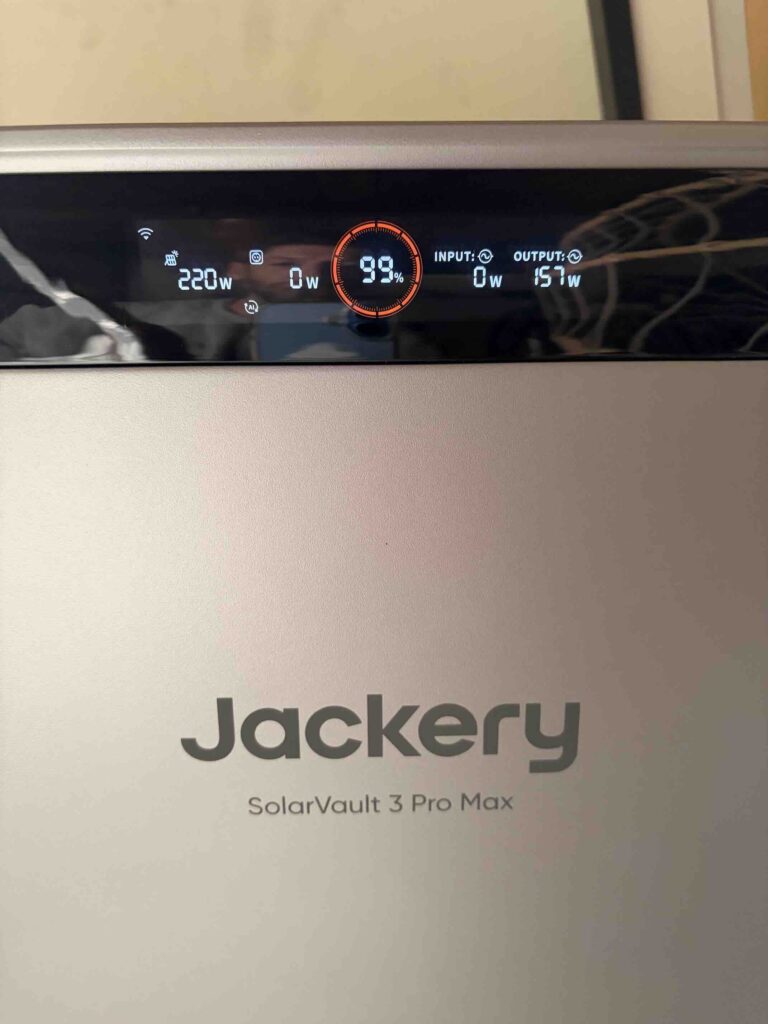
The physical display on the front of the unit is a nice touch as well. It continuously shows key information (state of charge, input and output power, operating mode), allowing quick monitoring without pulling out your phone. The overall design is refined, with a slate-gray, glossy front that fits nicely in a garage or living space.
Limitations of Our Setup and Recommendations
With a single 2.52 kWh battery, the storage capacity remains limited for meaningful long-term autonomy. In the evening and at night, when panels stop producing, the battery drains within a few hours if you run a few energy-hungry devices. For a family consuming between 5,000 and 8,000 kWh per year, ideally you would add two more BP2500 batteries to reach 7.56 kWh of storage, which would cover the nocturnal use of an average home and enable genuine tariff arbitrage benefits over a 24-hour period.
We therefore recommend a gradual investment: start with the Pro Max and a panel set to get acquainted with the system, then add one or two batteries as you learn your consumption patterns. This modular Architecture is one of the major advantages of the SolarVault 3 series: you are never locked into a fixed setup.
Another consideration: with our 1,300 W of panels, we are only using about a third of the system’s maximum input capacity. Adding panels to approach 4,000 W would charge the battery faster, generate more surplus to export to the grid, and significantly accelerate the return on investment. The four independent MPPT channels make this power ramp-up straightforward: you connect new panels to the available channels, and the system integrates them automatically.
Geography also matters. In the Île-de-France region, annual solar exposure is around 1,600 hours, compared with 2,600 to 2,800 hours in the south of France. Our roughly 10 hours of daily solar capture in May is not something that would hold true in December, when production drops to about 3 or 4 hours. This is a parameter to incorporate into system sizing: if you aim for meaningful self-consumption year-round in Île-de-France, you should plan for higher panel and storage capacity than a home in the Var region.
Safety and Robustness
The LFP chemistry is a well-regarded safety benchmark for residential storage. Unlike NMC batteries, which can pose thermal runaway risks, Lithium Iron Phosphate cells are inherently stable and do not release oxygen in case of overheating. Jackery pushes further with its automatic aerosol extinguishing system, which engages if the internal temperature crosses a critical threshold. This is a last-resort safety mechanism typically found in industrial setups, and its presence in a consumer-facing product is reassuring.
The IP65 certification allows outdoor placement of the battery without fear of rain or dust. We placed it in a semi-covered area, and it showed no signs of weakness even during a few rainy spells. The stackable design with an optional base (on wheels) is well thought out for reconfiguration: you can move the entire setup easily if you change your mind about the placement.
The automatic battery preheating feature for cold weather is a plus for regions with continental climates. When temperatures drop, the system initiates a preheating cycle before charging begins, preserving cell longevity. It’s the kind of detail that makes the difference between a device designed to last 15 years and one that loses performance after a few winters.
Notes
The Jackery SolarVault 3 Pro Max is part of a trio of products. The Pro (€1,139, 1,200 W output) targets smaller households or those seeking an entry system to start with. The Pro Max AC (€1,259, without direct PV input) is designed for retrofit onto an existing solar installation. The Pro Max we tested (€1,379) is the most feature-rich version, with direct PV input and a 2,500 W output.
The BP2500 extra battery (2.52 kWh) is sold separately and physically stacks onto the main unit. You can add up to five BP2500 units per system for a total of 15.12 kWh.
The system is compatible with other brands’ solar panels, provided the electrical specifications are respected: open-circuit voltage (Voc) between 16 V and 60 V, short-circuit current (Isc) less than or equal to 28 A, and MPPT channel power of up to 1,000 W. Jackery nevertheless discourages wiring a single panel over 400 W in series to avoid the risk of voltage overshoot.
Parallel operation of multiple units is announced as available via a future software update, enabled by linking the units to the same local network.
The system is compatible with third-party micro-inverters (Enphase, Hoymiles, APS) via AC coupling, which opens possibilities for integration with existing rooftop solar installations.
Verdict
The Jackery SolarVault 3 Pro Max is the kind of product that makes you want to push further. It’s perhaps the strongest compliment one can pay. After two weeks of use, we shifted from technical curiosity to a genuine desire to build a full solar installation: add more panels, stack batteries, and aim for real energy autonomy. The product creates a virtuous circle: the more you use it, the more you understand your consumption, the more you want to optimize, and the more you want to invest.
On the hardware front, the SolarVault 3 Pro Max sits at the top tier of what is currently offered in the plug-and-play residential storage market. The four independent MPPTs, 2,500 W of AC output, 3,680 W bypass, the 6,000-cycle LFP chemistry, sub-20 ms transfer, and IP65 rating: every spec aligns with the best systems on the market, including those that require professional installation.
From a software perspective, the Jackery app is a standout success. The AI mode, real-time monitoring, tariff-dynamic compatibility, and home automation integration: everything needed to turn a battery purchase into a smart, scalable self-consumption project is in place.
The main drawback remains the base storage capacity. With 2.52 kWh, the battery alone is not enough for comfortable nighttime autonomy. It’s a choice by Jackery that keeps entry price accessible but implies additional investment in BP2500 batteries to unlock the system’s full potential. We recommend considering at least two extra batteries for serious self-consumption use.
In the end, Jackery delivers with the SolarVault 3 Pro Max a product that fulfils its promises of accessibility and performance. The installation is truly within anyone’s reach, the control via the app is a benchmark of its kind, and the build quality inspires confidence for the 15-year lifespan claimed. For anyone considering residential solar without undertaking a full-on construction project, this is now the reference on the market.

Contact details
Address:
Farmers Forum,
36, Dominick Street,
Mullingar,
Co. Westmeath,
Ireland
Phone:
+353 (0)44 9310206
Or email us:
For technical issues please check out our FAQ's page or email - [email protected]
For general Queries email - [email protected]
Request to add event to our Calendar - [email protected]
Send us your mart reports - [email protected]
Suggestions and feedbacks - [email protected]
News Items / Press Release - [email protected]
To Advertise on Farmers Forum - [email protected]