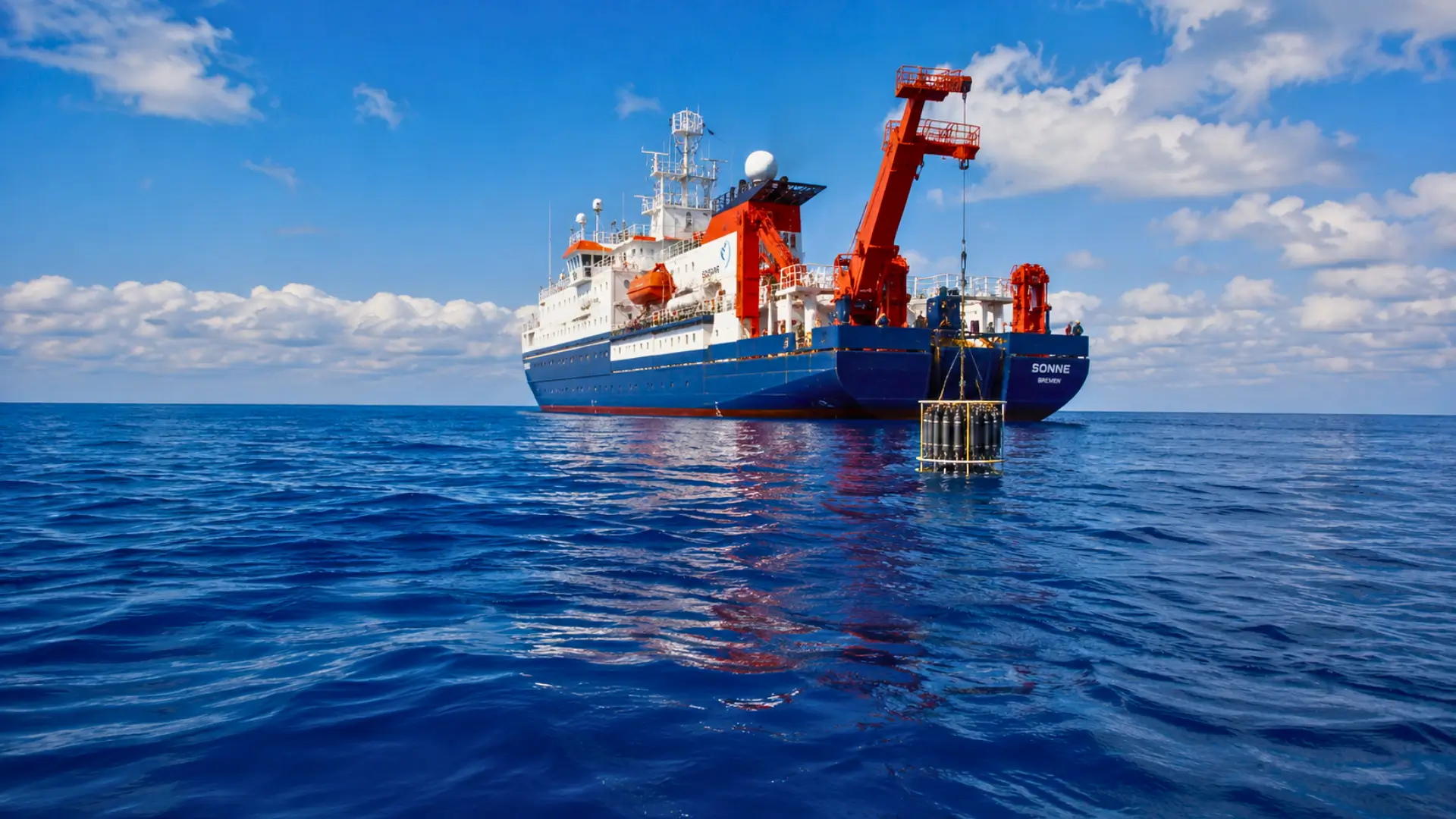
Thousands of kilometers away from major cities, researchers have detected massive traces of zinc linked to human activities in the Southern Pacific. This troubling discovery suggests that even the most isolated oceans are subject to lasting contamination.
The Southern Pacific now bears the invisible traces of human activity
For many years, the Southern Pacific carried with it a nearly mythical image. This vast oceanic region, distant from major shipping lanes and large industrial hubs, embodied the idea of a nature still intact. Yet recent analyses conducted by ETH Zurich and the German GEOMAR center reveal that even this secluded expanse now bears the mark of human pollution.
The scientists identified an abnormal presence of industrial zinc in the upper layers of the ocean. What is most troubling is the distance separating this region from major urban centers. Some portions studied lie so far from continents that they seem almost off the modern world, yet metallic particles are already circulating there.
Behind this discovery lies a broader reality. For decades, the oceans have been absorbing increasing amounts of substances stemming from human activities. Mercury, lead, microplastics or chemical residues are gradually adding to marine ecosystems already weakened by climate warming and overfishing.
Zinc isotopes reveal contamination originating from industrial activities
To understand the exact origin of the zinc found in the ocean, the researchers used a method worthy of scientific investigation. Each chemical element has isotopes, slightly different variants that act as a true signature. With this approach, teams were able to distinguish natural zinc from anthropogenic zinc.
The finding surprised even specialists. In some particles analyzed in the upper Southern Pacific, almost the entire zinc appeared to be linked to human emissions. This pollution does not originate from a single country or a single factory. It travels thousands of kilometers through the atmosphere before slowly falling back into the ocean.
Marine phytoplankton at risk of disruption due to metal imbalance
In seawater, zinc is not automatically an enemy. This metal even plays an essential role for certain forms of marine life. The problem arises when natural proportions change abruptly. The oceans operate thanks to extremely precise balances between several invisible micronutrients.
At the center of this mechanism lies the marine phytoplankton, a community of microalgae capable of producing nearly half of the oxygen present in the atmosphere. These tiny organisms also absorb enormous amounts of carbon dioxide. Without them, the natural regulation of Earth’s climate would become much more unstable.
Researchers now fear that an excess of metals such as zinc, copper or cadmium could disrupt the development of phytoplankton. A shift in this base of the food chain could then affect fish, marine mammals and the entire oceanic ecological networks. Behind a handful of metallic particles lies thus a potential global imbalance.
This invisible pollution shows that no ocean escapes human activities any longer
Published in the journal Nature Communications Earth and Environment, these findings go far beyond the realm of oceanography. They show that human activities now influence regions once considered out of reach, including the most isolated areas of the Southern Pacific.
Perhaps the most puzzling aspect remains the absence of a visible boundary. Winds, sea currents and atmospheric exchanges continually transport particles across the globe. Pollution produced on one continent can end up years later in a remote ocean zone, with no obvious signs for human populations.

Contact details
Address:
Farmers Forum,
36, Dominick Street,
Mullingar,
Co. Westmeath,
Ireland
Phone:
+353 (0)44 9310206
Or email us:
For technical issues please check out our FAQ's page or email - [email protected]
For general Queries email - [email protected]
Request to add event to our Calendar - [email protected]
Send us your mart reports - [email protected]
Suggestions and feedbacks - [email protected]
News Items / Press Release - [email protected]
To Advertise on Farmers Forum - [email protected]