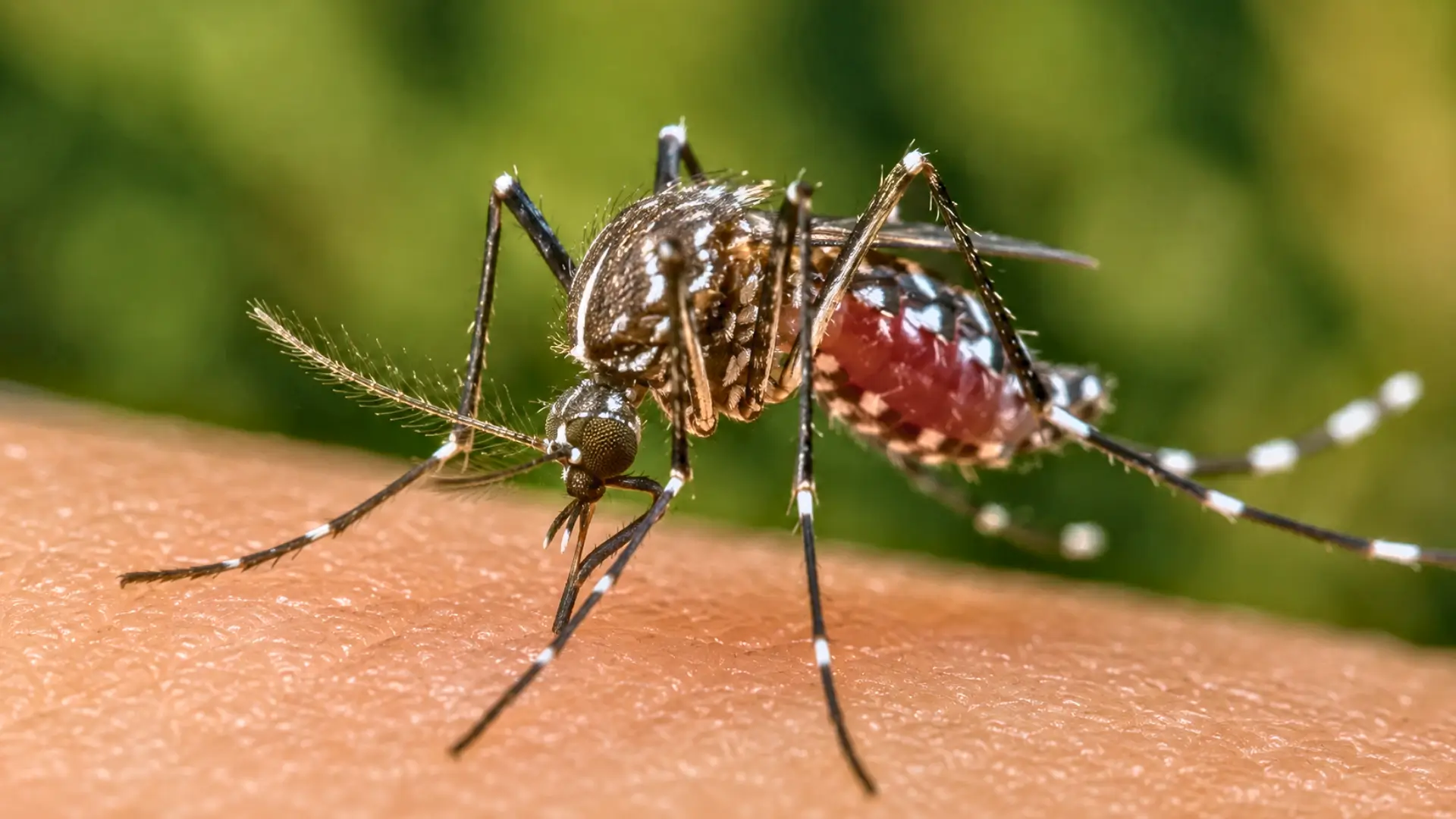
The tiger mosquito is invading gardens and patios from the very first signs of warm weather. Yet an artisanal method inspired by entomology is increasingly intriguing: a simple dark bucket capable of attracting and trapping the females before they reproduce.
The tiger mosquito is turning French gardens into ideal breeding grounds
Since the early 2010s, the tiger mosquito has been expanding across France at an impressive pace. According to Santé publique France, the insect is now established in the majority of metropolitan departments. Its adaptation to urban environments continues to astonish experts, because only a few centiliters of water suffice to trigger oviposition.
The most worrying aspect remains its discretion. Unlike traditional nocturnal mosquitoes, this one often attacks during the day and primarily targets the legs. As a result, outdoor meals become particularly painful. In certain Mediterranean towns, residents even avoid terraces after a marked rainy episode.
Chemical treatments, long presented as the miracle solution, now divide experts. At the same time, several environmental associations warn about their consequences for pollinators and beneficial insects. It is precisely in this climate of mistrust that a minimalist technique, based on a diverted biological trap, is beginning to attract attention.
This artisanal trap exploits the female mosquitoes’ oviposition instinct
The idea may seem almost absurd at first glance. Instead of driving mosquitoes away, this method seeks to lure them in willingly. Yet, everything rests on a very precise understanding of the females’ behavior, programmed to seek stagnant waters rich in organic matter.
In a dark bucket filled with water and decaying vegetation, natural fermentation quickly takes hold. Gradually, this maceration releases chemical compounds and carbon dioxide that mosquitoes detect from a distance. Thus, the mix appears to the females as an ideal oviposition site, comparable to a small protected pond.
The trap becomes formidable thanks to a mosquito net stretched just above the water. The females can lay eggs through the mesh, but they become trapped inside the device. Similar models, called “ovitraps,” are already used in some health surveillance programs in Brazil or Florida to monitor populations of invasive mosquitoes.
A weekly maintenance is enough to prevent larval proliferation
The success of the device hinges on a factor often overlooked: regularity. Indeed, without upkeep, the trap can become the exact opposite of its goal. Mosquito larvae develop very quickly when temperatures exceed 25 degrees, sometimes in less than a week.
To avoid this scenario, the water must be replaced each week on a dry or very warm surface so that the larvae die rapidly. The leaves or matted grass, meanwhile, can stay in the bucket to preserve the attractive scent. This simple routine turns a plain container into an ecological regulation tool.
This ecological method illustrates a new approach to invasive insect management
Behind this method lies, above all, a shift in mentality. For a long time, fighting mosquitoes relied almost exclusively on sprays, diffusers, and insecticides. Today, many researchers favor targeted approaches that disrupt the reproductive cycle directly rather than mass-eliminating all insects.
In several urban neighborhoods, residents are already organizing collective campaigns to eliminate standing water from yards and gardens. A clogged gutter or an overlooked saucer is sometimes enough to produce hundreds of mosquitoes in a few days. This awareness is gradually changing how outdoor spaces are approached.
With rising temperatures and humid spells, some specialists fear an even faster spread of the tiger mosquito toward northern Europe in the coming years. The idea that an old bucket could become a key piece in this ecological battle is somewhat fascinating.

Contact details
Address:
Farmers Forum,
36, Dominick Street,
Mullingar,
Co. Westmeath,
Ireland
Phone:
+353 (0)44 9310206
Or email us:
For technical issues please check out our FAQ's page or email - [email protected]
For general Queries email - [email protected]
Request to add event to our Calendar - [email protected]
Send us your mart reports - [email protected]
Suggestions and feedbacks - [email protected]
News Items / Press Release - [email protected]
To Advertise on Farmers Forum - [email protected]