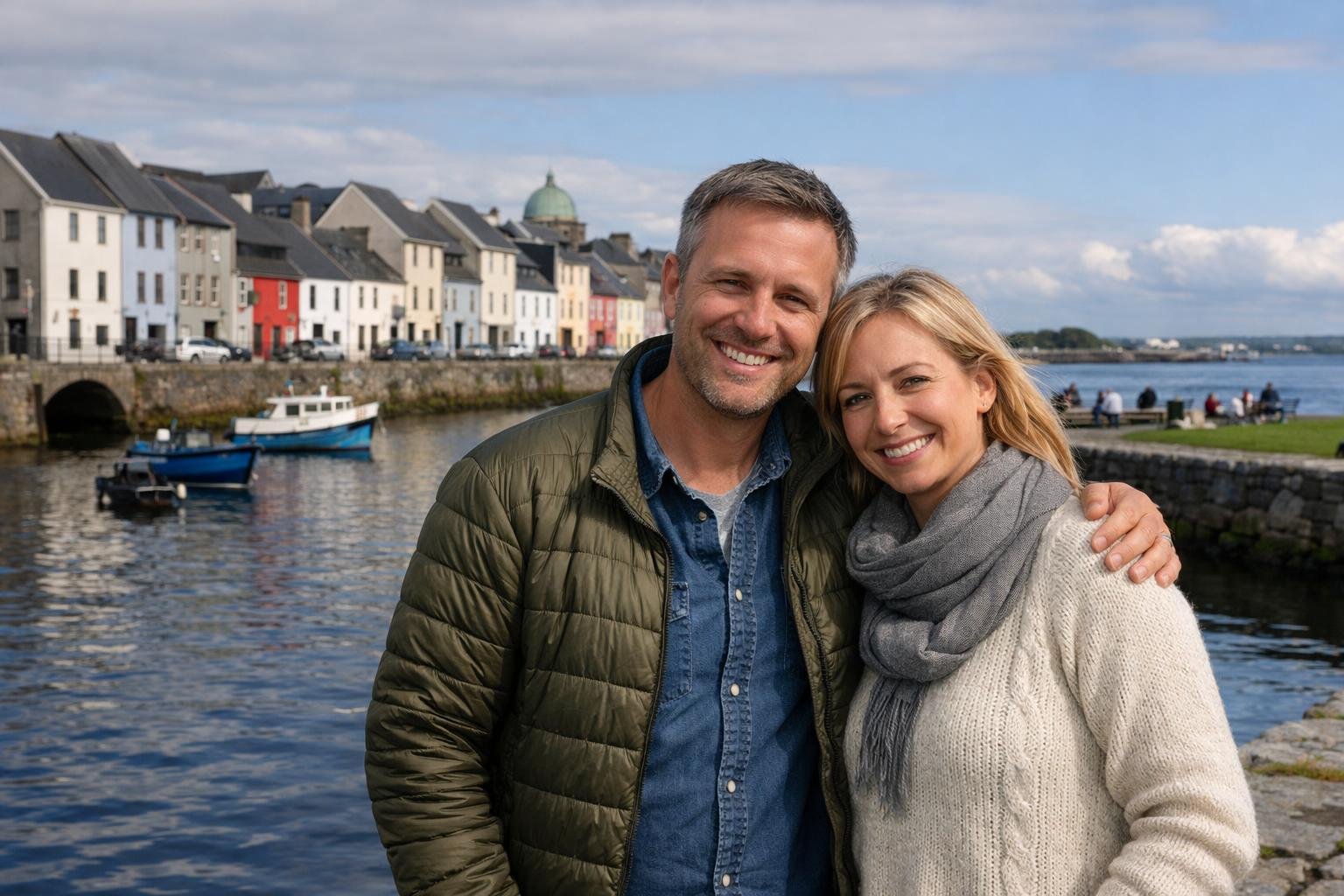
The ferry pulled into the bay under a wet sky, and Emma squeezed Jack’s hand. They had crossed a narrow stretch of water, yet it felt like a continent, a small leap that changed everything. Sitting on a suitcase in the hostel common room, they decided to stay, to build a life where mist meets music.
Why Galway called to them
They had visited on a long weekend, drifting through Shop Street’s buskers and the quiet curve of the Claddagh, and felt a tug they couldn’t name. “It wasn’t glamour,” Jack said, “it was the hum of a place that felt awake.” They both worked remotely in design and communications, craving a city that was creative but human.
On the map it looked small, but the edges spill into the Atlantic, and that sense of horizon became their daily medicine. “Galway doesn’t shout,” Emma added, “it sings, and the note lingers in your bones.”
The first weeks: awkward, bright, and salty
They found a tiny flat near Salthill, the kind with a stubborn window and a kettle that clicks like a metronome. The landlord handed over keys and a folded list of bus routes, and they learned the wind’s grammar on the Prom. Every evening, they watched locals turn for the Blackrock diving tower, counting steps like a prayer.
“The weather is a character, not a backdrop,” Jack laughed, stuffing towels into a backpack after a sudden downpour. They bought layers, seeded herbs on the sill, and learned to start mornings with strong tea and forgiving plans.
Finding a rhythm in a city of listeners
Community arrived in increments, a borrowed spade, a barista remembering their order, a Thursday session that welcomed a cautious bodhrán. “People actually listen here,” Emma said, “they leave rooms of silence so your story can breathe.” In a week, they had three new friends; in a month, they had a choir of names.
They volunteered at a cleanup by the river, then stayed for chips, watching swans fold themselves into white commas. On mismatched chairs, strangers traded recipes and routes to Connemara’s best bog road at sunset.
Work, money, and the softer clock
Remote work gave them flexibility, but they still chased Wi‑Fi like a pair of pilgrims. They learned which cafés had steady signal, which pubs let laptops linger until the first fiddle. “The cost of living can be spiky,” Jack admitted, “but the return on time is lavish.”
Their workday now breathes: morning emails, a fast walk, lunch by the Long Walk, then an afternoon push before the light slips. They measure days not by traffic, but by the sea’s mood, and a calendar dotted with small joys.
Weather as teacher, landscape as ally
Storms blew in like drummers, then cleared to blinding silver. They bought practical coats and learned to name clouds, hearing locals talk of the west with protective tenderness. “You don’t fight the rain,” Emma said, “you make a truce and keep moving.”
Weekends stretch wide: a bus to Roundstone, a shared flask on the Burren’s lunar limestone, or a chilly dip that resets the heart. “Connemara keeps our ego in check,” Jack smiled, “the mountains are always older and always right.”
Trad nights, small rituals, and the art of showing up
They stopped chasing the “best” pub and started showing up at the one with a corner that feels like home. A fiddler nods, the room leans in, and songs with salt on them spill into the night. They walk back along wet cobbles, trading lines of poems they never meant to memorize.
Out of the big-city hurry, they made small rituals:
- A Friday swim at high tide, no matter the mood
- A monthly train to Dublin to remember the scale
- A notebook of overheard phrases, saved like seeds
- One new route each week, even if it’s only a new alley
What they miss, and what they don’t
They miss late-night takeaways, a particular park, the familiar thrum of friends within twenty minutes. They do not miss the commute, the Tuesday misery, or the sense that their best hours were being spent on nothing.
“Here we’re not escaping,” Emma said, “we’re arriving, again and again.” A gull screams like a critic, the kettle hisses like a polite storm, and they feel oddly grown and newly light.
Advice for the next ferry
If you plan to swap one coast for another, they suggest small courage and practical boots. Ask questions, learn how to pronounce Gaillimh, buy a decent map, and tip the first musician who stops your breath. “Let the place teach you,” Jack said, “and don’t rush the hello.”
They didn’t find a perfect life, just a truer cadence, the kind that fits your lungs and lets your days sing. On clear evenings, the light turns liquid, the tide pulls at your ankles, and you remember why you came and how to quietly stay.

What a fabulously romantic, winning article ❤️❤️❤️❤️ all that Ireland is
Congratulations to Liam Kennedy on a lovely piece of writing. Congrats also to Emma and Jack for taking a leap of faith and winning.
I took that leap 45 years ago and never left Galway since. It has everything you describe and all are welcome. I’d tell you my favourite place to watch the sun go down on Galway Bay but then you’d all be there.
Sean. Thank you such much for a brilliant article.
I am born and bred in Ireland, in a hilly mountainous range in West Cork and im am still living here.
I have the fiercest grá for Galway. There is a ‘dríocht’ in the place that keeps you coming back time and time again.
So I can well understand people from outside this country coming over and getting hooked on this special little ‘cornereen” of Ireland.
The people, the place, the scenery, the pints and ‘the welcome’ – its all magical ..
You loose time in Galway.. it goes unaccounted for, but nobody asks or are even worried where it goes.
I loved this article about An Gailimh which is so very well written and the words are musical in their own rite on the descriptions of The Tribal Town.
It was an enchanting read..
Brilliant .What mpre can i say.
Don’t know how you crept in..but love meeting your pieces. Did not check how long or when you both came..but welcome. I look forward to the next meander..and that is truly what you’re writing is or does..it takes me on a reflective walk. Take care enjoy and continue with your craft.