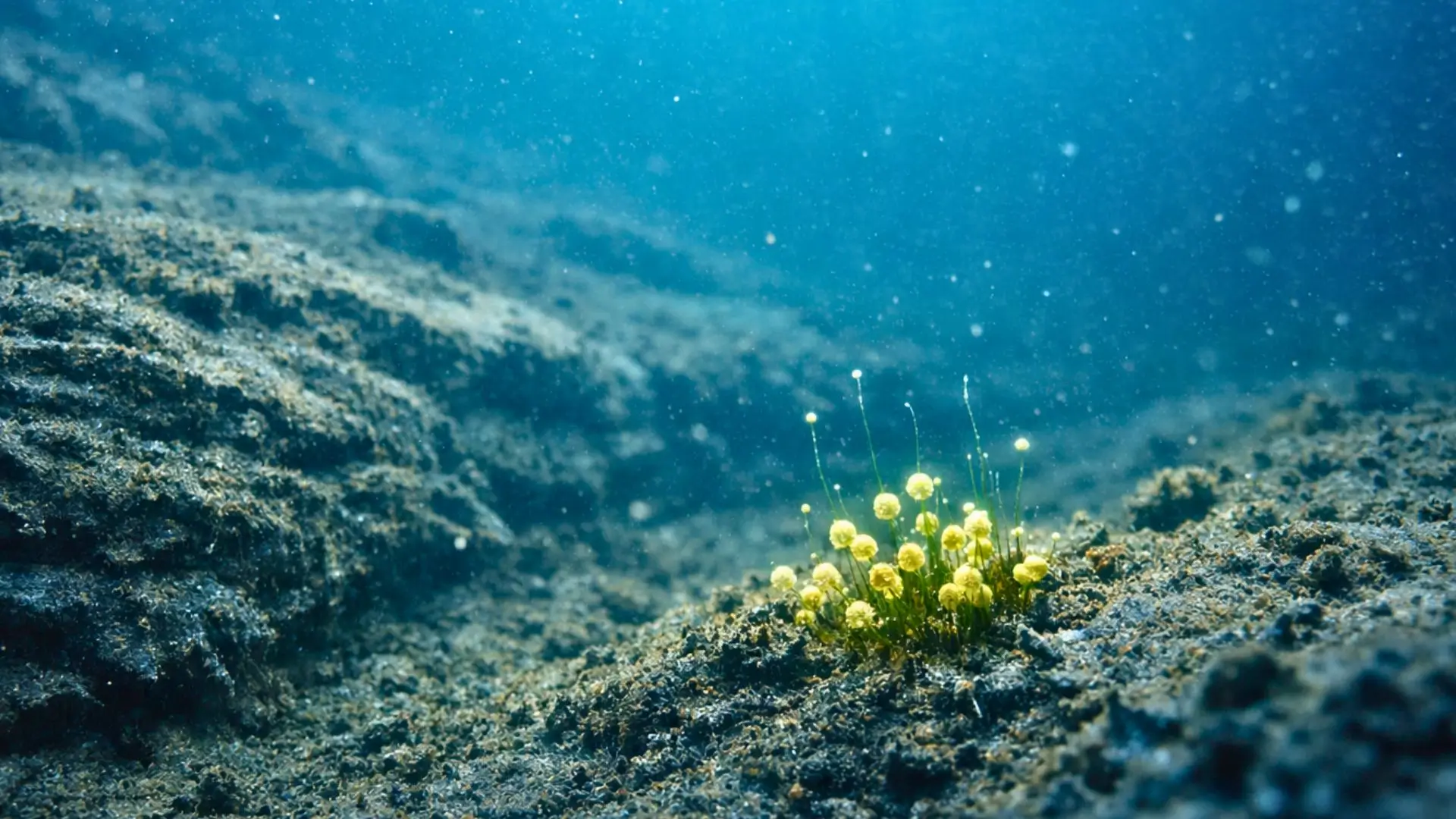
In the Baltic Sea, researchers have reactivated a diatom that had remained dormant for nearly 7,000 years. The announcement, published in early 2025, is not merely a record-breaking feat. It opens a concrete pathway to track the evolution of marine life.
At 240 meters under the Baltic, 6,871-year-old cells restart and shake the notion of living time
Everything begins in the eastern Gotland trench, at a depth of 240 meters. In 2021, the team retrieved sediment cores spanning roughly 7,500 years of history. In these anoxic layers, dormant cells were still awaiting their return.
The result is impressive because it rests on a solid fact: the diatom Skeletonema marinoi came back to life after up to 6,871 years of dormancy, with a margin of about 140 years. The study was published on January 3, 2025 in The ISME Journal.
This revival is not miraculous: light, oxygen and nutrients were enough to restart an intact mechanism
The researchers did not find an active organism by luck. They placed the sediments back under favorable conditions, with light, oxygen, and nutrients. Then some cells germinated, then began to grow again, divide, and produce oxygen, as in Baltic springtime.
A crucial detail: among all the samples tested, only one species was revived across all examined ages. It is this diatom, very common in today’s Baltic, especially during the spring bloom, which reinforces the comparison.
This point changes how we read the result. We are not merely looking at symbolic survival. We observe a complete functional restoration, documented in the laboratory, in cells buried since the time when the Baltic Sea was still undergoing deep environmental transformations.
The most troubling part comes next: growth and photosynthesis remain stable, despite seven millennia of silence
The most striking feature is the recovered biological stability. The resurrected strains show growth rates comparable to recent lineages. The maximum observed reaches 0.31 divisions per day. In other words, time has not broken their cellular engine.
Photosynthesis tells the same story. They measured an average production of about 184 micromoles of oxygen per milligram of chlorophyll per hour. Yet the interest goes beyond raw performance. These cells offer a living archive of the marine past.
Behind the feat, a method stands out: comparing living lineages separated by millennia changes everything
This is where the study becomes fascinating for you and for climate research. Through genetic analyses, notably by microsatellites, scientists distinguish cohorts separated in time. They can thus track living lineages adapted to several ancient states of the Baltic.
Then, this approach known as resurrection ecology offers more than a pretty headline. It enables direct comparisons between living organisms separated by millennia. To understand adaptation, it is much more powerful than mere fossils or fragments of DNA.
Finally, this breakthrough does not promise biological miracles. It shows rather where to look to test the resilience of life in the face of crises. In oxygen-poor seas, sediments sometimes preserve an active memory, capable of shedding light on our future.

Contact details
Address:
Farmers Forum,
36, Dominick Street,
Mullingar,
Co. Westmeath,
Ireland
Phone:
+353 (0)44 9310206
Or email us:
For technical issues please check out our FAQ's page or email - [email protected]
For general Queries email - [email protected]
Request to add event to our Calendar - [email protected]
Send us your mart reports - [email protected]
Suggestions and feedbacks - [email protected]
News Items / Press Release - [email protected]
To Advertise on Farmers Forum - [email protected]