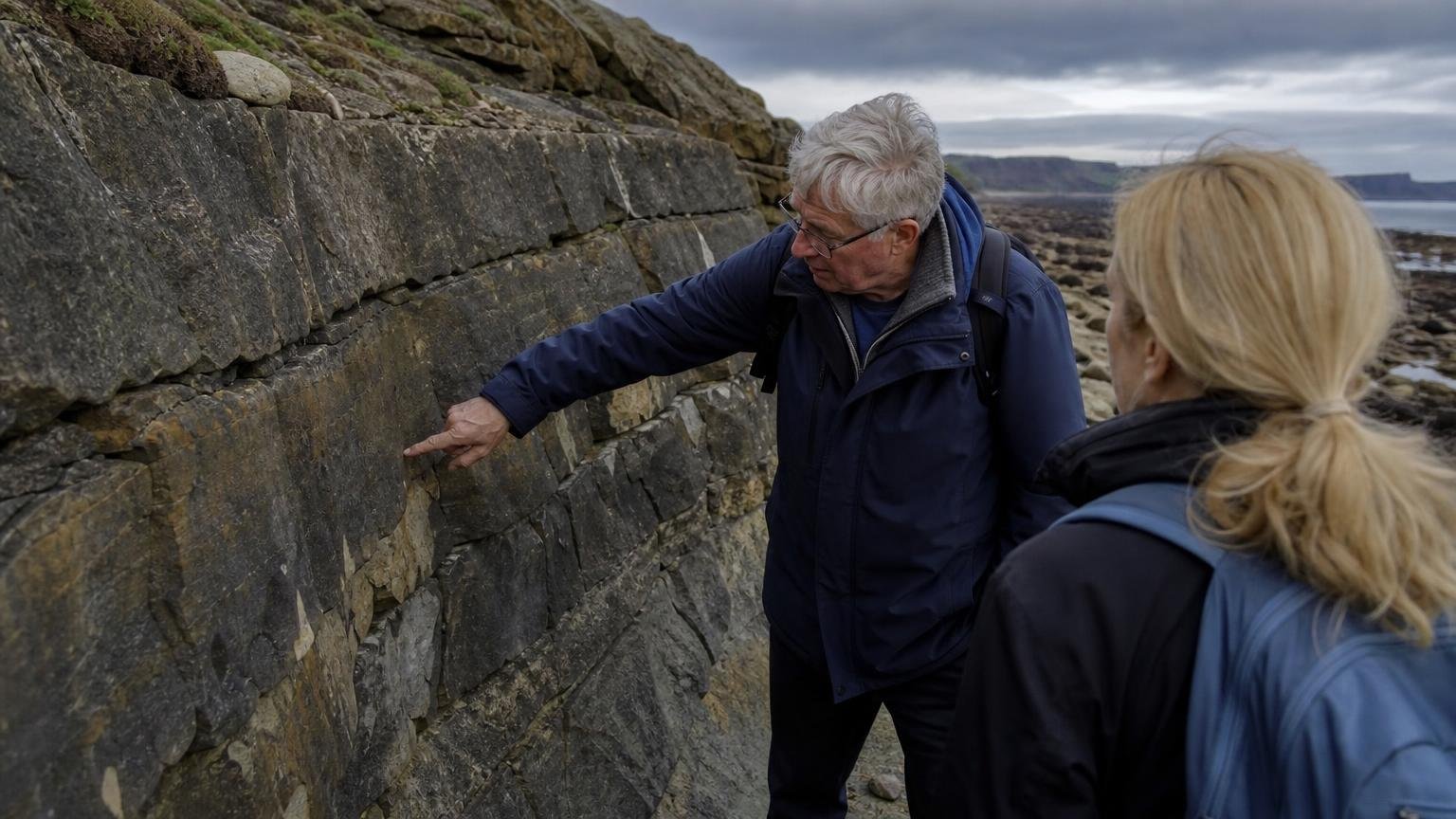
The first steps feel ordinary, but the ground is anything but. Each stride along this wind-bright edge of County Antrim stacks eras beneath your boots. In a couple of hours, the coast arranges the island’s deep past into readable layers, until cliffs and coves begin to sound like sentences and the map of Ireland turns into a story.
A gull veers, the Atlantic hammers, and the rocks answer. “The sea is the best geologist in Antrim,” an old fisherman once told me, “it reads what the rain writes.” Walk here and you learn to read it too: the black organs of volcanic columns, the white ribs of chalk, the honey-brown soils that whisper of tropical rain.
Where two hours stretch across deep time
Pick a two-hour slice of the Causeway Coast Way, and the timeline unfurls with ease. From Ballintoy Harbour to White Park Bay, on to Dunseverick Head, or from Dunseverick to the Giant’s Causeway—each segment is a compressed atlas.
The cliffs keep you high, then dip to beaches where fossils hide in plain sight. Waymarkers guide you over grassy promontories, past ruined walls, and into views that spool from Rathlin to the Mull of Kintyre.
A ranger once grinned at my notebook and said, “Give me two hours out here, and I’ll give you 400 million years.”
Layers that tell a story
Begin with older limestones and sandstones far below, ghosts beneath the fields. Near the shore, Cretaceous chalk steps clean from the cliff, laced with dark flint that once sparked Mesolithic fires and myths.
Above it lie Paleogene basalts, poured out as lava about 60 million years ago, cooling into astonishing columns. Some joints run like an organ pipe, others twist into fractured puzzles, all stacked over a thin band of rusty clay—the “interbasaltic” horizon—a tropical soil baked by time.
Look again and ice-age scripts appear: smoothed terraces, raised beaches, dunes that migrate like herds in a slow, airy dance. The coast is not just old; it is restless, always writing, always editing.
Walking the sequence under your feet
From Ballintoy, the path lifts onto limestone platforms and drops toward White Park Bay, where dunes breathe under marram and the scent of kelp feels almost prehistoric. Peer into the cliff and you’ll see chalk gleaming through grass, with tabbed flints like piano keys set in milk.
Push on to Dunseverick and the landscape hardens. The basalt cliffs turn serious, their black sheen clipped by sea spray. In small falls and fallen blocks, hexagons reveal their secret: a liquid past that crystallized into order.
Closer to the Causeway, the neat architecture of columns becomes surreal geometry. Walk the cliff top and the pattern still thrums through the turf, as if the land is quietly counting in sixes.
Human threads in the rock
People lean into this coast, the way grass leans into the wind. Lime kilns bite into chalky banks, old salmon stations cling to volcanic islands, and toponyms carry a cargo of Gaelic air.
Stand at a ruined castle, and the stones explain the myth. You don’t need giants to build a rocky road across the sea; you only need lava and patience, cooling and cracks. Yet the legend fits because the rock invites it—massive, musical, and intentional.
A local guide once murmured, “Our stories are anchored in the stone—pull the anchor, and the boats drift.”
What to watch for, fast
- Basalt over chalk: black on white, a crisp geologic semicolon you can spot in many cliff reaches.
How to see more with less
Start with the tide in mind; low water opens rock ledges and safe sand arcs. On high cliffs, the wind can punch like a boxer, so shoes with bite and layers that seal are not optional.
Buses link villages and trail heads, so you can one-way your walk and save light. Car parks sit at Ballintoy, Dunseverick, and the Causeway Visitor Centre; arrive early in summer, or aim for a golden hour.
Step lightly on turf and dunes; this is living fabric, stitching the cliffs to the sea. Search for fossils with eyes, not hands—photographs travel better than pockets full of someone else’s past.
Why the place finally clicks
Some coasts are pretty; this one is persuasive. The order of layers turns scenery into sense, and the walk becomes a decoder ring. You start by admiring shape and colour; you end up hearing process and time.
On the return, the same headlands read differently. That white band is no longer a stripe; it’s warm Cretaceous seas compressed to chalk. Those black pillars are not a quirk; they’re lava slowed to a patient architecture.
“Once you’ve seen it,” says a ranger, “you can’t unsee the story.” In two hours, the coast gives you a map to carry home—thin as a memory, solid as stone.

Contact details
Address:
Farmers Forum,
36, Dominick Street,
Mullingar,
Co. Westmeath,
Ireland
Phone:
+353 (0)44 9310206
Or email us:
For technical issues please check out our FAQ's page or email - [email protected]
For general Queries email - [email protected]
Request to add event to our Calendar - [email protected]
Send us your mart reports - [email protected]
Suggestions and feedbacks - [email protected]
News Items / Press Release - [email protected]
To Advertise on Farmers Forum - [email protected]