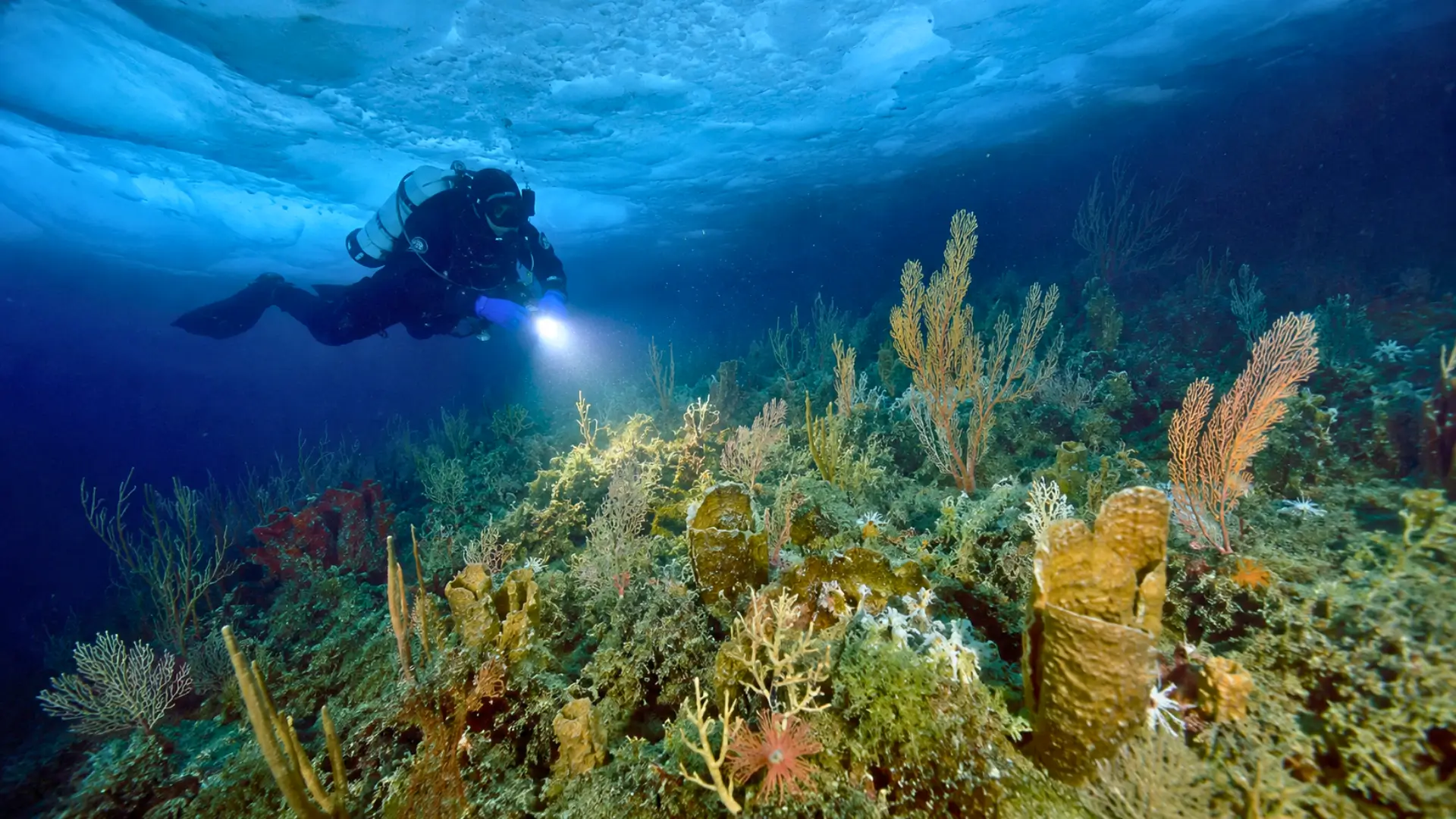
Beneath the Antarctic ice shelf, where one tends to imagine only emptiness, cold, and silence, divers encountered a landscape almost hard to believe. At 130 meters depth, a French expedition describes a teeming, fragile animal forest, perhaps pivotal in understanding the ocean of tomorrow.
Under the Antarctic Ice, an Extreme Dive Reveals an Invisible Ecosystem
Above, the scenery seems almost hostile to life. From the outset, the Antarctic Peninsula lines up ice, brutal winds, and cutting light. Yet beneath this mineral surface, the expedition Under The Pole spent three months exploring another world. More precisely, the mission took place on the western coast of Antarctica, as part of the DEEPLIFE program conducted with the CNRS.
The figure is dizzying. Indeed, the divers descended to 130 meters deep. That’s well beyond ordinary diving, in subzero water where every move costs. Moreover, some immersions lasted nearly three hours. They thus required heating equipment and logistics planned to the millimeter.
That is where the narrative shifts. Instead of a bare seabed, scientists encountered dense assemblages of gorgonians, corals, and sponges, standing like antlers. Thus, the term animal forest is not merely a poetic image. It describes a living, complex architecture. Within its reliefs, a multitude of species can find refuge.
At 130 Meters Deep, the Mesophotic Zone Reveals an Unforeseen Abundance
The color is another surprise. On the surface, Antarctica naturally evokes white, blue, and sometimes gray. Yet the Ocean Decade led by UNESCO reports that at depth, divers witnessed a true visual explosion. From then on, the contrast with the surface becomes striking. The abundance and density astonished from the very first observations.
In this so-called mesophotic zone, between 30 and 200 meters, light becomes scarce but does not disappear entirely. Yet this tier of life remains poorly understood. It lies between depths accessible to conventional divers and those accessible to robots. In other words, it constitutes a scientific blind spot where major ecosystems may hide.
Gorgonians, Sponges, and Corals Form a Key Habitat for Antarctic Biodiversity
These structures fascinate not only because they are beautiful. They also play a concrete role as a refuge for marine life. Between the flexible branches of the gorgonians, the masses of sponges, and the coral reliefs, many species find food, shelter, and breeding areas. Thus, taken together, they evoke an inverted canopy hanging beneath the sea.
That is the core objective of the ten-year program running from 2021 to 2030. Researchers measure the density of the forests, the size of organisms, the composition of species, and even the flow of currents. Behind the spectacular imagery, the aim is clear: to generate solid data to understand how these habitats function and their potential resilience.
The topic is far from being anecdotal. Moreover, Radio France notes that these ecosystems could contribute to the maintenance of biodiversity in the face of climate disruption. In a region already disrupted by warming, pressure on krill is also increasing. These forests could thus become refuges as precious as they are vulnerable.
This Spectacular Discovery Reinforces the Urgency of Protecting Polar Depths
The paradox is stark. Indeed, these worlds are barely described, yet they are already threatened. The Ocean Decade notes that marine animal forests have recently been recognized as vulnerable marine habitats by the IUCN. This recognition matters greatly. Because naming a habitat is already the first step in being able to defend it politically.
Under The Pole is therefore not only seeking to reveal the invisible. The team also wants to feed these observations into the debate on marine protected areas. The aim is simple. From now on, deep zones must no longer stay out of the frame. Otherwise, protecting only the surface of an ocean would be like saving the roof of a cathedral while neglecting the nave.
What is at stake beneath the Antarctic goes beyond mere exploration prowess. In fact, this forest observed at 130 meters reminds us that the most extreme regions are not empty margins. They are living libraries with many pages still closed. Perhaps, then, the great discoveries of the 21st century will begin there, in zones long judged silent.

Contact details
Address:
Farmers Forum,
36, Dominick Street,
Mullingar,
Co. Westmeath,
Ireland
Phone:
+353 (0)44 9310206
Or email us:
For technical issues please check out our FAQ's page or email - [email protected]
For general Queries email - [email protected]
Request to add event to our Calendar - [email protected]
Send us your mart reports - [email protected]
Suggestions and feedbacks - [email protected]
News Items / Press Release - [email protected]
To Advertise on Farmers Forum - [email protected]