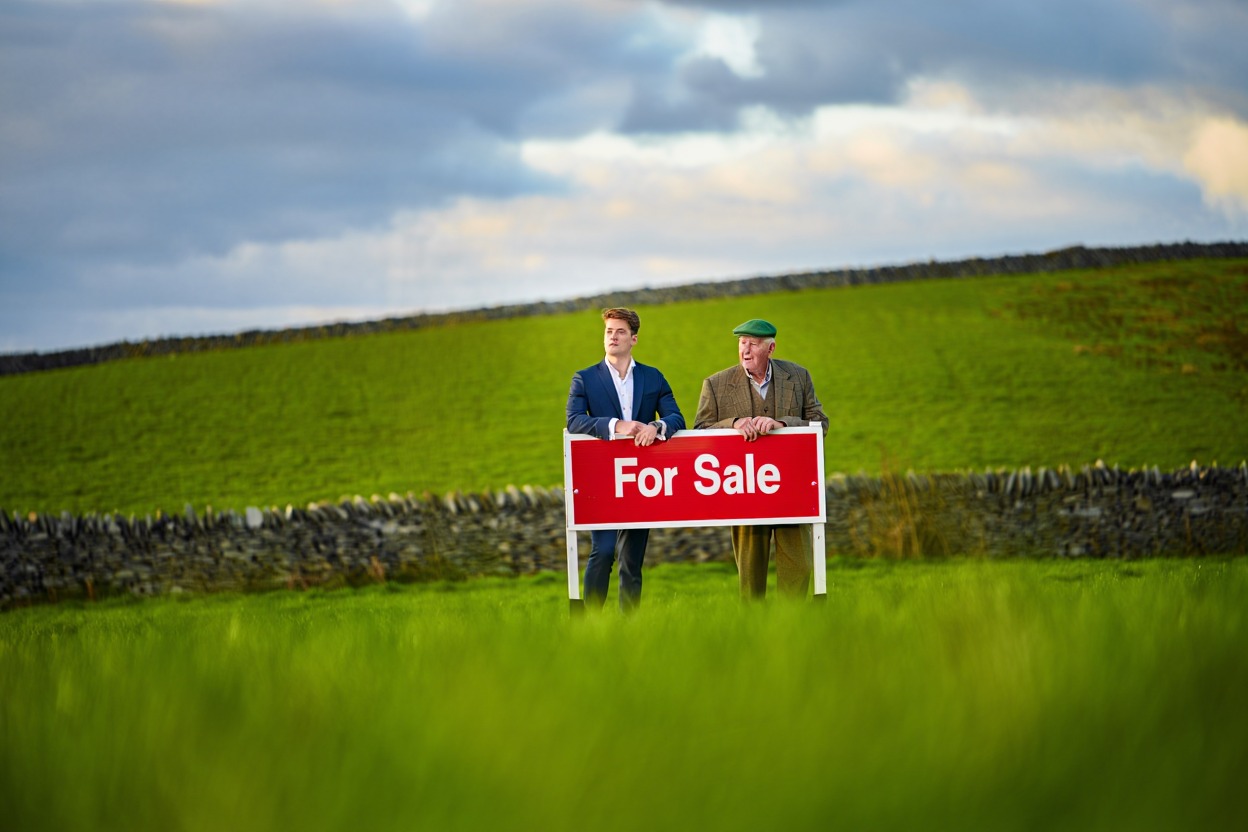
For generations, farmland in Ireland passed quietly from one farming family to another. Sales were local. Buyers were known. The land stayed within the agricultural community.
That pattern is changing.
Across counties such as Cork, Meath, Tipperary and Galway, auctioneers report a steady increase in non-farmers entering the market. In some areas, they are not just participating. They are outbidding traditional buyers.
The shift is subtle, but its implications for rural Ireland could be significant.
A Safe Haven in Uncertain Times
One of the main drivers behind the trend is financial. Agricultural land is increasingly viewed as a stable, long-term asset. At a time of inflation volatility, stock market swings and housing pressure, land is perceived as tangible security.
Unlike residential property, farmland carries fewer development risks and often benefits from predictable rental income through leasing arrangements. Long-term leases to active farmers provide steady returns without the day-to-day responsibilities of farm management.
For high-net-worth individuals and investment funds, Irish land offers both capital preservation and potential appreciation.
In some cases, buyers are motivated by tax planning advantages or diversification strategies. Land is not always purchased to farm it. It is purchased to hold it.
Limited Supply, Rising Prices
Ireland has a relatively small volume of farmland transactions each year. When land does come to market, competition can be intense. Active farmers often depend on expansion to improve efficiency and remain viable. However, their borrowing capacity is typically tied to milk or beef price cycles.
Non-farming buyers may have access to liquidity that is not linked to agricultural margins. This creates an uneven playing field at auctions.
In certain regions, particularly dairy-heavy counties, per-acre prices have climbed sharply. Local farmers report difficulty competing against bidders who are not reliant on farm income to justify the purchase.
The result is a gradual shift in ownership patterns.
Lifestyle and Environmental Motivations
Not all non-farming buyers are investors. Some are motivated by lifestyle choices. Remote working has increased interest in rural living. Owning land offers privacy, environmental control and long-term flexibility.
There is also growing interest in rewilding and environmental projects. Buyers focused on biodiversity, carbon offsetting or conservation are acquiring land to pursue sustainability initiatives rather than agricultural production.
While these goals may align with climate objectives, they can reduce the availability of productive farmland for active farming families.
Impact on Young Farmers
Perhaps the most sensitive issue is generational transfer. Young Irish farmers already face high entry barriers due to land prices and capital requirements. When non-farming buyers push prices further upward, succession becomes more complex.
Leasing remains an option, but ownership provides security and borrowing capacity. Without realistic pathways to purchase land, younger farmers may delay expansion or exit the sector entirely.
Rural communities feel these shifts quietly. Fewer owner-operators can mean fewer long-term commitments to local infrastructure, schools and co-operatives.
A Structural Change in Irish Agriculture?
The increase in non-farmer ownership does not signal an immediate crisis. Ireland’s agricultural model remains strong, particularly in dairy and grass-based systems. However, ownership patterns shape long-term resilience.
If land increasingly becomes an investment vehicle rather than a working asset, questions arise about decision-making priorities. Will profitability be balanced with food production goals? Will leasing arrangements support sustainable practices?
Policy discussions are beginning to reflect these concerns. Some industry voices argue for measures that prioritise active farmers in land transactions. Others defend open markets and property rights.
For now, the auctions continue.
In quiet parish halls and online bidding platforms, farmland changes hands. Sometimes the buyer farms the neighbouring fields. Increasingly, sometimes they do not.
The transformation is gradual, but it is real. And for many in rural Ireland, the future of land ownership may prove just as important as the future of farming itself.

Contact details
Address:
Farmers Forum,
36, Dominick Street,
Mullingar,
Co. Westmeath,
Ireland
Phone:
+353 (0)44 9310206
Or email us:
For technical issues please check out our FAQ's page or email - [email protected]
For general Queries email - [email protected]
Request to add event to our Calendar - [email protected]
Send us your mart reports - [email protected]
Suggestions and feedbacks - [email protected]
News Items / Press Release - [email protected]
To Advertise on Farmers Forum - [email protected]