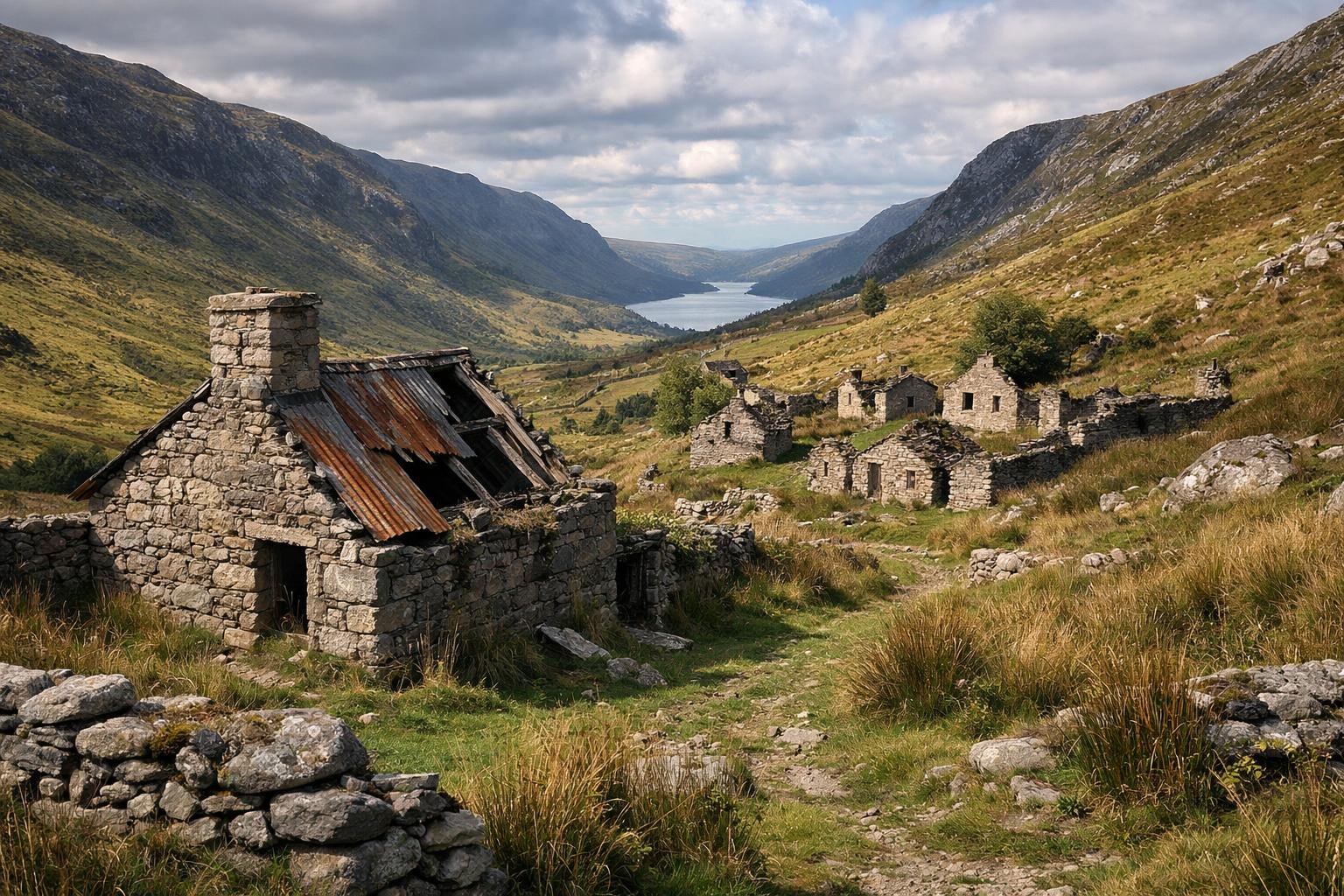
The road narrows, the hedges rise, and the Atlantic drops away into a quiet blue that feels older than maps. In the hush of a deep Donegal valley, ruined cottages lean into the wind, their doorways pocked by salt and time. You step from the lane and the air turns bright, the kind of bright that makes you squint even without sun, and think: someone lived a whole life here. A kettle hissed, a net dried, a child chased a hen around a broken wall. “It’s the stillness that gets you,” a walker told me, “the sense that the world has paused just long enough for you to hear your heart.”
A valley that swallowed time
The slope folds inward, a green pocket stitched with bog cotton and the pale ribs of drystone walls. From above, the cluster seems almost orderly, a chessboard the sea abandoned. Up close, it turns intimate: hearthstones still warm in memory, lintels scored by hands that knew the heft of a creel and the sting of spray.
On days when the cloud sits low, the place feels inland, hushed by turf and gorse. When the sky clears, the ocean reasserts itself, a vast sheet breathing in slow, tiring heaves. The valley holds that tension—between exposure and shelter, between a hard edge and a soft hollow—the way a palm cups a flame. It is not empty so much as listening, and you begin to listen too.
Stone whispers and salt air
Every threshold suggests a story, but the stories come in fragments: a skillet rusting into peat, a window slashed by bramble, a lane rubbed to a shine by bare feet. The houses were built to endure, yet the ocean teaches patience by undoing. Roofs slip first, then rafters, then walls that slouched so gently you hardly noticed they were falling.
Stand in a shell of a room and the wind becomes a narrator, stitching together peat-smoke and herring, weddings and wakes, the everyday industry of making a poor place generous. “They weren’t just surviving,” someone once said, “they were living, and the landscape was their language.” If you listen long enough, you can almost hear the verbs under your boots.
From hearthfire to silence
Why the people left is a braid of reasons, each strand rough with fact and fray with myth. Famine years bent the back, rents climbed on land that never quite gave enough, and the sea—so often provider—could turn a month’s hope into broken rope overnight. Winter storms raked the clachan, and the young looked over the horizon and saw light elsewhere.
Records are patchy, memories are tender, but the end feels less like a single event and more like a tide going out and forgetting to return. Fishermen folded their nets, mothers packed the press, and one by one the doors closed. Some went only a few valleys over, others crossed an ocean and posted back a careful photograph: a brick stoop, a new street, a smile that looked a little borrowed. The village did not so much die as it entered a different tense.
Finding it, keeping it wild
You can reach the ruins by a lane that becomes a track, and a track that becomes the simplest advice on any map: walk down. Park with care, tread lightly, and let your curiosity be slow. The last hundred meters are where the valley does its work, swapping chatter for breath, itinerary for attention. The temptation is to mark the spot, to name it too precisely, to translate secrecy into hashtags. Resist that urge. What’s left here is rare, and rarity asks for manners.
- Pack your rubbish out, keep to paths, touch with eyes not hands, and give livestock the kind of space you’d want on a bad day.
If you come in early light, the dew slicks the grass and the cottages look newly washed; at dusk, swallows draw soft punctuation over the gables and the stones go sober. Winter strips the place to its grain, summer feathers it with heather and gull feathers. All seasons are right, if you’re ready to be small.
A quiet hour at the edge of the map
Find a wall that still stands, and sit a little while. Count the waves that never repeat, the sheep that never quite agree, the minutes that stretch longer than your plans. You may feel a sting—not sadness exactly, more a kinship with people who asked the same questions you do and solved them with work, with song, with the arrangement of stones into shelter.
When you finally turn back, you’ll carry something unshowy: the clean taste of wind, the weight of quiet, a sense that the present is only one of time’s rooms. And if a friend later asks where you’ve been, you can simply smile, and say you found a little place where the past still remembers your name.

Contact details
Address:
Farmers Forum,
36, Dominick Street,
Mullingar,
Co. Westmeath,
Ireland
Phone:
+353 (0)44 9310206
Or email us:
For technical issues please check out our FAQ's page or email - [email protected]
For general Queries email - [email protected]
Request to add event to our Calendar - [email protected]
Send us your mart reports - [email protected]
Suggestions and feedbacks - [email protected]
News Items / Press Release - [email protected]
To Advertise on Farmers Forum - [email protected]