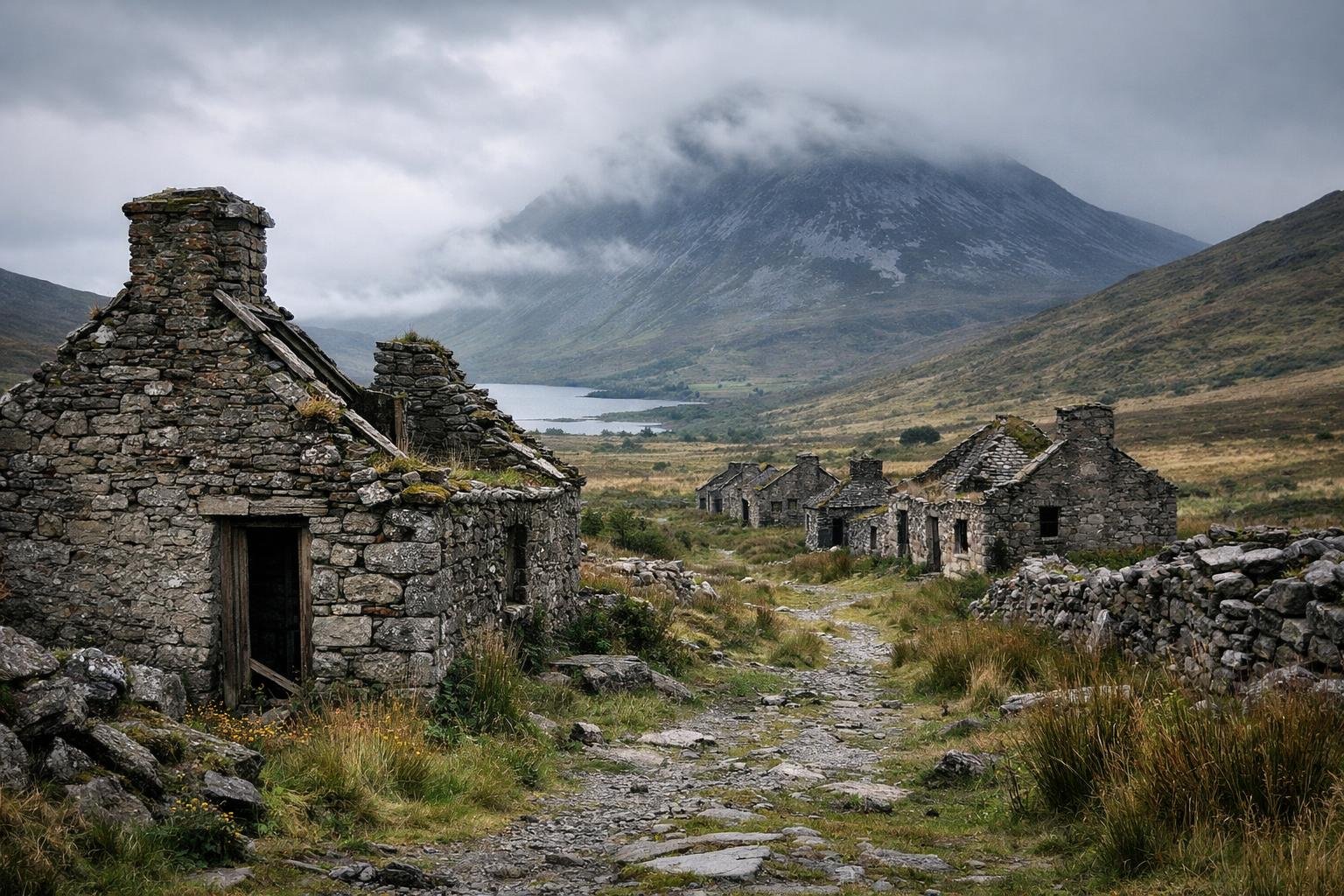
Salt-black wind curls over Achill Island and brushes a silent slope where stone walls lie open to the sky. Paths crease the heather like veins, and doorways frame only weather. You step onto an old laneway and the hush grows loud, the way sea-roar turns into memory. “It feels like time stopped,” someone whispers, and the place agrees with a shiver.
A ridge of rooms left to the wind
On the southern side of Slievemore, a string of roofless cottages climbs the hill. Their gables stand like books, spines out to the Atlantic. Between them run ribs of field, low stones and ditches combed by sheep. The ground keeps a texture of lives, pressed into peat and granite.
Each house faces the same way, toward light and shelter. Lintels lean but still feel deliberate, angles cut with care. Chimney stacks, short and stout, bite into cloud. A single lane stitches the row, threaded by puddles and crushed quartz.
How a village fell silent
People built here long ago, on rhythms of season and survival. Before potatoes failed, this ridge carried voices, smoke, and cattle. The Great Famine shoved families from hearth, but the story has more weave than flight. For decades after hunger, many returned in summer, practicing booleying, a highland transhumance that moved people with their herds.
They lived in these houses for months, then drifted back to lower wintering grounds. In time, emigration thinned the lanes, and wages tugged toward steamships and cities. By the early twentieth century, only grazers and weather remained. The doors stopped swinging, and the walls kept the last words.
Reading the stones
Look closely at the mortar, and a patient logic appears. Longstones sit as quoins, binding corners with quiet strength. Hearths mark the center, where turf flamed blue and sweet. Window slits are narrow and clever, built to cheat gales and save heat in thin light.
Some floors sink with peat, springy under your step. Thresholds polish to a soft shine, the patina of countless boots. You may find shards of slate, a rusted hinge, a buried cup. “Nothing fancy,” a guide once said, “but everything needed.”
Older than famine
Above the cottages, archaeology nudges your shoulder, asking for time. Neolithic tombs brood in the heather, older than stories we still tell. Lazy-bed ridges stripe the slope, a memory of potato furrows before they withered into rough grass. Field systems crisscross like maps, layered over centuries of hands.
The place is a kind of palimpsest, written over and over in weather and work. What survives is the grammar of a community: alignment, sharing, and the practical poetics of shelter. Even the gaps feel intentional, voids that hold the shape of vanished roofs and routines.
Walking the laneways today
The loop is gentle but uneven, a mile of soft rises and stones that roll under soles. Light flickers across Keel strand below, a band of silver sand curling into cold blue. Sheep watch with yellow eyes, saints of this pared-back parish. Ravens throw their harsh laughter, a chorus that suits the mood.
Visitors speak softly without being asked, as if the walls deserve quiet. “The wind does the talking,” someone says, and people nod. Photographs come out, then slide back away, as if lenses can’t hold the weight. You find yourself listening for footsteps, and hearing only your own.
What to notice, and how to behave
- Respect the fragile walls, and never climb the masonry; leave stones exactly where they rest, and keep to the worn paths to safeguard archaeology beneath your feet.
Access and weather
Achill is tethered to the mainland by a road and bridge, an easy sweep of tarmac and view. The site is signposted near the cemetery, with modest parking and clear boards. Bring good boots, because bog water is patient and deep. Pack layers for fast skies, where sunlight and squall share the same minute.
Even in high summer, wind files your breath to a clean edge. In winter the place turns starker, a gallery of greys and greens. Either season suits the story, but morning light gives the walls their best long shadows.
Why it lingers
The ache here is not only loss, but a precise presence. Dwellings remain because they were right, fitted to land and labour with bone-deep economy. What’s gone is the noise of living, the everyday clutter of laughter, argument, and bread. What stays is the framework, the clean idea of a small society made by its own weather.
Stand in a doorway and face the sea, and the cottages line up like sentences in a spare, exact poem. You can almost hear turf crackle and a kettle tick, almost see children spill into lanes with sharp cries. Almost, but not quite, which is why the heart tugs harder. “Leave it as you found it,” the wind reminds, and you step off the threshold a little more careful than when you arrived.

Contact details
Address:
Farmers Forum,
36, Dominick Street,
Mullingar,
Co. Westmeath,
Ireland
Phone:
+353 (0)44 9310206
Or email us:
For technical issues please check out our FAQ's page or email - [email protected]
For general Queries email - [email protected]
Request to add event to our Calendar - [email protected]
Send us your mart reports - [email protected]
Suggestions and feedbacks - [email protected]
News Items / Press Release - [email protected]
To Advertise on Farmers Forum - [email protected]