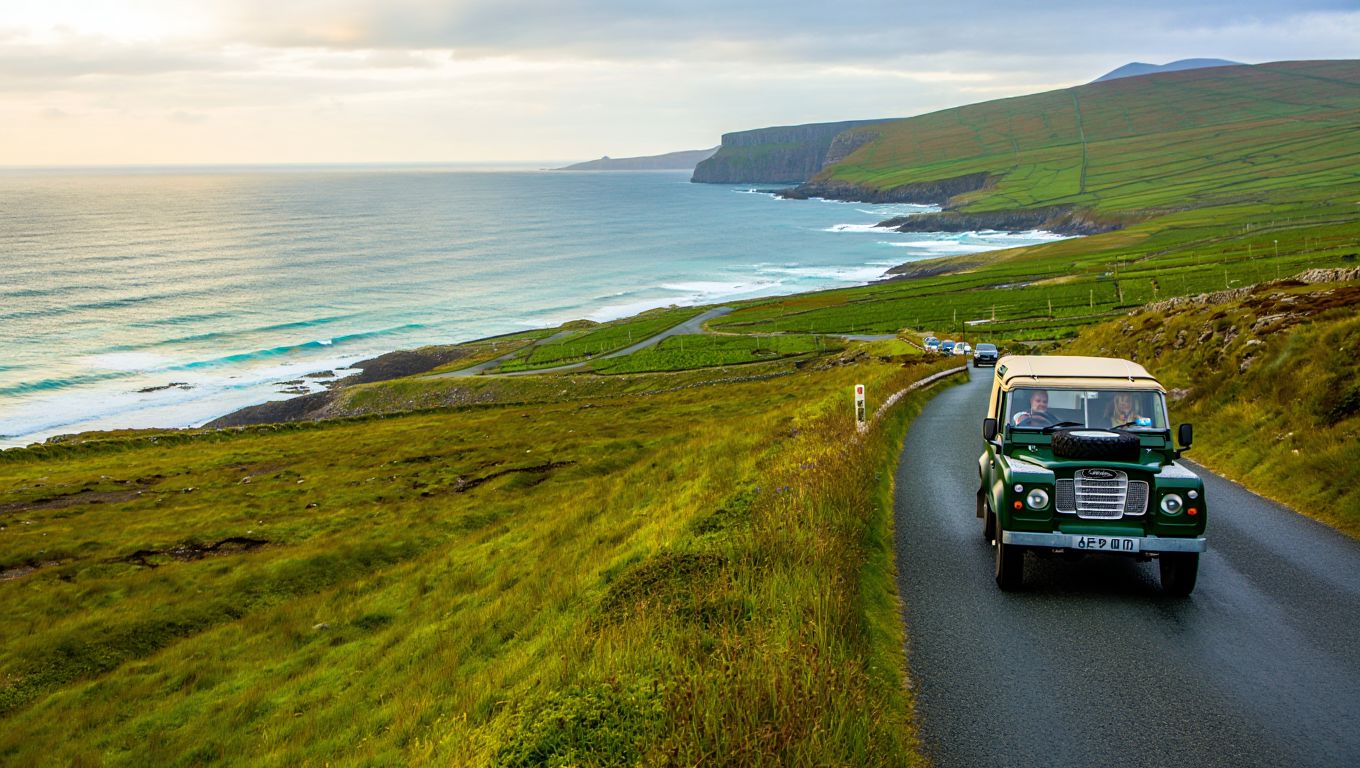
Summer on Ireland’s west edge feels like a film left too long in the sun. The ocean turns a deep cobalt, the hills wear electric green, and stone walls throw sharp shadows that map the lanes like scribbles. In this weather, the road becomes a viewfinder, and every pull-in feels like a ready-made frame.
The coastal miles are slow, in the best possible way. Curves ask for patience, wind asks for layers, and the light asks you to linger. “Out here, the light decides your schedule,” says a photographer in a salt-crusted parka. “You don’t chase it. You keep it company.”
The choreography of Atlantic light
Morning arrives with pearl tones and quiet water. By late morning, the sea bleaches to hard silver, forcing eyes to squint and compositions to simplify. Afternoon tilts toward honey, softening cliffs and cottages into benevolent shapes. Then the long evening begins, a drawn-out breath where waves pick up bronze edges and beaches grow endless. The camera loves this theatre, but the heart does too.
Wind is a constant editor. It cleans the air, sculpts cloud bands, and writes white script across the breakers. On days like these, the horizon feels honest, the distances feel near.
North to south, a necklace of moments
Up in Donegal, Slieve League drops like a sheer curtain into the Atlantic. Sheep move as white commas, pausing on green clauses between rock and sky. Fanad Head’s lighthouse stands precise, red railings bright as a child’s toy against the roaming weather.
Further down, Mayo opens with Achill—sand as pale as uncut linen, water so clear it seems invented. Keem Bay holds a perfect bowl of color where swimmers stitch small blue threads into cold water. “It looks painted, but it’s just true,” says a local with sun-pinked cheeks.
Connemara is all texture—bog pools for mirrors, mountains creased like an old jacket, and stone so patient you hear it think. A silver road flickers through it, with errant ponies as unbothered hosts.
Clare lifts the volume. The cliffs go vertical, the gulls go operatic, and the Atlantic laughs in big-tongued syllables. You learn to photograph the negative space—the gap under an arch, the dark slice beneath a ledge, the breath between a wave and the next impact.
Kerry rounds into drama—Skellig rocks like shark fins, coves like pockets of sapphire ink, heather smudges on hill cheeks. On the Beara, the roads are narrow, the views are limitless, and time moves like a deliberate tide.
Crafting the shot without losing the road
- Pack a light kit and trust a single fast prime; mobility beats weight when a gust comes calling. Seek foreground texture—ferns, ropes, wet stone—to anchor big vistas. Use a polarizing filter lightly; let some glare stay wild. Pull over only where it’s safe and let moments return; out here they often do. On phones, switch to RAW and tap to expose for the highlights; lift shadows later. If noon is harsh, chase shade, look for backlit grasses, or go fully graphic with silhouettes and lines.
The human notes in a landscape of scale
A red door on a whitewashed cottage can carry a whole story. A drying net on a pier becomes a bright counterpoint to blue depths. Children jump from a quay, and their shouts ring like small bronze bells.
Inside a pub, the afternoon turns gold, and the bow of a fiddle writes soft light across a player’s knuckles. “The sea gives us the weather, and the weather gives us the tunes,” a singer says, smiling into a tilted glass. It’s not just scenery; it’s company.
Weather as collaborator, not enemy
Summer means quick changes. A sky that starts lavender can swing to steel blue in ten minutes. Carry a thin shell, wrap the camera in a stubborn bag, and accept the speckled sensor of salt spray. The payoff is contrast—shafts of light that carve meadows, spotlights that land on one astonished gable while the rest stays moody.
Rain slides in like a soft argument, then leaves everything rinsed and new. Puddles make small, perfect oceans where boats float in double exposures.
Slowness is the secret ingredient
Distances are deceiving. A short line on a map can be an hour of tight bends, sheep debates, and surprise vistas. Plan less, stop more, and give the road permission to interrupt. Ferry crossings, tide tables, and the pull of a late glow will do their quiet work on your schedule.
Early starts buy empty carparks and low, sweet angles. Late finishes buy after-supper silence and skies that refuse to go fully dark.
What the camera can’t keep, you can
You won’t capture the warm peat note on the air, the clean sting of sea salt, or the tiny grit of blown sand between your teeth. You will carry the habit of looking longer, of waiting that extra beat, of noticing where the wind is pointing the grass like a living compass.
“Drive it like a story,” says a man mending a trap of lobster pots. “Let the quiet bits do some talking.” In high summer, that’s easy. The coast is in a speaking mood, the light is generous and playful, and every mile of tarmac feels briefly, tenderly, yours.

Contact details
Address:
Farmers Forum,
36, Dominick Street,
Mullingar,
Co. Westmeath,
Ireland
Phone:
+353 (0)44 9310206
Or email us:
For technical issues please check out our FAQ's page or email - [email protected]
For general Queries email - [email protected]
Request to add event to our Calendar - [email protected]
Send us your mart reports - [email protected]
Suggestions and feedbacks - [email protected]
News Items / Press Release - [email protected]
To Advertise on Farmers Forum - [email protected]