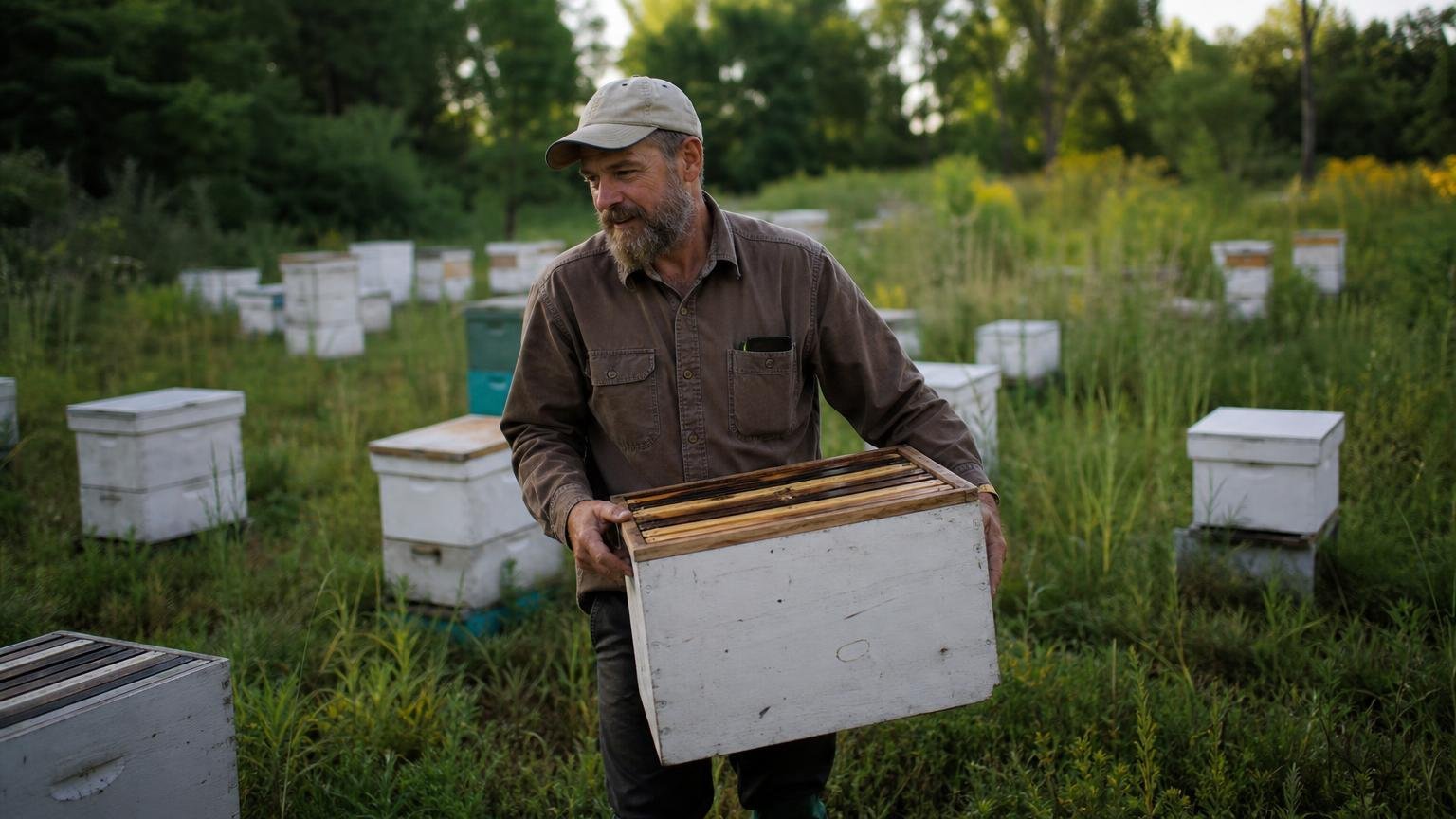
He starts before dawn, when the air is cool and the roads are empty. The truck hums, a soft promise under stacked wooden boxes, each alive with a sound like warm rain. By sunrise he’s easing down a gravel lane, rolling into a hedgerow yard that smells of mint and diesel and clover.
He works quickly, because bees dislike fuss and mornings are their most patient time. Veils and smoke, a lift and a tuck, a glance for brood and a hand on the lid to feel the living heat. Across three counties, he keeps a quiet circuit, a web of small agreements and steady visits, a map drawn in nectar and old handshakes.
A Highway of Flowers
His colonies move with the blooms, following a calendar older than fences or leases. Willow and dandelion, apple and blackberry, sumac, tulip poplar, then the wild asters that close the year. “Bees don’t read property lines,” he says, “they read the weather and the flowers.”
The yards are modest: a corner of pasture, the edge of an orchard, a bright slice behind a barn. He runs close to a hundred colonies, never too many in one place, because forage is a shared table, not an endless buffet. Balance keeps everything sane, including the neighbors.
Rent Paid Sweetly
He doesn’t write checks. He leaves cases of glass jars, each haloed amber in afternoon light, the label simple and honest. Spring light, summer dark, a limited run of knotweed that tastes like black tea and rain on dusty roads.
“Money disappears into the week,” he says, setting two jars on a kitchen counter. “Honey sits on a shelf and makes new mornings.” Landowners nod, because they eat the rent, and so do their friends.
What the landowners get:
- Fresh, local honey they can actually taste, plus better pollination for gardens and fields.
He meters the gift, careful to make it feel fair. A dozen jars for a small spot, cases for bigger yards that carry him through a long flow, always delivered with a few spare lids and a soft “thank you.”
The Quiet Logistics
The work is small motions repeated until they become music. A lid off, a puff of smoke, a frame lifted like a book you’ve read but still love. He checks for eggs, for varroa fall, for the glint of a young queen moving like a thought.
Fuel is a major cost, so he plans routes like a pilot, noting bloom reports, shade lines, and the wind that slants across hollows. He labels boxes with discreet codes, because yards multiply and memory sometimes bends under August heat.
Risks, Rules, and Remedies
Bears are rare but not imaginary, so he keeps fences hot and hives strapped against midnight curiosity. Vandals are rarer, but one yard lost a lid and a swarm found a church rafter. “Most folks are kind,” he says, “and the bees are better neighbors than we are.”
Disease is the real shadow. He treats when thresholds demand, never by habit, and keeps notes like a field doctor who travels by smell and season. “Healthy bees are a favor to every beekeeper within five miles,” he says, capping a sugar brick with a quiet tap.
Flavor Maps
The honey changes by county, by hill, by the slope that sees more moon than sun. Spring is floral and a little green, summer is bold and a little smoke. The river bottoms get a silkier finish, the ridge farms bring a brighter ring on the back of your tongue.
“Terroir isn’t just for wine,” a farmer says, rolling a jar like a marble between callused palms. “We can taste our own place when we butter a slice of bread.” He nods, because taste is the easiest map to teach, and the hardest to forget.
Why It Works
Land is expensive, and fences are complicated, but flowers are democratic if you move with care. He brings pollinators, attention, and a sweet yield, then parts with the kind of rent that does not leave a paper trail. Trust is the real currency, and he tends it like a queen.
He keeps his promises small and his schedule reliable. No trucks blocking the drive, no mess in the hedge, no late-night racket. When storms come, he texts a single line: “All good, thanks for the spot,” followed by a photo of lids tight and straps straight.
On good days, he leaves a yard with the taste of smoke in his beard and a pocket full of bent nails. On hard days, he leaves with a heavy heart and a plan to make things right. Either way, he will return, because that is how this works—circles within circles, seasons within seasons.
By evening, the truck is lighter and the map is longer. He eases onto the blacktop, hands sticky with resin, mind already counting the next bloom. In the passenger seat, a single jar rides shotgun, catching the last light of the day and making a small room of liquid, edible gold.

Contact details
Address:
Farmers Forum,
36, Dominick Street,
Mullingar,
Co. Westmeath,
Ireland
Phone:
+353 (0)44 9310206
Or email us:
For technical issues please check out our FAQ's page or email - [email protected]
For general Queries email - [email protected]
Request to add event to our Calendar - [email protected]
Send us your mart reports - [email protected]
Suggestions and feedbacks - [email protected]
News Items / Press Release - [email protected]
To Advertise on Farmers Forum - [email protected]