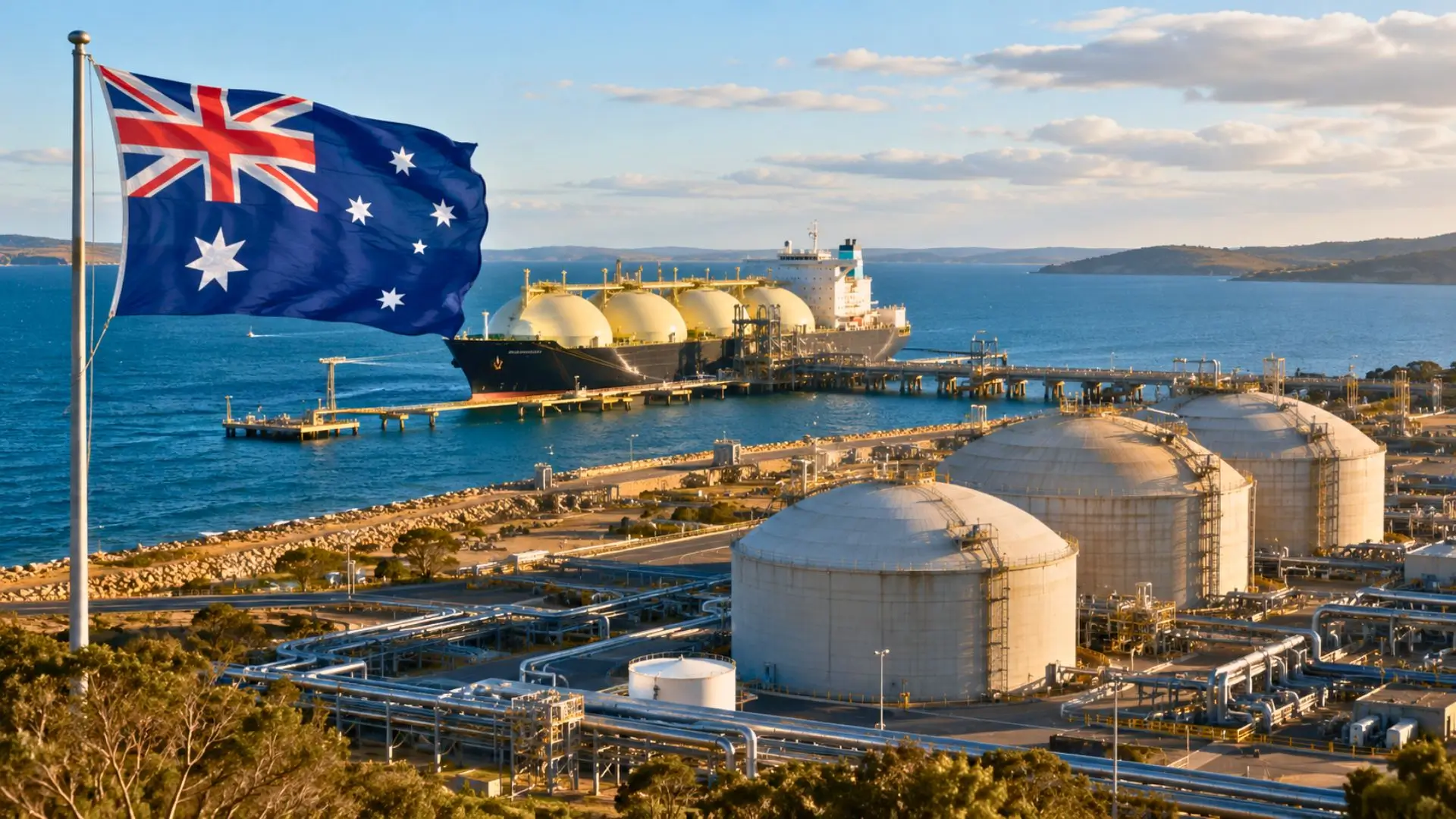
A major exporter can run short on margin at home. Thus, Australia aims to reserve 20% of certain volumes of gas exported for the domestic market. The rule is set to take effect on July 1, 2027. It will not affect contracts already signed with Asian customers.
Why Australia wants to keep 20% of the exported gas for its domestic market
The policy targets the eastern coast first. It is there that facilities convert gas into LNG before export. Chris Bowen, the Minister for Climate and Energy, therefore aims to limit the impact of global price swings on the Australian market.
LNG, or liquefied natural gas, is gas cooled to take up less space on a ship. In practice, the measure works like a reserve in a family pantry. A portion remains available locally before the more lucrative sales.
This rule is due to come into effect on July 1, 2027. However, it does not solve everything. It mainly creates a local cushion. This helps when Asian demand, global tensions or short‑term price swings reduce the volumes available.
What the protected contracts and the spot market mean for LNG exporters
The government says that existing contracts will not change. This precision matters for Japan, China and South Korea. Indeed, these three customers buy Australian gas. They therefore monitor the reliability of their supplier.
The spot market refers to short‑term sales, without long‑term commitments like a subscription. Yet volatility moves quickly in this space. If a cargo finds a better price elsewhere, local buyers may end up paying more.
Why one billion litres of fuel completes the energy security net
Gas is only one facet of the plan. Anthony Albanese, the Australian Prime Minister, also announced a public reserve of about one billion litres. It covers diesel and aviation fuel. Thus, the country strengthens its available stocks.
Indeed, Australia still depends on international flows for its refined fuels. A national reserve acts as a backup tank. It does not block price hikes. However, it reduces the risk of a supply disruption.
Origin Energy, Shell and Santos are among the groups affected on the east coast. Meanwhile, Madeleine King, the Resources Minister, defends a balance. She aims to keep more energy in Australia while remaining a reliable supplier.
What the 5,566 petajoules produced and the Australian energy transition say
The IEEFA estimates that Australia produced 5,566 petajoules of gas in 2024-2025, not counting gas used for extraction. This volume exceeds 900 million barrels of oil equivalent. It explains its weight in Asian trade.
According to this tracking, 83% of this production was used for LNG exports. Conversely, 17% fed the domestic market. A petajoule measures a unit of energy. It represents about 278 million kilowatt-hours of electricity.

Contact details
Address:
Farmers Forum,
36, Dominick Street,
Mullingar,
Co. Westmeath,
Ireland
Phone:
+353 (0)44 9310206
Or email us:
For technical issues please check out our FAQ's page or email - [email protected]
For general Queries email - [email protected]
Request to add event to our Calendar - [email protected]
Send us your mart reports - [email protected]
Suggestions and feedbacks - [email protected]
News Items / Press Release - [email protected]
To Advertise on Farmers Forum - [email protected]