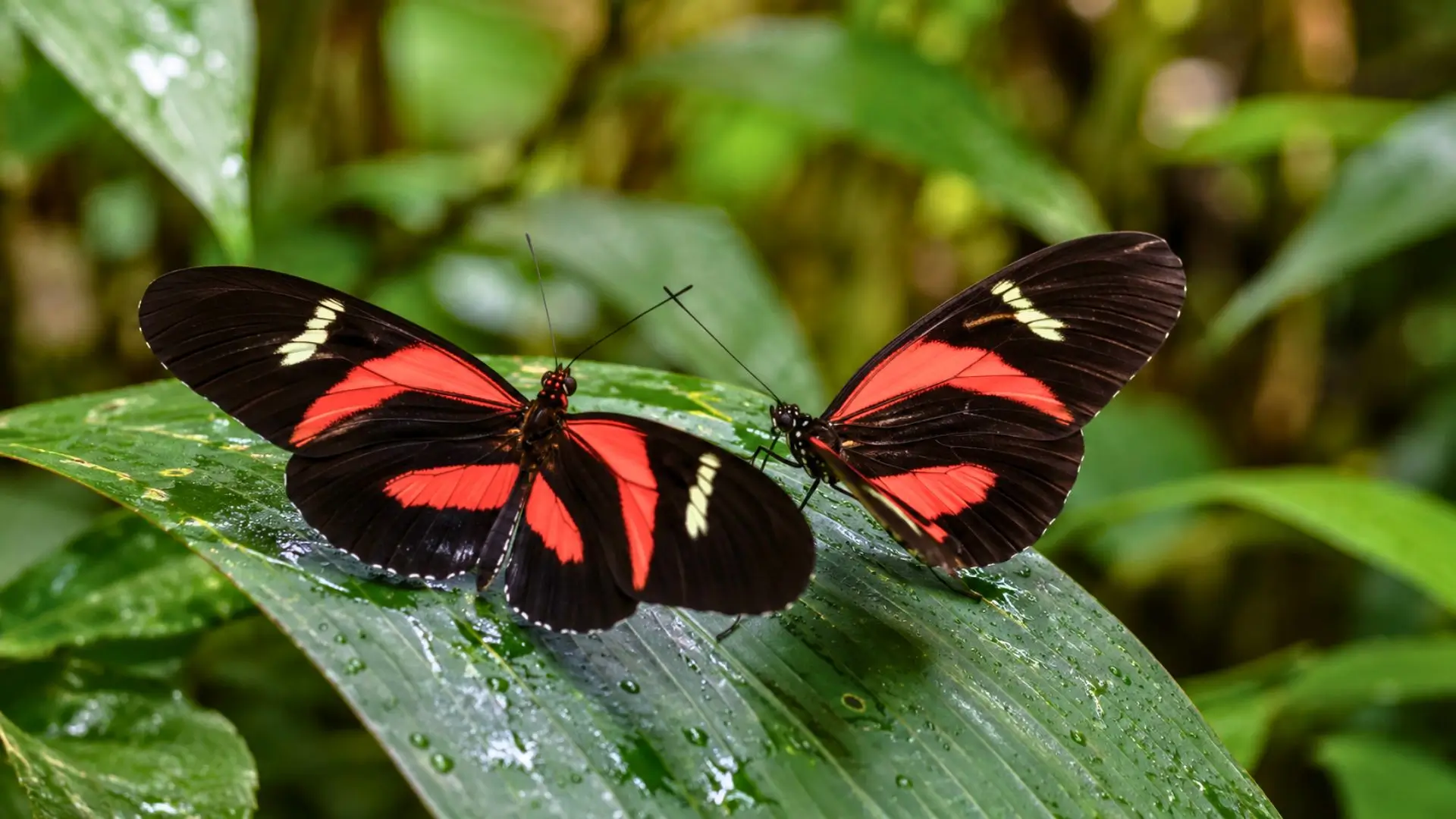
A butterfly can receive a survival solution from another species. In Peru’s Heliconius, researchers tracked the transfer of a gene linked to the red bands on their wings, a signal that makes evolution less vertical and more network-like.
Two Toxic Species Share a Red Signal That Teaches Predators to Avoid Them
Heliconius melpomene and Heliconius timareta live in the tropical forests of South America. Their black wings, marked with bright red, signal their toxicity to birds. In this context, bearing the same red bands limits repeated attacks.
This mechanism goes by a name, Müllerian mimicry. It designates genuinely defensive species that adopt a common signal. For a predator, learning resembles a food label: a single bad experience is enough to avoid several similar butterflies.
The Optix Gene Shows How an Adaptive Solution Can Move from One Species to Another
The optix gene controls a large portion of the red patterns in these butterflies. Genomic analyses indicate that H. timareta did not merely copy the pattern through separate mutations; it received a useful fragment from H. melpomene.
Chris Jiggins, professor of evolutionary biology at the University of Cambridge, has studied these butterflies since the 1990s. Along with researchers like Steven Van Belleghem, he describes species boundaries that are more porous than the classic depiction of a family tree.
The key term is adaptive introgression. It means that a hybrid cross transfers a stretch of DNA, then natural selection preserves this stretch because it helps survival. Here, the optix gene acts as a piece already compatible.
Genomic Tools Trace the Gene’s Journey Like a Fingerprint in DNA
This idea corrects a too-simple view. A hybrid is not always a dead end. Even when rare, it can carry an advantageous trait, like a key borrowed from a neighbor that already fits the right lock in the same building.
Geneticists compared ABBA/BABA sites, DNA positions where species share or do not share a variant. Patterson’s D statistics then measure the excess sharing. These tools had been used to study the interbreeding between modern humans and Neanderthals.
This Case Brings Evolution Closer to a Network Than to a Simple Lineage of Species
Among Peru’s Heliconius, these tests show non-random exchange. A study estimated that 2 to 5% of the genome circulated between H. timareta and H. melpomene amaryllis, with a strong signal near color regions.
The work on optix adds an important precision. The same locus, that is, the same region of the genome, reappears in several red motifs. Over a period of roughly 700,000 years, selection favored similar variants in neighboring populations.
The Heliconius case does not turn all species into permanent blends. It shows instead that some biological boundaries allow local solutions to pass through. In the Peruvian forest, this genetic circulation is read in a few red bands on a black wing.

Contact details
Address:
Farmers Forum,
36, Dominick Street,
Mullingar,
Co. Westmeath,
Ireland
Phone:
+353 (0)44 9310206
Or email us:
For technical issues please check out our FAQ's page or email - [email protected]
For general Queries email - [email protected]
Request to add event to our Calendar - [email protected]
Send us your mart reports - [email protected]
Suggestions and feedbacks - [email protected]
News Items / Press Release - [email protected]
To Advertise on Farmers Forum - [email protected]