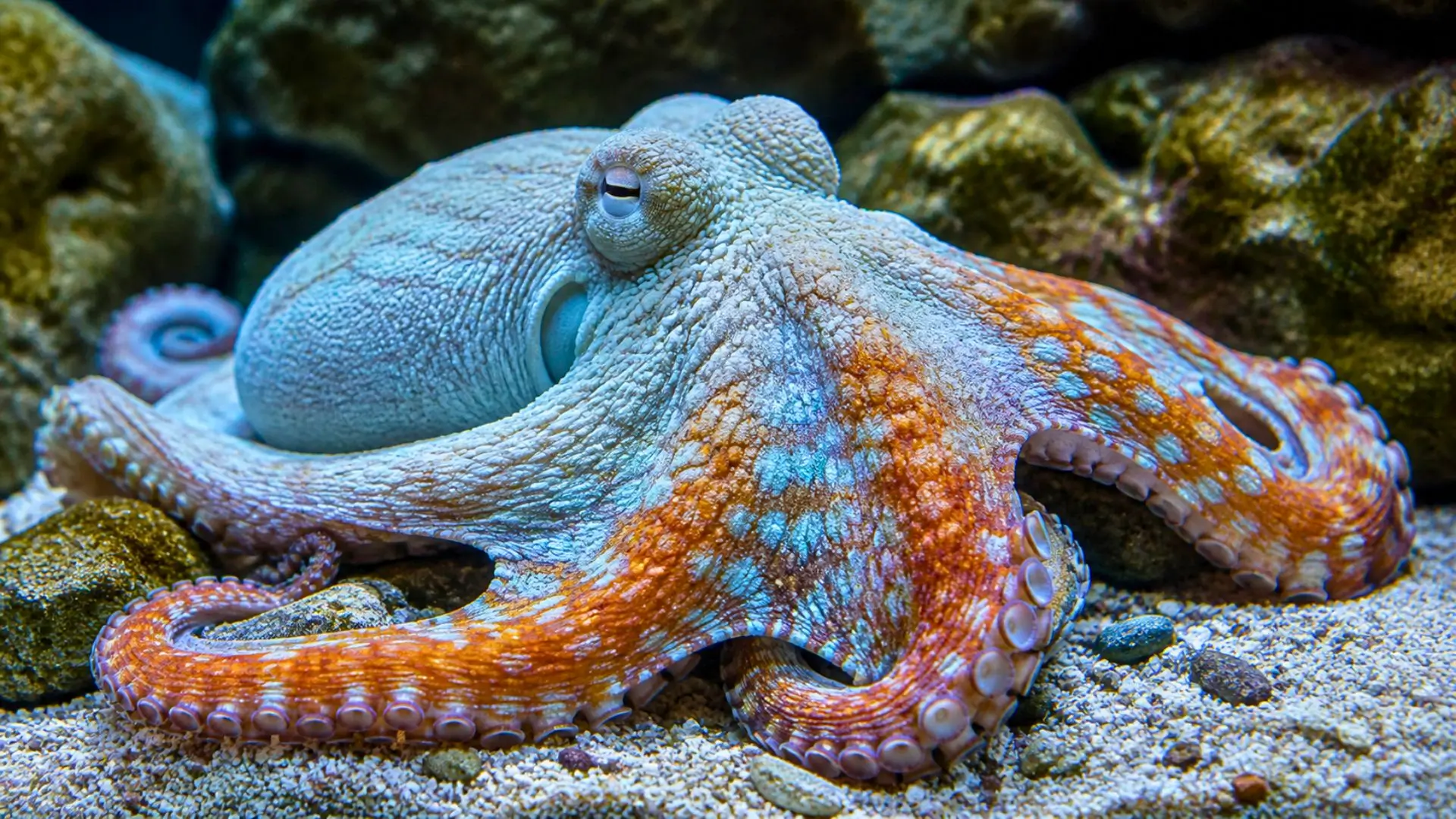
An octopus sleeps, then its skin lights up like a screen. In a laboratory at the Okinawa Institute of Science and Technology (OIST) in Okinawa, Octopus laqueus alternates pale rest with brief color bursts. These cycles bring its sleep closer to that of vertebrates, without proving that it dreams like a human.
An alternation between quiet sleep and active sleep observed on a pale skin
During quiet sleep, the octopus closes its pupils, flattens out, and its skin becomes almost entirely pale. The researchers refer to this as QS, for quiet sleep, i.e., calm rest. The animal responds less to stimuli, like a phone put in standby mode but still able to ring.
The sequence changes roughly once an hour. The arms tremble, the eyes move, breathing speeds up, and the skin displays color patterns for nearly 60 seconds. This active phase, called AS, returns after long stretches of still and pale periods.
What the study published in Nature really measures in the octopus’s brain
The team from the Okinawa Institute of Science and Technology, with the University of Washington, filmed and measured Octopus laqueus instead of limiting themselves to colors. The paper published in Nature in 2023 relies notably on 1,743 hours of video and brain recordings.
The term REM stands for rapid eye movement. In mammals, this phase often accompanies dreams reported upon waking. In the octopus, researchers observe instead a similar state, with brain activity close to wakefulness.
During quiet rest, the team also notes oscillations akin to the sleep spindles, brief bursts of electrical activity. In humans, these signals are studied for their possible link to memory. In the octopus, they appear in regions associated with learning.
Why 550 million years of separate evolution makes this comparison valuable
The cephalopods and the vertebrates diverged about 550 million years ago, long before many current groups emerged. Since then, the octopus has built a different nervous system, with highly autonomous arms and a central brain organized in another way.
This distance makes the resemblance more informative than a mere curiosity. Leenoy Meshulam, a theoretical physicist at the University of Washington, sees it as a clue to evolutionary convergence. This term describes similar solutions that arise independently, like two cities inventing intersections to ease traffic flow.
Skin coloration patterns that do not prove dreaming, but open a concrete lead
Chromatophores, pigment-containing cells controlled by nerves, give the octopus its visual language. In active sleep, these cells replay patterns similar to those seen during wakefulness. Sam Reiter, director of the Computational Neuroethology Unit at OIST, urges caution.
One hypothesis proposes that the animal maintains its camouflage motifs. Another suggests that it replays scenes related to hunting, escaping, or exploration. Aditi Pophale, a PhD student and co-first author, also notes the rebound observed after sleep deprivation.
The result does not turn the octopus into a dream-teller. It instead offers a visible readout of a brief brain state, sometimes likened to short clips. At 22 °C, the studied animals produced about 10 active phases per day, with skin turning from pale to orange.

Contact details
Address:
Farmers Forum,
36, Dominick Street,
Mullingar,
Co. Westmeath,
Ireland
Phone:
+353 (0)44 9310206
Or email us:
For technical issues please check out our FAQ's page or email - [email protected]
For general Queries email - [email protected]
Request to add event to our Calendar - [email protected]
Send us your mart reports - [email protected]
Suggestions and feedbacks - [email protected]
News Items / Press Release - [email protected]
To Advertise on Farmers Forum - [email protected]