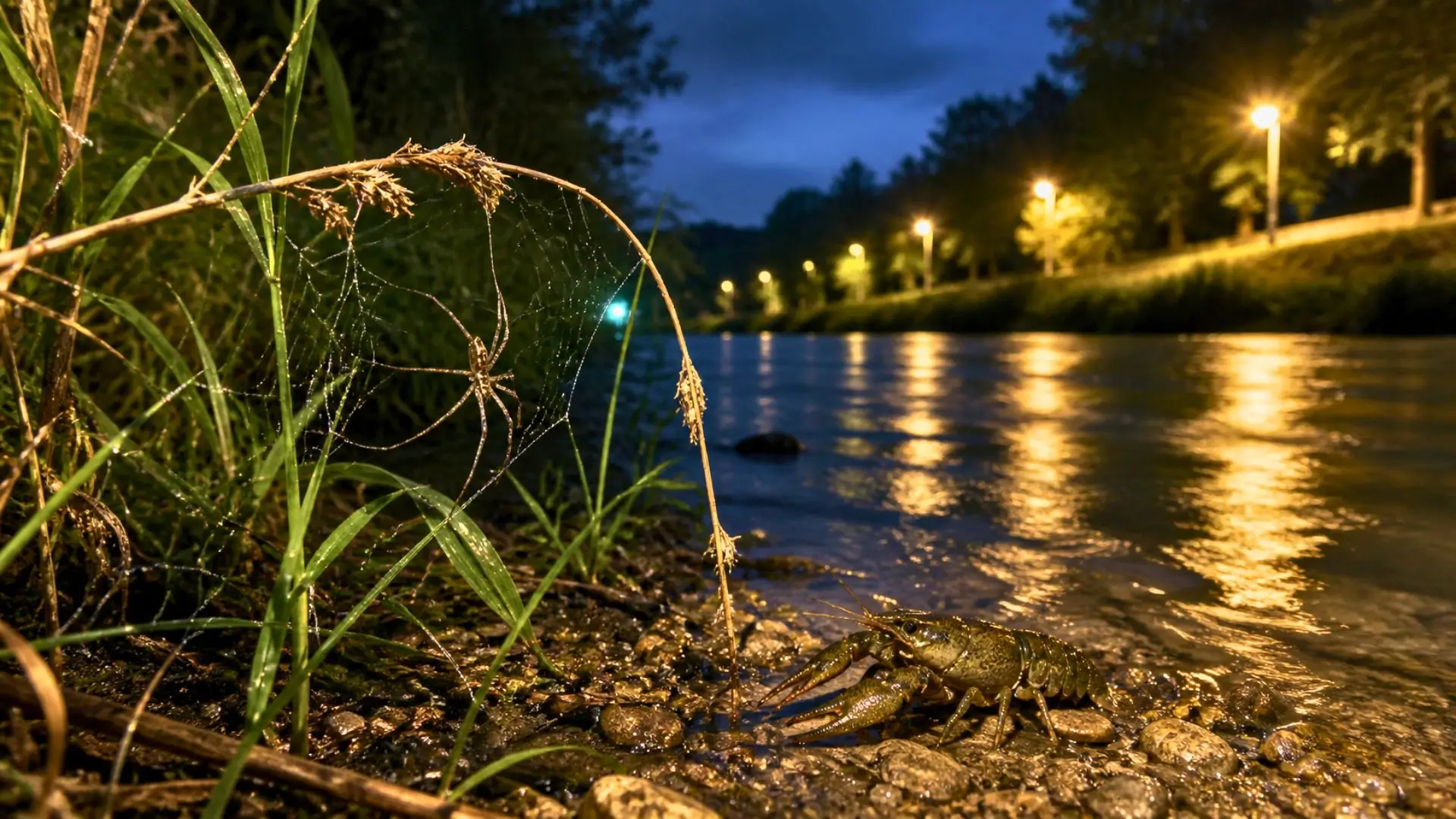
Night does not extinguish the life of rivers. A study conducted in Landau shows that lighting along the riverbanks can alter the meals of spiders and crayfish, thereby influencing the invisible exchanges between water, insects, and terrestrial predators.
Riverbank lighting transforms a crossing site into an area of ecological influence
In France, public figures provide a sense of the scale of the issue. In 2023, 72% of the continental territory remained exposed to high nocturnal light pollution at the heart of the night, despite a 19% decline since 2014. For a riverbank, every streetlight acts like a dining table laid out in the wrong place.
The team from RPTU Kaiserslautern-Landau used 16 artificial waterways paired with riparian zones. This setup, called a mesocosm, reproduces a small, controlled ecosystem. It allows observers to study a miniature river without losing sight of living organisms’ behaviors.
Spiders reveal how water also nourishes terrestrial predators
The researchers introduced two known pressures: nocturnal artificial lighting and the signal crayfish, an invasive species from North America. Collins Ogbeide, a researcher in aquatic ecotoxicology, then tracks the feeding exchanges between aquatic larvae, crustaceans, and the bank-dwelling spiders.
The key point lies in the trophic network, the term given to the feeding chain in an ecosystem. When aquatic prey emerge as adult insects, they feed terrestrial spiders. The river becomes a pantry that extends far beyond its bed.
To measure this menu, the team studied the stable isotopes of carbon and nitrogen. These isotopes are variants of the same chemical element, used as dietary markers. They function as a discreet label that tracks food through the tissues of animals.
The signal crayfish adds a pressure that alters the available resources
The results indicate that the spider Tetragnatha extensa derives a sizable portion of its diet from prey arising in the water. Under nighttime lighting, its isotopic niche, i.e., the range of resources consumed, widens. The menu becomes more varied, but not necessarily more stable.
The signal crayfish further destabilizes the balance. In a nearby study, its presence reduced the emergence of aquatic insects by 35% after one week. Under artificial light, its diet shifts more toward chironomids, small aquatic midges, and toward small crustaceans.
What municipalities can take away to light without weakening the banks
This shift matters because a riverbank acts like a seam between two fabrics. Water nourishes the land, the land hosts predators, and local lighting can move these exchanges. Light pollution thus does not only affect animals drawn to a lamp.
ADEME reminds us that nocturnal public or private lighting durably disrupts species that move, feed, or reproduce at night. Hedgehogs, owls, bats, and insects depend on dark landmarks as much as rivers depend on their light cycles.
French data also show room for action. The decline observed since 2014 is largely explained by stricter rules and energy savings following the 2021 crisis. A municipality can thus act without cutting off all human use of public spaces.

Contact details
Address:
Farmers Forum,
36, Dominick Street,
Mullingar,
Co. Westmeath,
Ireland
Phone:
+353 (0)44 9310206
Or email us:
For technical issues please check out our FAQ's page or email - [email protected]
For general Queries email - [email protected]
Request to add event to our Calendar - [email protected]
Send us your mart reports - [email protected]
Suggestions and feedbacks - [email protected]
News Items / Press Release - [email protected]
To Advertise on Farmers Forum - [email protected]