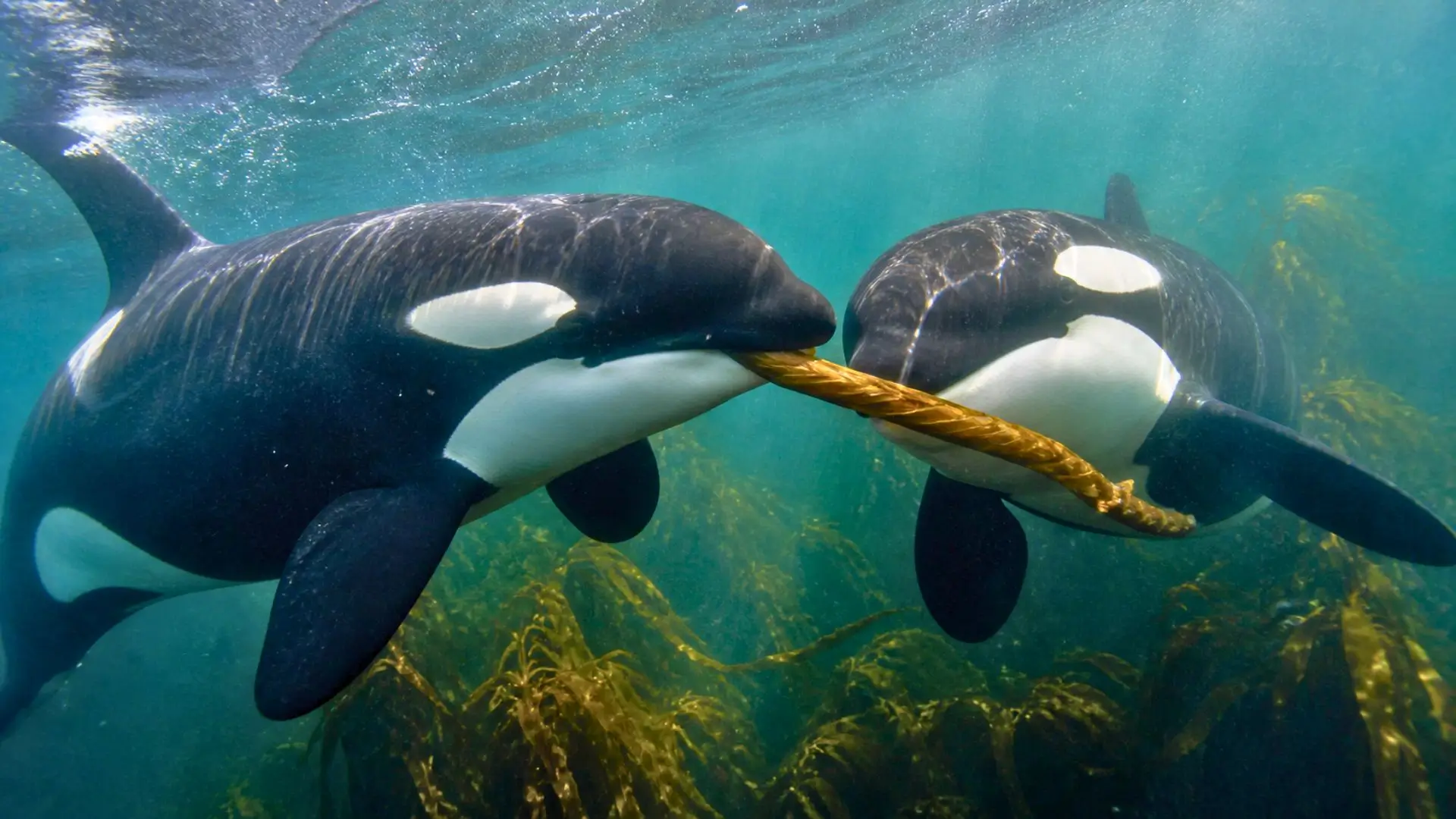
Under the water, two orcas roll a strand of kelp between their bodies. Drones have revealed this gesture among Southern Resident orcas, studied for 50 years. The tool does not aid in feeding, but could support skin, social bonds, and a culture already vulnerable.
A selected kelp tool, cut and shared between two orca bodies
The behavior, called allokelping by researchers, literally means “kelping with another.” The orcas seize giant kelp, cut a stalk, and then place it between them. This deliberate fabrication sets the gesture apart from a simple game with floating seaweed.
The piece used typically measures around 60 cm, about the length of an forearm. The stipe, the flexible stem of the alga, acts like a smooth garden hose. Under pressure, it rolls between the flanks without tearing.
Why this kelp massage speaks as much about renewed skin as it does about social bonds
The researchers advance a twofold explanation. The skin of cetaceans renews itself, but cold water can slow the shedding of dead cells. In individuals more marked by molt, the use of kelp appears more frequent in the videos analyzed.
Yet the gesture goes beyond hygiene. In primates, grooming maintains alliances, reduces tensions, and organizes group life. Allokelping resembles a prolonged handshake, except that the hand is replaced by seaweed held by two bodies.
Professor Darren Croft, from the University of Exeter and executive director of the Center for Whale Research, emphasizes this social dimension. The partners observed often come from the same pod, a family group of orcas, or share close maternal kinship.
What recent drones have made visible after half a century of observation
The Center for Whale Research has tracked this population since the 1970s. Boats and coastal stations have documented births, deaths, and movements. Yet drone cameras have added a decisive, almost vertical, vantage point.
Rachel John, an animal behavior student at the University of Exeter, spotted in a video a brown stalk stuck between two animals. The detail seems tiny when scaled to the size of an orca, like a straw between two swimmers in a dark pool.
A precious animal culture, kept track of in a population still fragile
The study published in Current Biology describes 30 allokelping sequences recorded across 8 of the 12 days of observation. Males, females, youngsters and adults participate. This distribution gives the behavior the appearance of a shared tradition, not merely a solitary habit.
The latest annual census from July 2025 counts 74 Southern Resident orcas, spread across pods J, K and L. NOAA Fisheries has classified them as endangered since 2005, with three major pressures: fewer chinook salmon, persistent pollutants, and ship noise.
The question thus goes beyond the survival of isolated animals. Bioaccumulation, the buildup of pollutants in the food chain, weighs on their health. The decline of kelp forests adds a very real cultural risk: beneath the surface, a brown stalk still rolls between two black-and-white bodies.

Contact details
Address:
Farmers Forum,
36, Dominick Street,
Mullingar,
Co. Westmeath,
Ireland
Phone:
+353 (0)44 9310206
Or email us:
For technical issues please check out our FAQ's page or email - [email protected]
For general Queries email - [email protected]
Request to add event to our Calendar - [email protected]
Send us your mart reports - [email protected]
Suggestions and feedbacks - [email protected]
News Items / Press Release - [email protected]
To Advertise on Farmers Forum - [email protected]